
Welcome to a new season of GRIVA’s German SIG. Our topic this time around is German emigration to colonial America, in keeping with the upcoming 250th anniversary of the Revolutionary War. Our updated schedule for the year is as follows, along with links to register for each program:
- February German SIG – February 3 – Palatines to New York – https://tinyurl.com/GRIVAGermanFeb2026
- March German SIG – March 3 – Pennsylvania Germans – https://tinyurl.com/GRIVAGermanMar2026
- April German SIG – April 7- Virginia Germans – https://tinyurl.com/GRIVAGermanApr2026
- May German SIG – May 5 – North & South Carolina Germans – https://tinyurl.com/GRIVAGermanMay2026
These two were originally scheduled for this spring but have been postponed. We’ll post new details when they are rescheduled:
- Salzburgers to Georgia
- Germans in the Rev War
This month, we took a look at factors driving emigration, where emigrants came from, port cities here and there, all facets of the journey from start to finish, and where emigrants settled once they got to the colonies. In future months, we will be looking at the main colonies for German settlement in greater detail.
Factors Driving Emigration
- Wars – German territories were overrun with wars for almost a century, from 1618 to at least 1714. The grimmest consequence of all these battles was a population loss of about 30% of the German people, with some areas experiencing even higher death rates. During this period, people were frequently uprooted as they fled oncoming armies; their property may have been destroyed by invaders, and their crops and livestock plundered. Population loss was particularly high in areas of southwest Germany.
- Plague – during the 1600s, there were several major cycles of the plague, including 1600-1613, 1625, 1626, 1637, 1640, and more. In the town of Backnang, for example, a third of the population succumbed to the plague between 1626 and 1635. In between plague losses and war losses, it took the town 100 years to get back to its former level of population. In some towns, population loss was as high as 65%.
- Religion – the rule after the Peace of Augsburg in 1555 was cuius regio, euius religio – the religion of the ruler is the religion of his country. Sometimes, when one ruler died, his successor brought in a different religion. Subjects who were not of that faith might be prosecuted, or might try to move somewhere else where their own religion was tolerated. After the Peace of Westphalia, three religions were officially recognized – Catholic, Lutheran (evangelical), and Reformed (Calvinism).
- Weather – the 1600s experienced a “little ice age,” leading to late planting, poor harvests, and possible starvation. The winter of 1708-1709 was particularly cold, and many people died.
- Taxes – rulers imposed (sometimes excessive) taxes on their subjects – rents, fees, and tithes could sometimes eat up as much as half of a farmer’s annual income. In addition, subjects were required to perform a certain number of days’ worth of labor for their lord, which took away from their ability to tend to their own property. Death taxes could be so high that heirs were sometimes forced to cede their inherited property to the local lord.
- Inheritance – inheritance practices varied by region. In south-western Germany, the predominant practice was partible inheritance, called Realteilung. This meant that a parent’s estate was divided equally among all children. While this system worked just fine after the 30 Years’ War, when there was relatively lots of land for a reduced population, successive generations were left with smaller and smaller properties, which may not have been enough to sustain a large family. These peasants often had to turn to other occupations in addition to farming. Impartible inheritance, or Anerbenrecht, was predominant in northern Germany. Here one heir inherits all of the property and possessions of the deceased parents. The heir may have been obliged to make payments to other siblings, however.
- Military service – In order to get permission from the ruler to emigrate, males had to show that they had completed their military service prior to leaving the country. A family who wanted to leave with young boys might have had to pay fees or fines in order to release their minor sons from military duty.
- (Proto-)industrialization – although the Industrial Revolution had yet to take place, the guild structure was already weaking in the 1700s. The merchant class was growing. Cottage industries such as weaving sprang up in many places in order to supplement meager farming incomes.
- Rumors – the major impetus behind the Palatine emigration of 1709 was a rumor that Queen Anne of England was giving away land in the North American colonies.
- Pamphlets and letters – Colonial proprietors wrote pamphlets describing their colonies, e.g. Pennsylvania and Carolina, and encouraging emigration. These tracts included details about the land itself, as well as tips for preparing for such a journey. Leaders of various sects and minor denominations wrote tracts about the religious freedom to be found in the colonies, where emigrants could practice their faith in peace, without fear of retribution or prosecution.
Where Emigrants Came From
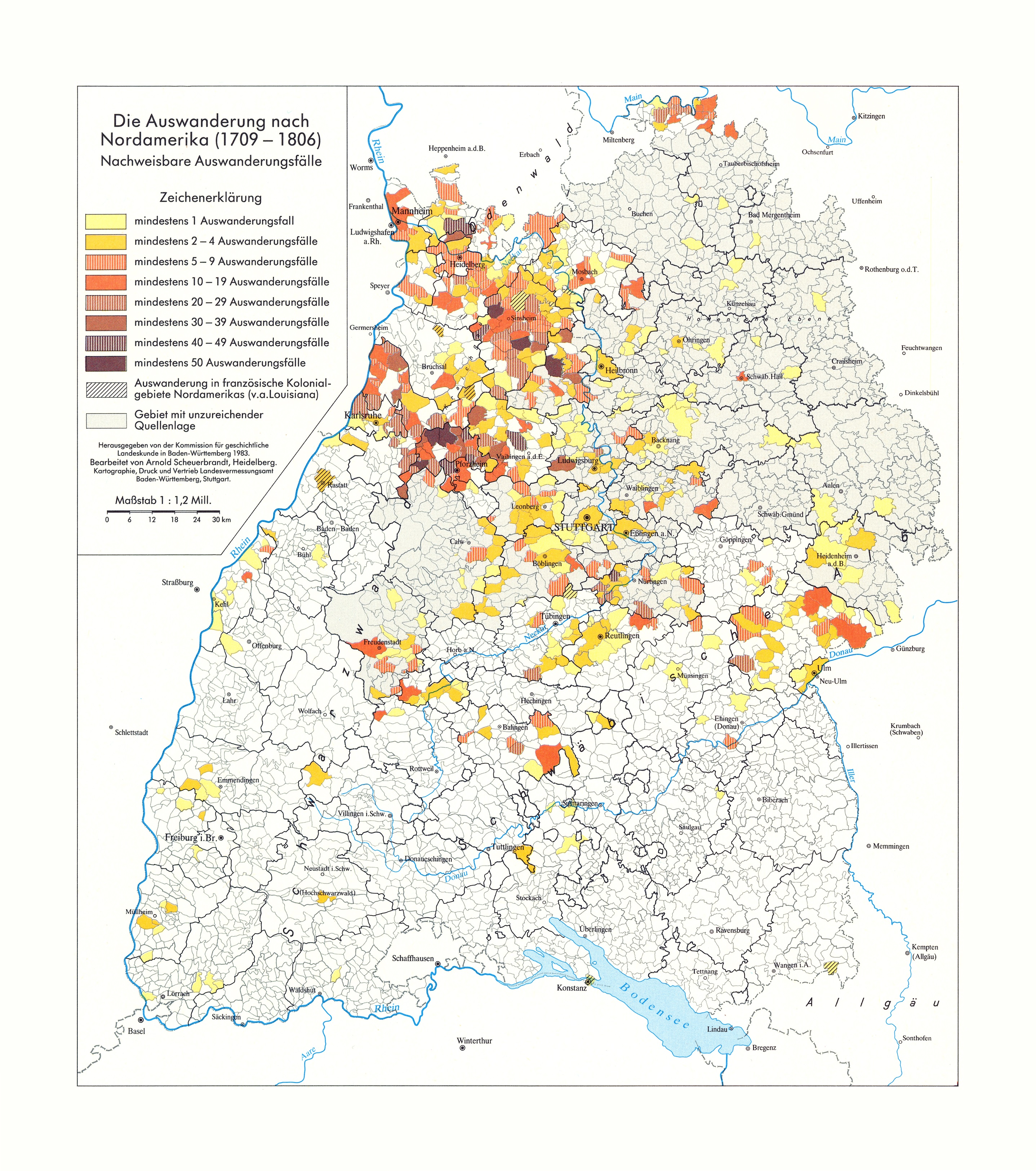
In the colonial era, most of the emigrants came from the southwest, especially territories along the Rhine, since this was the major route to get to the port cities of Amsterdam and Rotterdam. Although the emigrants as a group were referred to as Palatines, they actually came from a wider area, including the Pfalz (Palatinate), Baden, Württemberg, Saarland, Alsace, and even Switzerland. These early emigrants usually traveled in groups, rather than singly, and were more likely to be farmers and artisans. This map shows areas of emigration for what is now Baden-Württemberg.
Port cities
The most frequently used ports for colonial emigration were Rotterdam, Amsterdam, and LeHavre. From there, ships first had to stop at a British port (usually London, Cowes on the Isle of Wight, or Bristol) before proceeding on to North America. By far the most popular port in North America at this time was Philadelphia – 3/4 of German emigrants arrived here. New York was not yet as important as it came to be later, and Baltimore was also a popular port of debarkation. This map shows graphically the shipping routes for colonial America.
The Journey
The process of emigration was by no means as simple as deciding to go, packing up, and leaving. Numerous steps were involved, and it could take months, or even years in some cases, before a person actually got on a boat.
- “Newlanders” were agents who worked on commission for shipping and merchant companies who went from town to town, recruiting emigrants. They often worked with river boatmen and port contacts to smooth the way for emigrants. They also had local contacts among innkeepers and printers, who might help them drum up interest in joining a party of emigrants.
- Once a person decided to join an emigration party, they had to seek permission to leave from the local government. Paperwork to support the request included documentation of good standing, birth and marriage records, proof of residency, and references from other villagers. It might take months to get permission to leave, or the would-be emigrant may be rejected altogether (Catholics were denied permission to emigrate). Depending on the location, some rulers were very reluctant to see people emigrate – it meant not only a loss of workers, but also a loss of income in terms of taxes and fees. So once permission was granted to leave, the emigrant had to pay a manumission fee, which was usually about 10% of the value of real property, plus a 10% surcharge on all other property. Emigration was costly! Next, the emigrant had to pay all outstanding taxes, fees, and other debts. They had to prove that their military service had been completed, or pay a fee to the government for avoiding it. If only part of the family was emigrating, provisions had to be made for the remaining family members left behind, so they did not fall on the welfare of the town. Emigrants also had to renounce local citizenship rights, including claims to property or inheritance.
- Prospective emigrants were usually caught between playing a waiting game for permission, and timing the sale of their property to maximize the amount they would receive. Often the timing was against them, and they had to take a loss on the sale, cutting into the funds available for the journey and arrival in the new country. Because they had renounced their local citizenship, they were often forced to leave the town immediately after the property was sold. Property of people who emigrated without permission was confiscated. Even worse, property was confiscated and people were arrested if they tried to sell their land before receiving official permission to leave.
- The journey to the port city could take 4-6 weeks, depending on the starting point and method of travel. Poorer emigrants might walk along the river to eventually get to the port. Others with more means could take a boat or travel by wagon. By boat, there could be as many as 30 or more toll stations along the way, each little dukedom or principality making money from the departing countrymen. Emigrants had to pay for their own food and lodging along the way, as well as at the port (where they might be forced to wait for several weeks before actually boarding a ship). They had to purchase a ticket for the ship if this had not been arranged in advance with a Newlander.
- Even once on the ship, passengers did not immediately sail for the Atlantic. First there was a mandatory stop in a British port, such as London, Cowes, or Bristol; this part of the trip could take about 8 days on average. And of course, more fees were assessed before leaving the British port. A ship usually held anywhere from 300-450 passengers, depending on its size. Each adult was given a 6-foot by 2-foot sleeping space. There were limited sanitary facilities, and cooking was only allowed on the deck. If a person ran out of the provisions they brought with them, they were often able to buy food from the ship’s stores, then settle with the captain upon reaching land for the costs incurred.
- The trip across the ocean could take anywhere from 7-14 weeks (or even longer), depending on the weather. And then it could take another week to sail up the Delaware to Philadelphia. Aside from bad weather, passengers faced many other dangers on the journey, including a high death rate from illnesses and overcrowding, piracy and other theft, and food and water shortages and spoilage. One passenger wrote home that the salted beef was first soaked in sea water, then cooked in the same water! An extreme case of passengers hardships is reported on page 62 (image 147) of The German Immigration into Pennsylvania through the Port of Philadelphia, 1700-1775.
- Upon arrival at the American port, passengers often had to be examined by a local doctor before debarking. They had to settle the ship’s bill for any extras incurred during the voyage. If the ship landed in Philadelphia, all adult males (age 16 and older) were first taken to the courthouse to swear an oath of allegiance. Redemptioners had to stay on board until a local person paid for their passage.
Redemptioners
Redemptioning was a system of payment for passage by shipping companies without prior charge to the passenger. Upon arrival at a port city, they were given the opportunity to pay for their passage themselves, or have a local family pay for them. If neither of these things was possible, then the ship’s captain would sell the passenger’s labor to the highest bidder, and the potential employer would reimburse the shipping company for the passage. The passenger himself had little room to negotiate the terms of his service. This system continued in effect until 1819.
Healthy adults would bind themselves for 3-6 years for the amount due by them, according to their strength and age. People who became ill on board were sent to a hospital to recover, then bound out when they were well again. Children under the age of 16 were required to serve until age 21. Tragically, families were often separated at the port by this process, and some were never able to reunite. If a husband or wife died during the voyage, the surviving spouse would have to serve a term to cover both their expenses. There might be some compensation given to the person after completing their bound service, e.g. a new set of clothing, or even a horse or cow.
Where Immigrants Settled
The earliest settlers stuck to the east coast of North America. Over time, they moved further west and south. Permanent settlements of large groups of German immigrants include the following:
- 1683 – Germantown PA; 13 families from Krefeld
- 1709 – 3000 Palatines to New York (Hudson Valley)
- 1710 – Palatines and Swiss to New Bern NC
- 1714, 1717 – two waves of settlers to Germanna VA from Siegerland, Pfalz, Baden, and Württemberg
- 1734 – Salzburg exiles to Ebenezer GA
Some Publications for Further Background
German Immigration to America: The First Wave, by Don Heinrich Tolzman; ISBN 1-55613-797-4
German Immigration to America: When, Why, How, and Where, by Stephen Szabados; ISBN 9798631331525
German Genealogical Research, by George K. Schweitzer; ISBN 0-913857-15-7
The German Research Companion, by Roger P. Minert et. al.; ISBN 0-9656761-6-1
Germany in the World: 1500-2000, by David Blackbourn; ISBN 978-1-63149-183-2
Our Daily Bread: German Village Life, 1500-1850, by Teva J. Scheer; ISBN 978-1-453-72169-8
Redemptioners and Indentured Servants in the Colony and Commonwealth of Pennsylvania, by Karl Friedrich Geiser
Some Publications of Emigrant Lists
Werner Hacker – Auswanderungen aus Rheinpfalz und Saarland im 18. Jahrhundert; Kurpfälzische Auswanderer vom Unteren Neckar
Annette K. Burgert – Eighteenth Century Emigrants, Vol. 1 The Northern Kraichgau, Vol. 2 The Western Palatinate; Westerwald to America
Trudy Schenk et al – Wuerttemberg Emigration Index (8 volumes)
Cornelia Schrader-Muggenthaler – Baden Emigration Book, Alsace Emigration Book (2 vols). Swiss Emigration Book
Don Yoder – Rhineland Emigrants: Lists of German Settlers in Colonial America
Albert Faust, G. Brumbaugh – Lists of Swiss Emigrants in the 18th Century to the American Colonies
Brigitte Burkett – Emigrants from Baden and Württemberg in the 18th Century
Some Useful Links
German Roots – Finding Passenger Lists before 1820
LoC – German Immigrant Arrivals
CompGen – Germans to America
Ancestral Findings – German & Swiss emigrants 1700s-1800s
NARA – Passenger Arrival Records
Immigrant Ships Transcribers Guild
Immigrant Entrepreneurship: German-American Business Biographies, 1720 to the Present
Frontier Culture Museum, Staunton VA
LABW – Auswanderung aus Südwestdeutschland
Institute for Palatine History and Ethnology Digital Migration Database