
November 2024 – Deep Dive into Baptism Records
For the next several months, we will be taking a deep dive into German church records – why do they look like they do, how they change over time, and how they vary from place to place. There are actually two aspects of these records that we’ll be considering-
- The rules for what gets written in the church register and by whom
- The rules and guidelines for the church rite itself
These rules and guidelines can be found in books that deal with Kirchenrecht, or canon law. It is important to remember that, unlike in America where we have separation of church and state, there was no such separation in the German political entities, so some of these rules may have been dictated by the state, and others by the church.
For this series, we’ll be looking at information from Baden, Hessen, and Sachsen, using the following volumes (which are all available on Google Books):
- Versuch eines badischen evangelisch-lutherischen Kirchenrechts, 1806
- Praktisches Evangelisches Kirchenrecht, mit besonderer Hinsicht auf Sachsen, Preußen und andere evangelische Länder, 1826
- Kirchenrecht der evangelischen Kirche des Herzogthums Hessen, 1884
These are all written in the old Fraktur script, but Google gives you the option to view a plain text version of the pages. You can put that plain text into a translation tool such as Google Translate or ChatGPT to get a readable English version.
If your ancestors didn’t come from one of these three places, you can search for a similar volume in the desired state by using any of the following search terms:
- Kirchenordnung + state
- Kirchenrecht + state
- Kirchenagenda + state
- Stol(l)ordnung or Stol(l)gebühren + state (the word may be spelled with one L or two in older publications)
- Amtsblatt + Taufe + state
- Regierungsblatt + Taufe + state
- Intelligenzblatt + Taufe + state
Baden – Guidelines for Church Register Entries

Guidelines for church register entries in the volume shown above can be found on pages 377-384, inclusive of baptism records. Some of these guidelines are as follows:
- Before the pastor begins making entries, and when he ends his tenure in the parish, he is to make note in his own hand of the start, as well as the end of his time of service in the church book and sign his name to it.
- In the case of pastoral vacancies, the acting clergyman named by the Spezial should do the same. Other clergy do not make entries, but rather give them to the acting pastor on a separate piece of paper.
- No event shall be omitted. However, if this happens, and is noticed later, the omitted event shall be added in the place where it should have been recorded. The concerned parties should be called in and at least one of them certify [the entry] in the left margin.
- But this entry can only be made by the pastor who should have made it. If this is not possible because of death or change of jobs, etc., the entry can be made under the direction of church authorities.
- Everything must be entered cleanly and neatly, with no corrections or crossing out, unless there is a note explaining why this happened, in order that entries in church registers may be trusted.
- Offensive actions and damaging judgments, or housekeeping notices are not to be included.
- The church register must be duplicated in its entirety.
- Extracts should be exact copies of what is written in the church register.
- The day as well as the hour of the birth is to be entered. If the latter is not known, the entry should state “about __ o’clock.”
- The last or family name of the child is not written with the child but the father’s name is entered in the margin.
- The names of the parents are added, as well as their occupation, and if they are not from the parish, their place of residence, and religion.
- Mothers are listed with their first name and also their maiden name,
- Godparents are numbered, and extra ones are noted in the margin.
- If the godparents are not members of the parish, their names, occupations, residence, and religion are to be entered.
a. if a husband and wife are asked, then the man is entered first, and the wife directly after him.
b. If a husband alone is asked, his name, occupation, residence, and religion are to be entered; if a wife alone, her name and maiden name, her husband’s name, residence, and religion
c. An unmarried man is to be designated as such; an unmarried woman likewise, with her father’s name as well.
Males are to be entered first, one after the other, except for married couples, who are entered together. - If a child was conceived before the marriage, this is to be noted in the margin.
- For illegitimate children, if the father is not known, this is noted in the margin. If the father acknowledges paternity, this is to be noted in the margin, like a child conceived before marriage. If the mother names someone as the father and he denies it, the name is to be entered as “alleged father.”
- When a child is legitimized through marriage, the father’s name is to be noted in the original entry, in the right-hand margin.
- Children who received emergency baptisms and were subsequently presented [in the church] are to be entered with the name of the person who performed the baptism, as well as the witnesses who were present.
- Taxes for unnecessary home baptisms are to be noted in the margin.
Baden – Guidelines for Baptisms
Information about the rite of baptism itself is included on pages 63-69, and page 193f. Baden recognizes three types of baptism:
- Orderly: in church with the pastor, parents and godparents (witnesses), the child is named, touched with holy water in the name of the Father, Son, and Holy Ghost; this usually takes place after the prayer hour or other public church service.
- House or private: only permitted if the infant is ill or other urgent circumstances exist; unauthorized private baptisms are fined 2 fl. which goes to the orphanage.
- Emergency: in case of illness and the absence of a pastor, an emergency baptism can be performed by any honorable Christian person (perhaps the schoolmaster or midwife); the pastor must review the baptism to ensure it was done properly; the child must be presented in church and “fully” baptized if any part of the rite was omitted.
Guidelines for baptism in Baden include the following:
- Legal number of godparents or witnesses – at least two, one of which is male
- Father or his proxy must be present at baptism
- Who can be godparent or witness – only those who have been baptized and of the same religion as the infant, and not under any kind of prohibition
- Who can’t be a godparent or witness – the unbaptized, anyone not yet confirmed, anyone declared dishonorable; a person can only be a godparent once per year, except for close relatives
- Naming the child is normally left to the parents
- If a given name is very common in that place, such that it could cause mistaken identity, then the pastor should persuade the parents to choose another name
- If the parents refuse, then the pastor is obligated to add another name in addition to the one chosen by the parents, e.g. the name of a godparent, or the name of a saint
Hessen – Guidelines for Church Register Entries

This book is the only one of the three selected volumes that was published after the unification of Germany in 1871. As such, some of the information reflects the need for coordination with the local civil registration office.
Guidelines for entries in the church register in Hessen are found on pages 416-418, and include the following:
Baptism entries must contain:
- First and last name of the child
- Date of baptism, month, and year, written out
- Date of birth, hour, month, and year in numbers
- First and last names of the parents, occupation and residence, maiden name of the mother
a. For illegitimate children, the name of the mother and her parents
b. The father of an illegitimate child is listed only if acknowledged by the civil registrar - If the father was married more than once, state which wife the child is from
a. State what number son (or daughter) of the father this is
b. State what number son (or daughter) is of the current wife - The birthplace and baptism place
- The religion of the father or mother, if not evangelical
- Name, occupation, and residence of the godparents
- Designation and signature of the pastor
- Notation in the margin of illegitimate children who were later legitimized
Hessen – Guidelines for Baptisms
Information about the rite of baptism itself is included on pages 303-310. Guidelines included the following:
- The evangelical church requires its members to present infants for baptism soon after birth.
a. Parents who do not present their child for baptism within a certain amount of time face disciplinary action.
b. There is no stipulation of the period of time within which baptism must be requested
c. It must correctly be done before the child reaches school age. - There is no set form of baptism, because of a lack of church law provisions due to the absence of an established liturgical agenda
a. An absolutely essential requirement is the observance of the baptismal command in Matthew 28:19, namely the use of water and the invocation of the trinitarian formula
b. It must also include a confession of faith, such as the Apostles‘ Creed, obligation questions for the godparents, Mark 10:13-16, and the Lord‘s Prayer
c. According to church regulations, baptisms should take place on Sunday (except in emergencies) in front of the assembled congregation. This custom is no longer observed in many places, in favor of a home baptism.
d. The father must be present at the baptism.
e. The naming ceremony was separated from baptism by law on February 6, 1875. The civil registrar must be informed of the birth and the child‘s name within a week, or no later than two months after the birth. Names in the birth register must match names in the civil registration.
f. According to Hessian instructions to civil registrars, the father is entitled to name the child. In the case of fatherless children, the mother; after her death, the guardian. For foundlings, the local police authority.
g. “Only names that are customary can be recorded as first names; the provisions of the law dated 11 Germinal XI are not affected by the Reichsgesetz.”
h. Certificates of birth for the purpose of baptism are to be issued free of charge according to No. I of the fee schedule for the law of February 6, 1875; however, this is not legally required. The entry into the birth registers is to be granted to the clergy free of charge - Baptism is to be performed by an ordained minister
a. For an emergency baptism (in the Lutheran church), someone else can perform the rite, which is then reconfirmed in the church
b. The Reformed church does not allow emergency baptism - Baptism is performed according to evangelical principles only for children who are fully and humanly born
a. Unless agreed upon otherwise beforehand, children from mixed marriages will be raised in the religion of the father
b. If there is any doubt whether a child has been baptized, it will be performed in the normal manner
c. Children of non-Christian parents can be baptized if arrangements can be made for their Christian upbringing [education] - Godparents serve as witnesses to the baptism, and as guarantors for the Christian education of the child
a. Biological parents cannot be godparents
b. At least one sponsor or suitable representative must be present at the baptism
c. Unconfirmed children and non-Christians cannot be sponsors
d. Individuals leading a notoriously immoral lifestyle or manifestly displaying an anti-religious attitude should be excluded from sponsorship
Sachsen – Guidelines for Church Register Entries

Guidelines for church register entries in the volume shown above can be found on pages 189-191, inclusive of baptism records. Some of these guidelines are as follows:
- Pastor, school teacher, or sexton creates entry in baptism register, the latter under the direction of the former. Registers to be created in duplicate, following the format given by the consistory.
Provide year, day, and hour of the birth and baptism, name and place, with letters that are readable and orthographically correct, not according to the local dialect, never erased or corrected in order to prevent inheritance disputes. Corrections are to be noted. Premature births before 7 months are not to be included. - If the mother of an illegitimate child names the father and he denies it, the name is nevertheless entered, along with his denial. If he is cleared of the charge through proof or oath, then the name is removed from the register.
- Baptism extracts are to be created word for word from the original. If the sexton prepares the extract, the pastor is to certify its accuracy before signing it.
- The time of birth is provided by the parents or midwife, based on the closest ringing of the church bells, or a wall clock or watch.
Sachsen – Guidelines for Baptisms
Information about the rite of baptism itself is included on pages 169-189. Before laying out the guidelines for baptisms, this volume includes a section on midwives and their importance in the birth/baptism process:
Midwives (obstetrices) must be well-educated and certified by the authorities, and also be mothers who are healthy and moral. The doctor rules on the former, the pastor on the latter. If the pastor has no objections to the midwife, he is to educate her fully on emergency baptism. She receives no remuneration from the church.
Guidelines included the following:
- Candidates for baptism:
–All Christian children who are truly born and in human form, but not miscarriages or half-born infants
–For defective births, if the head has a human form, the doctor is consulted. If the Misgeburt has two human heads on one body, then baptism takes place twice.
–Illegitimate children (spurii liberi) cannot be denied baptism. The pastor must ask for the name of the father, but not investigate whether the information is true. Bells can be tolled if the mother requests it, because the child is innocent of its illegitimate birth. Fees in this case cannot be raised or doubled, nor shall the pastor take the Eingebinde [monetary gift from the godparents]. No prayer of thanksgiving.
–Foundlings (liberi exposititii) shall be baptized regardless of their origin.
–Gypsies (cyngari) or children of other nomadic people should not immediately be baptized unless they are newborn or in danger of death. They have been known to appear for baptism more than once in order to get the godparent’s monetary gift. This is punishable by jail time.
-No one shall baptize himself, nor dead or insensible children, nor lifeless things, e.g. bells. - Who can baptize:
–Traditionally only bishops and elders
–Now all ordained pastors and deacons
–For a newborn, the pastor of the father
–For an illegitimate child, the pastor of the mother, in the parish where the mother was born
–If a child is born in another town, parents can have it baptized in their home town or the town of birth; only one pastor can collect fees
–Either the father, the midwife, or someone of equal standing must notify the pastor of the birth in a timely manner, and request baptism
–The pastor must gather information beforehand, e.g. the time and type of birth, status of the infant and mother, name and status of the godparents and their suitability
–In case of emergency, i.e. bodily weakness or sudden illness of the child, if the pastor is far away, other persons can perform the baptism, e.g. the school teacher, the midwife, or the father
–Even if the baptism is performed by someone of a different confession, it is still valid - Time of baptism:
–Baptism always takes place within 8 days of the birth of the child; in Prussia, within 6 weeks
–If on a Sunday, it will occur after the sermon in the presence of the assembled congregation; in Darmstadt it takes place at the beginning of the service
–If parents delay the baptism, or if the infant dies before being baptized, the parents are fined, or a guardian can be appointed
–This does not apply to Jews
–In Altenburg, a child must be baptized within 14 days after birth. Parents can choose to delay until 29 days after the birth, but must pay a 6 gr fine per day for each day beyond the 14th. Any longer delay requires dispensation from the Consistory. Parents who delay beyond this time are subject to a fine of 5-10 Thaler, and possibly jail time, and the Consistory will baptize the child.
–The pastor cannot delay a baptism, either because of the sins of the parents, to first find out the name of the father of an illegitimate child, or to collect fees beforehand. - Place of baptism:
–As a rule, the baptism takes place in the church at the baptismal font. In winter, it is permissible to use the heated sacristy, schoolroom, or other place
–Home baptisms can take place in an emergency, or by privilege or dispensation. The midwife, not the pastor, determines if the child is too weak or ill to be taken to a church for baptism, esp. between November and April in bad weather
–Home baptism is a privilege for the nobility, royal or princely advisors, academics, high-level officers - Godparents:
–Godparents, witnesses, and sponsors (compatres, patrini, susceptores) are chosen by the father, or in his absence and for illegitimate children, by the mother, or if both are deceased, by the nearest relative.
–To be a godparent, one must
> belong to a Christian church recognized by the state
> not be under a church ban or inquisition
> not be an imbecile or deaf and dumb
> not living in open sin (cohabiting, drunken, gambling etc.)
> be at least 15 years old and confirmed
> not be the parents of the child
> if a pastor, have a proxy as godparent for the baptism, or have another pastor perform the rite
–Catholics can be godparents for Protestants, but not the other way around.
–The sex of the godparents is voluntary. It is customary to name 2 godparents of the same sex as the child. If there are more than 3 godparents, they are usually chosen in pairs, so sex does not matter.
–The number of godparents is determined by canon law:
> Nobility – at most 7-9
> Civil officers, citizens, and farmers – no more or less than 3
> In Hannover – 2-3
> Citizens must ask for dispensation to have more godparents
> he sexton or school teacher can serve as proxy
–Visiting wine taverns before or after the baptism is punishable by a monetary fine or pillory
–Baptism money (pecunia lustrica) has nothing to do with the pastor. Legal amounts are:
>For the nobility and council members, at most 1 ducat
>Citizens and craftsmen, not above 1 Thaler
>Farmers, not above 12 Groschen - Baptism ceremony:
–Pastors are to follow the ritual in the church book and not deviate from it
–There is no difference between the baptism of illegitimate or legitimate children
–The practice of exorcism is discontinued in most cases
–The water for baptism should be pure and natural, not mixed with anything, and warmed in winter - Emergency baptisms are not forbidden, but the pastor should be notified immediately
- Baptism names:
–The father and the mother have the right to name the child
–For illegitimate children, if the father is not named, then only the mother; if the father is named, then the child gets his surname
–In some places the godparents, but never the pastor, can have input
–If the chosen name is vulgar or heathen, the pastor may try to dissuade the parents
–There is no law concerning the naming of a child
A Word about Baptism Fees
Baptism fees, referred to as Stolgebühren, varied by time and place, and even time of the year. They could be charged for things like performing the baptism ceremony, recording it in the church register, creating an extract from the church register, fee for the organist, fee for “extra” godparents, and so forth.
- Stol(l)gebühren ( Jura stolae ) are fees that clergy receive for baptisms, marriages, funerals, and the performance of documentary functions.
- As early as the end of the 5th c. the fee initially went to the church and the pastor took his share.
- Later, each pastor was authorized to collect the Stolgebühren for himself.
- In Prussia in 1892, Stolgebühren were replaced with compensation for clergy positions, to be paid by the parishes with legally guaranteed state aid.
October 2024 – Grammar and Vocabulary for Reading Records
A minimum understanding of German grammar is essential for being able to read and correctly interpret the contents of a given record. So this month we took a very basic look at some of the more useful parts of grammar, as well as vocabulary, and calendars for interpreting record dates.
The first topic we covered was alphabet shifts. By this I mean words that may be written with one letter or another similar-sounding (in German!) letter. When you’re looking for a surname that you think starts with one letter, be sure to look for entries indexed under the alternate letter. Here are the most common letter combinations –
- d -> t, e.g. Tochter, Dochter
- c -> k, e.g. Carl, Karl; Marckt, Markt
- g -> k, e.g. Gretschmer, Kretschmer
- b -> p, e.g. Buschmann, Puschmann
- dt -> t, e.g. Todt or todt, Tod or tot
- f -> v, e.g. Sofia, Sovia
Another common letter substitution is X for the prefix Christ-, so you will see a name abbreviates as Xtian for Christian, or Xtoph for Christoph. Similarly, a G stands for the prefix Gott-, so you might see Glob for Gottlob, or Glieb for Gottlieb. If you don’t find your person indexed under the correct name, try one of these abbreviations instead.
Next we talked about days and calendars. In very old German records, you might find strange month names, such as Hornung or Lenzing. Here is a table that lists these month names –
| English | German | Old form | Abbreviation |
| January | Januar | Jänner, Hartung | |
| February | Februar | Feber, Hornung | |
| March | März | Lenzing, Lenzmond | |
| April | April | Ostermonat, Ostermond | |
| May | Mai | Weidemonat, Wonnemonat | |
| June | Juni | Brachet, Brachmonat | |
| July | Juli | Heuert, Heumonat | |
| August | August | Ernting, Erntemonat | |
| September | September | Fruchtmonat, Scheiding | 7ber, 7bris |
| October | Oktober | Weinmonat, Gilbhard | 8ber, 8bris |
| November | November | Reifmonat, Nebelmonat | 9ber, 9bris |
| December | Dezember | Julmonat, Christmonat | 10ber, Xbris |
The French Republican calendar was used in the early 1800s in areas west of the Rhine. To find out more about the peculiarities of this calendar, you can go to the FamilySearch Wiki or to Napoleon.org. Here is a table that lists the months in the French Republican Calendar –
| English | French | German | Latin |
| grape harvest | Vendémiaire | Weinlesemonat | vindemiarum |
| fog | Brumaire | Nebelmonat | brumarum |
| frost | Frimaire | Reifmonat | frimarum |
| snow | Nivôse | Schneemonat | nivium |
| rain | Pluviôse | Regenmonat | pluviarum |
| wind | Ventôse | Windmonat | ventorum |
| germination | Germinal | Keimmonat | germinum |
| flowering | Floréal | Blütenmonat | florum |
| pasture | Prairial | Wiesenmonat | prætorum |
| harvest | Messidor | Erntemonat | messidoro |
| heat | Thermidor or Fervidor | Hitzemonat | thermarum |
| fruit | Fructidor | Fruchtmonat | fructum |
It is important to understand the ecclesiastical calendar, because many records, whether Catholic or Protestant, will refer to events according to church terminology. So starting in January, here are the most common days that may be mentioned –
- Epiphany – 6 January
- Septuagesima – 9 weeks before Easter
- Sexagesima – 8 weeks before Easter
- Quinquagesima – 7 weeks before Easter
- Lent – 40 days before Easter
- Invocavit or Quadragesima – 6 weeks before Easter
- Reminiscere – 5 weeks before Easter
- Oculi – 4 weeks before Easter
- Laetere – 3 weeks before Easter
- Judica, Passionssonntag – 2 weeks before Easter
- Palmarum, Palmsonntag – 1 week before Easter
- Easter
- Quasi Modo Geniti – 1st Sunday after Easter
- Misericordia – 2nd Sunday after Easter
- Jubilate – 3rd Sunday after Easter
- Cantate – 4th Sunday after Easter
- Rogate – 5th Sunday after Easter
- Exaudi – 6th Sunday (Ascension = Himmelfahrt)
- Pentecost = Pfingsten – 7 weeks after Easter
- Trinity – 8 weeks after Easter, until the last Sunday before Advent (22-27 weeks depending on when Easter falls in a given year)
- Advent – 4 weeks before Christmas
Dates a most often written in day-month-year format, but may sometimes be represented as a fraction, in which case the day is above and the month is below the line. Dates may be expressed as a number of weeks after Trinity, for example Dom. 7 p. Trin means the seventh Sunday after Trinity.
The FamilySearch Wiki has an article about feast days and their importance. To find out when a feast day falls in any given year, use the website Kirchenkalender.
Occasionally, dates may be accompanied by a little symbol that indicates the day of the week. These are shown in the table below.

Other common symbols that may appear in church records include an asterisk * to indicate a birth, a + to indicate a death, and an infinity sign Ꝏ to indicate a marriage.

That was the easy part of the presentation. Now we get to grammar and why it is important to have a basic understanding in order to interpret the church records or civil registration records, or indeed any other type of document you come across.
There are three basic verbs that can be used alone or in conjunction with another verb. These are –
sein ~ to be
- er, sie, es ist; sie sind – he, she, it is; they are
- er, sie, es war; sie waren – he, she it was; they were
- er, sie, es ist gewesen; sie sind gewesen – he she, it has been; they have been
werden ~ to become (will)
- er, sie, es wird; sie werden – he, she, it (will) become); they (will) become
- er, sie, es wurde; sie wurden – he, she, it became; they became
- er, sie, es ist geworden; sie sind geworden – he, she, it (will) have become; they (will) have become
haben ~ to have
- er, sie, es hat; sie haben – he, she, it have; they have
- er, sie, es hatte; sie hatten – he, she, it had; they had
- er, sie, es hat gehabt; sie haben gehabt – he, she, it have had; they have had
Past tense form vs. past perfect, which is more commonly used in the records –
- taufte vs. hat getauft – baptized vs. has baptized
- heiratete vs. hat geheiratet – married vs. has married
- starb vs. ist gestorben – died vs. has died
Verbs with ge– at the beginning and –en or –t at the end are usually past perfect tense.
Some verbs have prefixes that may be split from the main verb; such prefixes include ein-, aus-, auf-, ab, and so forth. If you don’t look for that prefix somewhere else in the sentence, you may be trying to translate the wrong verb. For example, the word auswandern means to emigrate. But look! It has one of those prefixes that can be separated from the main part of the verb by one or more words or phrases. There is a verb wandern, which means to hike, wander, or roam. You can see how this would change the meaning of a sentence if you missed that little prefix. Here’s how auswandern might look in a a record:
- Er wandert aus. – He emigrates.
- Er will auswandern. – He wants to emigrate.
- Er wanderte nach Nordamerika aus. – He emigrated to North America.
- Er ist im August 1854 ausgewandert. – He emigrated in August 1854.
Just as these verbs are split, with intervening words, sentences may also be phrased with the verb form split. Is that confusing? Here are some examples to show what I mean:
- was baptized on Sunday – ist am Sonntag getauft worden
- was married in the church – wurde in der Kirche copuliert
- was buried in the cemetery – ist in dem Friedhof beerdigt worden
And phrases are often nested in a sequence unlike that which we use in English. A word-for-word translation can result in gibberish.
- daughter of the farmer who died in Pfullingen – Tochter des in Pfullingen verstorbenen Bauers
- unmarried son of Johann Schmidt, citizen and weaver in Auenheim – lediger Sohn des Auenheimer Bürgers und Webers Johann Schmidt
Now that we’ve covered some verbs ans sentence structure, we can turn to nouns. All nouns in German are capitalized. All nouns have a gender, i.e. der, die, or das, and the gender is arbitrary. For example, it’s die Tochter (the daughter) and der Sohn (the son), which totally makes sense. But add a diminutive ending such as –lein or –chen, and the word suddenly becomes neuter – das Töchterlein or das Söhnlein.
There are four cases in German, and these affect the form of that “the” word before the noun.
- Nominative – the subject of the verb
- Accusative – the object of the verb
- Dative – indirect object, e.g. to him
- Genitive – used to show possession, e.g. farmer’s wife, child’s name
Nouns are “declined” to show who is doing what to whom. It is important to understand this in order to know what’s going on in a church record that you’re transcribing/translating. The table below shows the various forms of der, die, and das, depending on the case.

And finally, here are some basic vocabulary words that you will find in various types of records. Many of the entries have examples of the written word in the old German handwriting.
Birth

Marriage

Death

Relationships


Status

Abbreviations


This is just the tip of the iceberg for German grammar, but hopefully it gives you a starting point for diving into those fascinating records. Further sources for grammar include the following:
- FluentU – Guide to German Sentence Structure
- Germanologyunlocked.com – $$$
- In Their Words – A Genealogist’s Translation Guide – German
edited by Jonathan D. Shea and William F. Hoffman - BYU Script Tutorial – word lists by category
September 2024 – That Strange German Handwriting
German handwriting and the Fraktur font are two of the major challenges for people doing research on their German ancestors. This month, we looked at both in greater detail, with hints for how to recognize various letters, cautions for telling one letter from another similar one, and various tools to help you decipher handwriting and words.
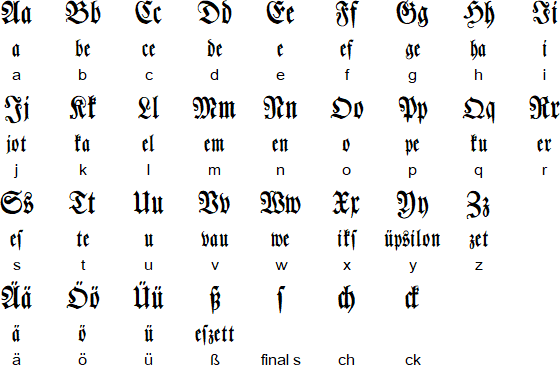
Here is a chart of the Fraktur type, which can be found here:

Capital letters in this font that can easily be confused or misread are B, P, V; C, E, G; D, O, Q; K, R; I, J. Lower-case letters to watch out for are f, l, (long) s; t, k; r, x.
Here is an example of the Kurrent alphabet, available online here.

Notice that these letters are written within four lines. Many of the letters are formed between the middle two lines only; the letters can be sorted into those with no ascenders or descenders, those with ascenders only or with descenders only, and those with both. Lower case letters with neither ascenders or descenders are: a, ä, c, e, i, m, n, o, ö, r, u, ü, v, and w. Those with ascenders only include: b, d, k, l, s, and t. Those with descenders only are: g, j, p, q, x, y, and z. Those with ascenders and descenders are: f, h, s, and ß. Most capital letters have ascenders; those with descenders include: E, F, G, H, J, P, Q, Y, and Z.
Letters that can commonly be confused in Kurrentschrift include the following:
- c and i – the only difference between the written form of these two letters is the dot over the i. In some areas, at some periods of time, scribes may have added a little “hook” at the top of the c to distinguish it from the i.
- e, m, n, r, u, v, w – the n and e can look almost identical, depending on the handwriting; in theory, the e is narrower than the n. The way the lower-case n is written is identical to the lower-case u. In order to distinguish the two, the scribe will add an U-Bogen, which is the little swoop above the u. (This is not the same as an umlaut, the two dots that may appear above an a, o, u, or in older records, possibly also the y.) When a word contains a double m or a double n, the scribe might write the letter only once, and put a straight line over the letter to indicate that it’s actually a double letter. Consider the word Zimmermann – carpenter. In the Kurrentschrift handwriting, it looks like an endless series of zigs and zags, as in the first line below. The second line shows the use of the straight line over the m and n to indicate the double letter. Next to it is an example of the word from an actual record, for comparison.
- Lower-case a and o may be confused.
- Lower-case b, d, and l might be hard to distinguish.
- Especially challenging are the lower-case f, h, and long s.

German handwriting tutorials are available as follows:
- Old German Script – 3 parts by Dr. Fritz Juengling
- German Paleography Seminar – 9 parts by Charlotte Noelle Champenois
- https://script.byu.edu – script tutorials for various languages
- A Guide to Writing the old German “Kurrent” Script
- Sütterlin tutorial
German dictionaries online can be helpful for deciphering words:
- http://dict.leo.org or http://dict.cc – German-English dictionaries (not necessarily great with archaic terminology)
- https://woerterbuchnetz.de/ – 44 German dictionaries, in German, but good for archaic terms and also some dialect words
- https://www.familysearch.org/wiki/en/German_Genealogical_Word_List
Other tools that can be useful for translating and even transcribing records include:
- Schrift generator – https://www.deutsche-handschrift.de/adsschreiben.php
- Transkribus – https://www.transkribus.org/ can transcribe both handwriting and Fraktur with mixed results
- https://www.wordmine.info/ to decipher words
- Deepl – to translate words and phrases, good for idiomatic phrases
- ChatGPT – good for translating records
- Download Kurrent font to your computer
May 2024 – Your Turn!
Thanks to all those who submitted documents and records for this month’s presentation.
The first three submissions came from Colonial America, and were records other than the traditional birth, marriage, and death records that we often rely on:
A will from Baltimore in 1763 – most of the signatures on the will were readable except one. Unfortunately, it’s still unreadable and the person who signed this document remains a mystery. The person is identified as “nearest of kin” so perhaps more family or FAN research will eventually help solve this mystery.
Moravian biography and letter – the biography is a 7-page document written by Georg Ernst Schlosser, a merchant from Pforzheim who moved to Philadelphia in 1752. The document describes his birth, parents, education, marriage and subsequent divorce, his faith journey and conversion to the Moravian sect, and finally his journey from Pforzheim via Rotterdam to Philadelphia. It is a remarkably detailed document. The letter from Schlosser was written to Moravian elders in Bethlehem after his arrival in America. He asks for permission to move to Bethlehem to get his children away from “the general corruption of the youth here” in Philadelphia!
Finally, we had a document created on the eve of the Revolutionary war, by German settlers in Linn and Penn Townships in Northampton County, Pennsylvania. The first page of the document describes a protection alliance to safeguard their homes and property, and the next page lists over 60 signatures of people who joined in the alliance. Many surnames are repeated, indicating family relationships among the signers.
From Colonial America, we jumped to post-WWII Germany, with a couple letters written from Lippe to relatives in America, re-establishing contact after the war. The first letter is handwritten and short, giving a few details about how the family fared during the war. The second letter is two typewritten pages, and goes into great detail about post-war conditions for this family.
Next we looked at some traditional birth and death records from West Prussia, an area that is now part of Poland. With birth records from 1839 and 1841, and then a death record for 1841, the question was what were the names of the children in these records, and which one died in 1841. Based on the age at death – 2 weeks – it became clear that it was the second child who died in 1841. It is interesting that the death record listed “heirs” of the infant as his parents. The second death record was for the father of these children. It listed his survivors as his widow and five children, two of which were still minors. It is important to remember that the age of majority varied by time and place, so that someone who was 21 or 22 years old might still have been considered underage.
The next case comes from my own family, and is another testimony to looking for clues beyond the standard BMD records. For 20 years, my brick wall was a marriage record – actually two – for my third great-grandfather. Franz Florl married the first time in 1800, and again in 1812 in Bohemia. In neither record does it say who his parents are, nor were any relatives listed as witnesses. Looking through all the records for the towns where he married, there is no other Florl to be found, so I was stuck. Fast-forward to last summer, when I checked available records for the town again. This time, land records were also available, and I found the record for his land purchase from his father-in-law within a year of his first marriage. When Franz died in 1826, he still owned the original property, plus another one in a different town where he lived with his second wife. Again the land records came to my rescue, because the disposition of his estate was laid out in detail there. The original house was left to the children from his first marriage, who were all of age. The second house was left to the children of his second marriage. Because these children were under age, Franz’s brother Anton was named as the guardian. A brother! Armed with a new name, I was able to find a marriage record for Anton, listing Franz as a witness. It still didn’t mention the parents, but looking through the records in the town where Anton got married, I was able to find birth records for both siblings. Based on this breakthrough, I have been able to trace the family back to 1664 in Bohemia.
The last item for this month’s presentation was reviewing land measurement terminology. This is helpful in understanding, perhaps, the size of our ancestors’ farmland properties, or for the many words that translate as farmer in English. The FamilySearch German Word List has a special section with terms for farmers – and there are over 125! Be sure to check it out.
For the definitions used in the presentation, I relied on a volume called Complete Handbook of Money, Measurements, and Weights in all Countries on Earth, by Friedrich Albert Niemann, published in Quedlingburg in 1830. It is written in German in the old Fraktur type, but the website does offer an option to convert the text into a modern typeface for easier readability. It is often frustrating for researchers to find out that a given measure varies by time and place, but this comprehensive volume can help with those kinds of questions. Land terms we looked at were the following:
- Acker = (cultivated) land. From this word we get terms such as Ackerer, Ackermann, Ackerbauer, Ackerwirth, Ackerleute, all of which can translate to farmer
- Elle – unit of length, varies from ~21.5 – ~32.7 inches
- Fuss = foot, length varies
- Hektar = hectare = 1000 square meters
- Hufe in northern Germany, Hube in southern Germany, Hubel in Switzerland; farm size measurement, varies by area. From this we get words like Hubler and Hübler, both of which translate to farmer; you may also see Halbhübler for someone who owns a half-size farm
- Joch = yoke, measurement of acres
- Klafter = fathom or cord; unit of length = 6 Fuss; unit of volume = 6 Fuss x 6 Fuss x 4 Fuss
- Morgen = morning; unit of land measure, i.e. the amount of land one man and one ox can plow in one morning; the amount of land may vary greatly depending on the type of land – sandy, swampy, rocky, hilly, etc.
- Ruthe = rod; land measure, length varies by location
- Viertel = one quarter; a Viertler is a farmer with a ¼-sized farm
April 2024 – Jewish Research in Germany
For a brief history of Jews in Germany, see Wikipedia. Maps used for this part of the presentation include the following:ü
- 1897 Distribution of Jews in Germany
- Jewish population in Europe: 1750
- Jewish population in Europe: 1800, 1850
- Jewish population in Europe: 1900, 1930
- Jewish population in Europe: 1950

Research possibilities for Jewish records include the following:
- Cemetery records – Compgen has documented many Jewish cemeteries in Germany. Unlike most other cemeteries in Germany, these gravesites do not have to be re-rented after a given period of time. Note that gravestones may be in Hebrew or German. JewishGen also has a worldwide database of Jewish cemeteries.
- Census records – the 1938/39 minority census can be viewed at a FamilySearch Center or on MyHeritage. Roughly 410,000 individuals were recorded in this census.
- Church / synagogue records – since churches were the record keeper for the state, Jewish births, marriages, and deaths may appear in Catholic or Protestant church registers. These entries may be mixed in with other entries, or may be in a separate section of the respective church register. In some places such as larger cities, starting sometimes in the 1800s, synagogues were allowed to keep their own records. Some of these records can be found at the following sites:
- Hessen State Archives – vital records
- Baden registry books 1810-1870
- Württemberg, Baden, Hohenzollern civil registers, 18th-20th centuries
- Freiburg registry books 1810-1870
- Civil registration – civil registration began in 1874 for Prussia and 1876 for the remaining German states. Records for Jewish residents will indicate the religion as Mosaisch or Israelitisch.
- Holocaust records – the Bundesarchiv in Berlin maintains a Memorial Book of Holocaust victims. It is a work in progress and updated as information becomes available. The Memorial Book documents Jews who were murdered or died as a result of persecution from 1933-1945, and lists people within German territory as of 1937 regardless of nationality. JewishGen and Yad Vashem are two other sites that maintain a Holocaust database.
- International Tracing Service (Bad Arolsen) – the Arolsen Archives is a comprehensive archive on the victims and survivors of Nazis. Its collection has information on more than 17.5 million people.
- Surname declarations – In 1808, Napoleon decreed that Jews had to choose a surname (rather than patronymic) in areas left of the Rhine; other parts of Germany followed suit later. Family names had to be registered at the local Standesamt, and these permanent names were sometimes published in an Amtsblatt or Intelligenzblatt for the area. Such published lists often included familial relationships and place of residence.
There are, of course, many websites specifically for Jewish genealogy research, and they are too numerous to list here. But I would like to point out just a few more sites that can be helpful.
First is the FamilySearch Wiki. Each German state has a Wiki page with helpful information and sub-pages for various record types available for the respective states. Clicking on the Jewish Records menu option will take you to a listing of available records for that state. Some states may also show a Minorities menu option, and this is another place to look for possible records.

JewishGen has already been mentioned here several times, and it is one of the main sites for Jewish research worldwide. The site includes many databases and also has a section specifically for German Jewish research.
Compgen is another site that has frequently been mentioned for German research. In the section for Ortsfamilienbücher, the website has included a database of German Jews. It currently includes over 480,000 people and over 120,000 families.
The Judaica Collection at the Goethe Universität in Frankfurt contains almost 50K digitized titles in multiple languages from many countries. It includes books, journals, illustrations, manuscripts, and more.
Alemannia Judaica is an organization that researches Jewish history in southern Germany and surrounding areas (e.g. Switzerland and Alsace). It has searchable cemetery and synagogue databases.
March 2024 – Berlin
The first mention of Berlin as a town is in 1251 A.D., and across the Spree, the town of Cölln in 1261. These two towns eventually merged into the core of Berlin as we know it today in 1432, with about 8000 inhabitants. Between the bubonic plague in 1576 and the Thirty Years War from 1618-1648, the population of Berlin was devastated. As a result, Friedrich Wilhelm promoted a policy of immigration and religious tolerance in order to rebuild the population quickly. By 1685, over 6000 Huguenots had come to the city, and by 1700, more emigrants had come from Poland, Bohemia, and Salzburg.
Berlin was named the capital of the Kingdom of Prussia in 1701. Friedrich I, the new king of Prussia, introduced universal primary education. In the 1700s, there was a great emphasis on arts and culture in the city, but it was also headquarters for much of the military. By 1755 the city population was 100,000, of which 26,000 were soldiers.
In 1815, Berlin became part of the Province of Brandenburg, then its capitol in 1827. By the mid-1800s, Berlin was the fourth-largest city in Europe, with a population of 400,000. At that time, the city was about 85% Protestant. In 1871, Berlin became the capital of the German Empire, and the imperial government and military expanded there. Building of the Reichstag began in 1884.
Berlin suffered greatly during WWI. Initially, people thought that the war would be short, so there was little advance preparation, either in terms of munitions or food supplies. As the war dragged on, there were shortages of everything, and dwindling food supplies were exacerbated by bad harvests. Migrants flocked to the city, which in turn created housing shortages.
After WWI, Berlin became the capital of the Weimar Republic. In 1920, the Greater Berlin Act incorporated surrounding towns, which doubled the population to almost 4 million and increased its area by 13 times to 341 square miles. Berlin was now the third largest city in the world.
In the wake of the Depression, 450,000 people in Berlin were unemployed and inflation was rampant. Political turmoil raged between the established government, the Communists, and the Nazis. After the Reichstag burned in 1933, Hitler took control of the government. Political opponents fled the city, and persecution of the Jews began.
Berlin was the target of massive bombings in WWII, leaving many homeless and destroying 10% of the buildings irreparably. By May 1945,, 40% of the population had fled the city.
In May 1945, the city surrendered, and the task of rebuilding began. The Soviets dismantled industry, transport, and other facilities in Berlin. Other sectors of the city were divided between the US, England, and France. Bonn became the capital of the new Federal Republic of Germany, but (East) Berlin remained the capital of the Democratic Republic of Germany. Refugees poured into the city from former eastern German territories.
In June 1948, the Soviets began the Berlin Blockade, in an attempt to gain control of all of Berlin. The Allies responded with the Berlin Airlift, which transported food and other essential items into West Berlin. The airlift lasted from June 1948 to May 1949.
In 1961, the Soviets built the Berlin Wall in order to stop people from fleeing the eastern sector of the city. Over the years, more than 5000 people successfully left, but more than 200 were killed in their attempt to flee Communist control. In June, 1963, John F. Kennedy gave his “Ich bin ein Berliner” speech.
In June 1987, Ronald Reagan gave his “Mr. Gorbachev, tear down this Wall!” speech. As more people were able to flee East Germany via Hungary and Czechoslovakia, Communism’s hold over the country was slipping. By September 1989, there were mass demonstrations, with people chanting “Wir wollen raus!” – “We want out!” On 9 November 1989, the Communist government had decided to loosed rules for leaving East Germany. Because of a miscommunication, the rules were made effective immediately, and thousands of people rushed to checkpoints at the Wall to be let through. The re-united Berlin has been the capital of Germany since 1991.
For a summary of available online records for Berlin, see the FamilySearch wiki for Berlin.
- Church records – Available at FamilySearch (mostly Lutheran and military) and Ancestry ($), Archion ($, Lutheran), and Matricula (Catholic – military only). Some older records may be found in Brandenburg archives rather than Berlin.
- Civil registration – available as of 1874; these records can be found at FamilySearch and Ancestry. Because of the size of the city, Berlin has more than one Standesamt. In order to find records, it is important to know which Standesamt created the respective birth, marriage, or death record. The Landesarchiv Berlin has detailed instructions and finding aids to help with this process. (The web page is in German, so use Google Translate.) Be sure to pay attention to the year of the record you’re interested in, because Standesamt boundaries changed several times over the years.
- Civil registration – Standesamt I – Berlin has created a special Standesamt that keeps some surviving records from the former Eastern territories. This Standesamt is also the place that records events for Germans that occurred outside German boundaries.
- Ortsfamilienbuch – there is only one OFB for Berlin, incorporating church records from various districts in the city. Most of these records go only up to 1700, but the material is sometimes updated, so check again later if you don’t find your person now.
Other record sources for Berlin include:
- Einwohnermelderegister – residential registration has been required in Berlin as of 1874. Records prior to 1948 have been lost, but records between 1948-1960 These records are not available online, but can be ordered from the Landesarchiv Berlin.
- Compgen page for Berlin
- Berlin on Wikipedia, FamilySearch
- Berlin.de – official state website
- Landesarchiv Berlin
- Bundesarchiv – federal archives; uses Invenio for searches
- Stasi Archives, Stasi Mediathek
- Military Archives (aka WASt, Deutsche Dienststelle) – there are considerable looses to pre-1945 records due to an archive fire in 1945.
- Digitale Landesbibliothek Berlin – good source for historical maps, city directories, some newspapers and journals; global search across all collections
- Berliner Stadtplansammlung
- Staatsbibliothek zu Berlin – good source for digitized newspaper collection (not just Berlin). Note that Berlin newspapers recorded birth, marriage, and death announcements for other places besides Berlin.
- Arolsen Archives – comprehensive archive on the victims and survivors of the Nazi era.
- Einwandererzentralstelle – between 1939-1945, the EWZ kept records for ethnic German emigres from eastern Europe. There are three parts to these records – the application, card index (included immigrant and health sections) and family forms (Stammblatt). Some of these records have been digitized and can be searched via Invenio.
February 2024 – Bayern
The history of Bayern is intertwined with the history of the current state of Rheinland-Pfalz. The latter was covered early on in our tour of the German states, so look under the “Previous German SIG Posts” dropdown menu for more details there. For the history of the current state of Bayern, see the predecessor states:
- Herzogtum (Duchy) of Bayern
- Kurfürstentum Bayern
- Kurpfalz Bayern (sorry, this link is in German, use Google Translate!)
- Kingdom of Bayern
- Freistaat Bayern
For a summary of available online records for Bavaria, see the FamilySearch wiki for Bavaria.
- Church records – Available at FamilySearch and Ancestry ($), Archion ($, Lutheran), and Matricula (Catholic). Catholic church records may also be found at the Archive and Library of the Archdiocese of Munich and Freising
- Civil registration – available as of 1876; these records can be found at FamilySearch and Ancestry. You may have to write directly to the local Standesamt if the records are not available online.
- Ortsfamilienbücher (OFBs), cemeteries, and city directories – can be found at CompGen.
- Military records – WWI rosters are available on Ancestry, WWI casualty lists on Compgen, and selected Bavarian military records on FamilySearch
Other resources for Bayern include:
- Compgen page for Bayern
- Bayern on Wikipedia, FamilySearch
- Bayern.de – official state website
- Die Staatlichen Archive Bayerns – includes guidelines for researching in Bayern, help for reading the old German handwriting
- Bavarikon – great resource for historical maps, also Ortslexicon
- Haus der Bayrischen Geschichte – no data, but interesting background stories
- Sprachatlas von Bayern – regional dialect variations for Bavaria
- Regierungsblatt für das Königr. Bayern – available on Google Books for various years, especially good for emigration announcements
- digiPress – online newspapers
- Bayrischer Landesverein für Familienkunde.V. (€30/yr outside Germany)
In terms of emigration, most of the very early activity was from the Pfalz in the 1700s. For the rest of Bayern, there were essentially three waves of emigration – 1846-1857 (140K), 1864-1873, and 1881-1893 (170K), with America being the destination for almost 90% of the emigrants. Sources for emigration information specific to Bayern include:
- Birkenhördt Project – southern Palatinate emigration
- Good Bye Bayern – Grüß Gott America
- German Genealogy Society Emigration Database (Bavaria and Pfalz) – compiled emigration notices from newspapers, 1823-1873, ~150K names
- Kommt Bald Nach – Auswanderung aus Bayern nach Amerika 1683-2003 – in German, but a good description of emigration throughout several centuries
I mentioned that many emigrants used the redemptioner system to come to America, and this raised some questions as to the difference between the redemptioner system and indentured servitude. So here are some links to give more background on this topic:
- Wikipedia on Redemptioners, indentured servants
- The Phasing out of 18th Century Patterns of German Migration to the United States after 1817
- Redemptioners – this article focuses specifically on immigrants to Maryland
- Redemptioners in Pennsylvania, indentured servitude
January 2024 – Your Turn!
Due to lack of response, the January SIG is canceled. We will resume in February with Bavaria.
November 2023 – Sachsen
If you’ve attended previous German SIGs, you may have felt like you had already heard some of the history of Sachsen – and that’s because you did. Predecessor states of the current state of Sachsen have already been mentioned when we talked about Thüringen and even Sachsen-Anhalt. Here are Wikipedia links to each of these predecessor states:
- Duchy of Saxony – 880-1356 AD
- Electorate of Saxony – 1356-1806
- Kingdom of Saxony – 1806-1918
- Free State of Saxony – 1918-1952
Available records for Sachsen include the following:
- Church records – Available at FamilySearch and Ancestry ($), Archion ($, Lutheran), and Matricula (Catholic). Because many wars have caused record loss in Sachsen, you may not be able to find records for your town. There may be church record substitutes found in the extracts done by Alfred Maschke, available at FamilySearch.
- Civil registration – available as of 1876; these records can be found at FamilySearch and Ancestry. You may have to write directly to the local Standesamt if the records are not available online.
- Ortsfamilienbücher (OFBs), cemeteries, and city directories – can be found at CompGen. Sachsen also has its own website for city directories, with a very easy user interface.
- Census – some censuses and equivalents (Seelenliste, Einwohnerverzeichnisse) for selected years and towns in Sachsen can be found on FamilySearch
Other resources for Sachsen include:
- Compgen page for Sachsen
- Sachsen on Wikipedia, FamilySearch
- Sachsen tourism
- Sächsische Staatsarchiv – digitized records here include court records (record set 12613), military records before and after 1867, officers after 1921, and Bohemian Exulanten
- Sachsen.Digital – over 80 collections, including Wanderbücher, newspapers, letterheads of Sachsen businesses
- SLUB – more than 75 digitized collections, including Sachsen newspapers and city directories
- Maps and Gazetteer
- Impfscheine – vaccination lists for smallpox immunizations; not many survive, but can provide family details
- American Consular Records 1837-1917 (NARA RG 59 & 84) – while other Germany states usually had only one US consulate, Sachsen had nine! In- and out-correspondence may have information about birth, marriage, death, pensions, wills and inheritance, citizenship, etc. Not all of these records have been digitized.
- Leipziger Genealogische Gesellschaft e. V. (€30/yr)
- Dresdner Verein für Gelealogie.V. (€25/yr in Germany)
There is not much information available about emigration from Saxony. In 1838-39, about 750 “Stephanist” Lutherans came to St. Louis, then eventually settled in Perry County, Mo. Others left after the failed revolution of 1848, and Sachsen emigration peaked in the 1850s. Emigrants from Sachsen may be found from these sources:
- The Hamburg Passenger Lists – FHL guide
- Hamburg Passenger Lists, 1850-1934 ($) index and images
- Hamburg Passenger Lists, Handwritten Indexes, 1855-1934 ($) images
- Bremen Passenger Lists
- German Emigrant Database
October 2023 – Thüringen
If you’re confused about why all the predecessor states of Thüringen start with “Sachsen,” hopefully this month’s presentation will have brought a little clarity. Here’s a list of those states, hot-linked to their respective Wikipedia articles:
- Herzogtum Thüringen
- Großherzogtum Sachsen-Weimar-Eisenach
- Herzogtum Sachsen-Altenburg
- Herzogtum Sachsen-Meiningen
- Herzogtum Sachsen-Coburg und Gotha
- Fürstentum Schwarzburg-Sondershausen
- Fürstentum Schwarzburg-Rudolstadt
- Fürstentum Reuß ältere Linie
- Fürstentum Reuß jüngere Linie
The Free State of Thüringen was created after World War I, incorporating most of this territory; Coburg was merged into Bavaria. After a brief period of US control post-World War II, Thüringen came under Soviet control. In 1952 it was divided into three Bezirke (districts) – Erfurt, Gera, and Suhl. In 1990, Land Thüringen was created after reunification with slightly different borders.
Available records for Thüringen include the following:
- Church records – available at Ancestry ($), FamilySearch, MyHeritage, Archion ($, evangelisch only), and Matricula (Catholic).
- Civil registration – available as of 1876; these records can be found at FamilySearch and Ancestry.
- Ortsfamilienbücher (OFBs), cemeteries, and city directories – can be found at CompGen.
- Census – some censuses and equivalents (Seelenliste, Einwohnerverzeichnisse) for selected years and towns in Sachsen-Weimar can be found on FamilySearch
Additional resources for Thüringen include the following:
- Compgen page for Thüringen
- Thüringen on Wikipedia, FamilySearch
- Thüringen tourism
- Thüringer Landesarchiv
- Arbeitsgemeinschaft für mitteldeutsche Familienforschung e. V. (€50/yr)
- Verein für Thüringische Geschichte (€35/yr)
Between 73,000 and 100,000 people from Thüringen came to America through the ports of Hamburg, Bremen, or Rotterdam. Between 1871-1884, about 20,500 came to the US. Many other emigrants left for South America, Africa, and New Zealand. The Thuringian Emigration Society brought some settlers to Pennsylvania in 1832, but quickly disbanded.
Emigration resources for Thüringen include the following:
- The Hamburg Passenger Lists – FHL guide
- Hamburg Passenger Lists, 1850-1934 ($) index and images
- Hamburg Passenger Lists, Handwritten Indexes, 1855-1934 ($) images
- Bremen Passenger Lists
- German Emigrant Database
- Die Auswanderung aus den Thüringischen Staaten nach transatlantischen Ländern
- Thüringen Emigration Database
- Allgemeine Auswanderungs-Zeitung
- Schwarzburg-Rudolstadt Emigration
- Emigrants from Sachsen-Coburg, Sachsen-Kronach, Sachsen-Meiningen
September 2023 – Brandenburg
The history of Brandenburg is intertwined with Berlin and also Prussia. Berlin today is a separate state in Germany and will be covered in March 2024.
As for Brandenburg itself, its history goes as far back as the 900s, when it was a territory of a Slavic tribe called the Wends. The area was referred to as the Northern March, or Altmark, and gradually grew to include surrounding areas.
The Margraviate of Brandenburg was part of the Holy Roman Empire from 1157-1806. After 1356, it was known as the Electorate of Brandenburg, and in 1411 came under the control of the Hohenzollern family. In 1539, the Electorate accepted the Lutheran religion, although some later rulers were Calvinists.
Between 1618-1701, the area became known as Brandenburg-Prussia, after the Hohenzollerns intermarried with the Duchy of Prussia to the east. The area suffered greatly from the 30 Years War, losing almost half of its population; as many as 5000 villages were destroyed. In order to repopulate and revitalize his territory, Frederick William the Great Elector encouraged immigration from Mecklenburg, Saxony, the Palatinate, Württemberg, France, Switzerland, the Netherlands, and Poland. To those who came, he granted freedom from conscription, freedom from taxation for a fixed period, freedom from import duties, freedom of religion, and subsidies for housing construction. Many French Huguenots settled in the area.
In 1701, yet another name was applied to the region – now it became the Kingdom of Prussia from 1701-1918. Under Frederick II “the Great,” it continued to consolidate its power among other nations in Europe, as well as becoming the dominant German state. In 1772, 1793, and 1795, it gained portions of land from Poland, most of which it lost again after the Napoleonic Wars.
The Province of Brandenburg was created in 1815 as part of Prussia, with slightly difference borders than the old Margraviate of Brandenburg. There were two government districts – Potsdam with 13 counties, and Frankfurt/Oder with 17 counties.
Frederick Wilhelm IV instituted a new constitution in 1848, then revised it in 1850. The main features of this constitution were the creation of a bicameral Landtag, the introduction of jury courts, freedom of the press and freedom of speech, free and compulsory education in schools, and a standing army under the control of the king.
In 1862, Otto von Bismarck was named Prime Minister. Under his leadership, the North German Confederation grew to 21 states. By 1871 all of Germany was unified.
After WWI, with some border adjustments, the area became known as the Free State of Prussia from 1918-1947. After 1947, part of Prussia was given to Poland, and the remaining area came under control of the Soviets, who called it Land Brandenburg. In 1952, Land Brandenburg was dissolved and replaced with thee districts – Potsdam, Cottbus, and Frankfurt/Oder. In 1990, Brandenburg was reestablished as a state in the Federal Republic of Germany.
Emigration from Brandenburg happed in two waves. The first wave was between 1816-1818, and most people went to Poland; about 5500 came from the Potsdam district alone. Some of these emigrants later returned to Brandenburg. The second wave started in the 1840s, and consisted mostly of the so-called “Old Lutherans.” Some of these emigrants went to Australia, but many came to the US and settled in New York, and the Midwest, especially Wisconsin.
It is important to note that many records, both church and civil registration, were damaged, destroyed, or lost after WWII.
Available records for Brandenburg include the following:
- Church records – available at Ancestry ($), FamilySearch, Archion ($, evangelisch only), and Matricula (Catholic).
- Civil registration – available as of 1874; these records can be found at FamilySearch and Ancestry. Records for the Neumark district (which became part of Poland) may be available at Berlin Standesamt I.
- Ortsfamilienbücher (OFBs), cemeteries, and city directories – can be found at CompGen. Don’t forget to check out Niekammer’s landwirtschaftliche Güter-Adreßbücher at the Martin-Opitz-Bibliothek; this volume is basically a farm directory for all of Brandenburg.
- Census – some censuses and equivalents (Seelenliste, Einwohnerverzeichnisse) for Angermünde can be found on FamilySearch.
Other resources for Brandenburg include the following:
- Compgen page for Brandenburg
- Brandenburg on Wikipedia, FamilySearch
- Landesportal Brandenburg
- Brandenburgisches Landeshauptarchiv
- Martin-Opitz-Bibliothek
- Die Territorien der Mark Brandenburg
- Brandenburgische Genealogische Gesellschaft Roter Adler (€40/yr)
Emigration-specific resources include the following –
- The Hamburg Passenger Lists – FHL guide
- Hamburg Passenger Lists, 1850-1934 ($) index and images
- Hamburg Passenger Lists, Handwritten Indexes, 1855-1934 ($) images
- Bremen Passenger Lists
- German Emigrant Database
- Brandenburg, Germany Emigration Records ($)
- Huguenot Refugees in Brandenburg (FS Wiki)
- German Huguenot Association
- Die Altlutherische Auswanderung um die Mitte des 19. Jahrhunderts by Wilhelm Iwan
- People in Transit: German Migrations in Comparative Perspective, 1820-1930 – Dirk Hoerder, Jörg Nagler, eds.
- –“Emigrations from Regierungsbezirk Frankfurt/Oder, 1815-1893” by Uwe Reich
- –“Colonist Traditions and Nineteenth-Century Emigration from East-Elbian Prussia” by Rainer Mühle
- –“Emigrations from Regierungsbezirk Frankfurt/Oder, 1815-1893” by Uwe Reich
May 2023 – Your Turn!
No one submitted any samples, so there was no meeting in May. Have a nice summer!
April 2023 – Sachsen Anhalt
Sachsen-Anhalt, the home of Martin Luther, was created from land of three different areas –
- Braunschweig – only a very small part of Braunschweig became part of the Province of Sachsen after WWI; this part was then merged into Sachsen-Anhalt after WWII. (See German SIG April 2022 for more details on Braunschweig.)
- Anhalt – dated back to the 9th century under Saxon rule. Anhalt became its own territory in the early 1200s, and underwent various changes in territory and rulers over time. After WWI it became the Free State of Anhalt, then after WWII, was united with the Province of Sachsen as the state of Sachsen-Anhalt.
- Province of Sachsen (not to be confused with the Kingdom of Sachsen) – was created at the end of the Napoleonic Wars in 1815 under Prussian rule, with territory from various areas, including land from the Kingdom of Sachsen, land west of the Elbe, and more. After WWII, some of the land went to Thüringen, the rest was joined with Anhalt to become the state of Sachsen-Anhalt.
Available records for Sachsen-Anhalt include the following:
- Church records – available at Ancestry ($), FamilySearch, Archion ($, evangelisch only), and Matricula (Catholic).
- Civil registration – available for 1799-1811 under Napoleon, then also starting as of 1850 for Anhalt, and as of 1874 for the Province of Sachsen; these records can be found at FamilySearch and Ancestry.
- Ortsfamilienbücher (OFBs) – can be found at CompGen; note that the city of Magdeburg is not listed alphabetically under M, but rather as AGGM-Magdeburg at the beginning of the list.
- Cemeteries – Compgen has over 75 listed for Sachsen-Anhalt. Here’s a link to the tragic foundry accident I mentioned as a rare example of a headstone from the 1800s (use Google Translate to find out what it says).
- City directories – see CompGen for a list of available Sachsen-Anhalt directories.
- Province of Sachsen census – some exist for the years 1770-1934 at FamilySearch.
- Emigration – the best options for finding emigrants from Sachsen-Anhalt are the passenger lists from Bremen and Hamburg. Some other publications include Mercenary Troops from Anhalt-Zerbst, Germany, During the American Revolution by Virginia E. DeMarce; Emigration to the United States (1904); Auswanderer aus Anhalt und den preussischen Regierungsbezirken Magdeburg und Merseburg 1850-1852.
Other general resources for Sachsen-Anhalt include the following:
- Compgen page for S-A
- S-A on German Wikipedia
- S-A on FamilySearch
- Anhalt on FamilySearch
- Braunschweig on Wikipedia
- S-A State Portal
- Digitized maps at Uni Halle
- Regierungs-Bezirk Magdeburg Handbuch 1820
- Familie von Alemann – Magdeburg history
- AG Genealogie Magdeburg – group that created Compgen OFB
- Landesarchiv S-A
- Digitized newspapers at Uni Halle – currently 1799-1944
March 2023 – Mecklenburg-Vorpommern
Mecklenburg-Vorpommern is one of the northern-most states of Germany today. The earliest mention of Mecklenburg is in the 11th century, when this area was ruled by the House of Mecklenburg. Over time, the region was split among competing descendants, but in 1701, the various smaller territories were reformed into the Duchy of Mecklenburg-Schwerin and the Duchy of Mecklenburg-Strelitz. The latter was mostly to the east, but retained a small area of land to the west of Mecklenburg-Schwerin. For a time, both states came under Napoleonic rule, and were part of the Confederation of the Rhine. After the Congress of Vienna in 1815, they were both elevated to the status of Grand Duchy. In 1871 they became part of the German Empire. In 1918 they became Free States in the Weimar Republic. After WWII, both states came under Soviet control and were joined with Vorpommern to form the state of Mecklenburg-Vorpommern; in 1947, the combined state was renamed Mecklenburg. In 1957, Mecklenburg was dissolved by the GDR and replaced with three districts. In 1990, after the wall came down, the state of Mecklenburg-Vorpommern was reconstituted, with minor border changes.
Pommern – or Pomerania – is an area that has variously come under German, Danish, Swedish, and Polish rule, among others. It is first mentioned in the 10th century. After the 30 Years War, in 1648 Pommern was divided between Sweden and Brandenburg-Prussia. Over time, Brandenburg regained most of the territory. In 1815 the consolidated area was then broken into two parts – the Prussian Province of Pomerania and the Province of West Prussia. These provinces likewise became part of the German Empire in 1871. After WWI, the area historically referred to as Pomerelia (the eastern portion) was returned to Poland. In 1945, all of Pomerania came under Soviet control, and the Oder-Niesse Line became the new boundary between Germany and Poland.
For most of its history, the area of Mecklenburg was largely agricultural, and in fact, the feudal system there was not abolished until 1820. Large areas of farmland were owned by a small group of nobles, to whom the serfs were obligated in numerous ways. When looking at various records – civil, church, census, and so on – the relative status of these land owners and tenants can be surmised from the vocabulary used to describe them:
- Ritter- or Gutsbesitzer – wealthy men owned most of the land in M-V; an estate is called Gut or Hof
- Gutspächter (or just Pächter) – tenant of the Gut
- Hüfner – peasant with one Huf of land – enough to feed one family; also Halbhüfner (note that the size of a Huf – area of land measure – varies by region)
- Kossate – peasant with even less land – e.g. quarter Huf
- Hauswirth or Hausmann – peasant who leased land; Erbpächter has hereditary lease that is usually passed to the oldest son
- Büdner – peasant with a small plot of land
- Häusler – landless peasant
- Knecht, Magd – landless workers
- Taglöhner – day laborer
- Arbeitsmann – (non-farm) laborer
- Einlieger – subtenant who has no own house and no land
- Holländer – dairyman
Because of the way this state was divided and reconstituted over time, you may have to look for records in German or Polish archives, depending on where your ancestor lived. Available records for Mecklenburg-Vorpommern include:
- Church records – available from Ancestry and FamilySearch. The book Mecklenburgs familiengeschichtlichen Quellen (FHL #007717822, beg. Image 387 of 605) contains a list of available church records for towns in Mecklenburg-Strelitz and Mecklenburg-Schwerin. Jewish BMD records from 1813-1918 are available at Ancestry.
- Civil registration – began in 1874 in Pommern, 1876 in Mecklenburg-Schwerin and -Strelitz. Records are available at FamilySearch and Ancestry.
- Census – like Schleswig-Holstein, there are census records available for Mecklenburg-Schwerin for the years 1819, 1867, 1890, 1900 and 1919. These years are available at FamilySearch and Ancestry; some are also at MyHeritage. There are also a few very censuses from the early 1600s available at FamilySearch. Censuses were taken in Mecklenburg-Strelitz, but only statistical data survives – no individual names. Information presented in each year of the census varies.
- Ortsfamilienbücher (or Local Heritage Books) – over 60 OFBs are available online at ComGen. Be sure to check for printed copies if you don’t find your town online.
- Cemeteries – CompGen has a database of names from 284 cemeteries in Mecklenburg-Vorpommern. Remember that in Germany, graves are not forever; if a family fails to pay the rent for the plot, it will be “recycled” for someone else to use.
- City directories – a list of digitized Adreßbücher can be found at CompGen.
Other general resources that may be useful for your research in Mecklenburg-Vorpommern include the following:
- Compgen page for Mecklenburg-Vorpommern
- Mecklenburg-Vorpommern on Wikipedia
- Mecklenburg-Schwerin on FamilySearch
- Mecklenburg-Strelitz on FamilySearch
- Vorpommern on Wikipedia
- Mecklenburg-Vorpommern State Portal
- Pommerscher Greif e. V.
- Verein für mecklenburgische Familien- und Personengeschichte e.V. – emigration databases, links to digitized works, OFBs
- GenWebsite for Mecklenburg-Vorpommern – history, emigration, research links
- Mecklenburg-Vorpommern Archive Portal (Ariadne) – over 40 archives in Mecklenburg-Vorpommern searchable here
- Mecklenburg-Vorpommern Digitale Bibliothek – maps, newspapers, matriculation records, etc.
- •My Pommerania – portal for digitized records
Between 1850-90, 146K people emigrated from Mecklenburg – out of an overall population of 420K. Not all of this number went to America, many went to other states in Germany or other countries in Europe. Many were from urban areas. Most left via Hamburg.
Emigration resources for Mecklenburg-Vorpommern include the following:
- Die Auswanderung aus Mecklenburg-Schwerin in überseeische Länder, besonders nach den Vereinigten Staaten von Nordamerika
- Auswanderer Griese Gegend – database with 5000+ entries for southwest Mecklenburg
- Strelitzer Auswanderer – database with 7000+ entries for Strelitz
- Emigration records from Pommern to Mecklinburg
- Immigrant Gen Society Emigrant database – 20K+ entries for Mecklenburg
February 2023 – Handwriting – Your Turn!
Thanks to everyone who contributed records for the SIG this month. We had an interesting selection of cases, and hopefully you were able to pick up some helpful tips for your own research.
Anton Schön
This query came with a postcard from the early 1900s, but with little detail other than Anton’s name on the card. A helpful tool for surname research is Geogen, which shows the distribution of surnames in Germany today. A name like Schön is very widespread (think Smith or Jones), but for an unusual surname, it can be very useful.
Wittke birth and marriage records
In this case, there were questions both about the occupation listed for the man in the records, as well as the names of some of the towns mentioned in the individual records. One of the occupation words was Knecht, which means servant or laborer. In this case, it probably referred to a farmhand of some sort. The other word that appeared for occupation was Instmann, which is another word for farm worker, but can also refer to a pensioner. In order to verify the towns that were mentioned in the records, I used Meyers Orts- und Verkehrs-Lexikon des Deutschen Reichs, commonly known as Meyer’s Gazetteer. This gazetteer includes listings for places that were part of the German Empire prior to WWI, so this means it includes town that are now in Poland or France, for example. The online gazetteer not only includes the information in the original, but also adds a map and lists other parishes within a 20-mile radius of the specified location.
The other lesson to be learned from this particular set of records is about a peculiarity of the way some records were filmed by FamilySearch. In this case, the left- and right-hand pages of a birth record were separated by many intervening images – the person who did the original filming first copied all of the left-hand pages in the register, then all the right-hand pages. Maybe easier for them in terms of setup, but more challenging for us as researchers. The first clue that this might be the case in a film you’re looking at is in the FamilySearch catalog:

For example, these baptism entries include the notation r. & L. S., which means rechte & linke Seiten – left- and -right-hand pages. When you see this notation, it means that the right-hand page will NOT follow next after the left-hand page in the filming sequence. You’ll have to look further on in the film to find the rest of the record. In fact, in the last two entries in this example, you’ll actually have to go to another film entirely to get the rest of the record.
The other clue, in case you didn’t see the notation in the catalog entry, is the banner at the top or bottom of the record image:


Here, the word Doppelseite, which means the record is a double-page entry, gives us a clue that the second page of the record will not be the following image. The number 041 indicates the page in the original register, and the word links means this is the left-hand page. In order to find the rest of the record, you’ll have to scroll forward (or backward?) until you find the corresponding rechts image with the number 041. Be sure you note the line number of the person you’re searching for, so you can go to the same line number when you find the rest of the record.


Fleuter Family records
This query was a simple request to read the challenging handwriting in various family records. One thing to note in this series of records is the use of the word Jungster to refer to some of the female witnesses on the baptism record.

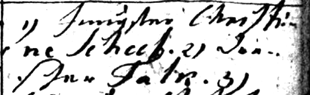
Normally, the word used to refer to an unmarried female in these records is Jungfrau or Jungfer, meaning “maiden”; the male counterpart is Junggesell, which means “bachelor.” My guess is that this is probably a local dialect word. Since I had never seen it before, I tried to look it up in the dictionary apps that I usually use (dict.cc and leo) without success. So I pulled out the big guns and went to woerterbuchnetz.de, and much to my chagrin, had no luck there either. But don’t let this one instance stop you from checking out this wonderful website. It has over 40 German dictionaries, including some regional dialect dictionaries, with a meta-search capability that checks them all for the word in question. My favorite among these is the Deutsches Wörterbuch by Wilhelm and Jacob Grimm of fairy-tale fame. They not only collected stories, they collected the words that made them, and compiled this comprehensive dictionary that includes definitions as well as first-known usage of the terms.
Johannes Pirron
The document presented in this case seemed like it might be a marriage record, but wasn’t quite in the expected format, so it required a more careful look. It turned out to be a sort of oath of allegiance to the state, which had to be certified before the groom was allowed to marry. The regulation was from an 1818 law in the Kingdom of Bavaria, the text of which was found online.
In most cases, when we search for a German marriage record, the result in a church register will be a line across one or two pages, or maybe a single paragraph (depending on the timeframe of the marriage), or a two-page preprinted form in the case of a civil registration marriage. What was unusual in this case was that the marriage entry for Johannes included not only the two-page marriage record itself, but also all the supporting documents, including his and his bride’s birth registrations. In the FamilySearch catalog, this type of marriage entry will look like this:

The word Eheverkündigung means “marriage announcement” and the word Heiratsbelege means supporting documents for the marriage. When you see these words in the catalog, be sure to look at all the pages in the record for that marriage, not just the marriage certificate itself.
Max Fiedler
Often, there will be a notation on a civil record that was added after the original record was created. In Max’s case, there was a notation on the record of his first marriage in 1920, indicating that the couple subsequently divorced in 1928. There was a further notation at the bottom of the second page, indicating that his wife had remarried in 1940. When a record is indexed, whether it’s for FamilySearch or Ancestry or whoever, these side notations are not a part of the indexed information. So it’s important for you as a researcher to always look at the original record, not just the index, for any extra information that can be gleaned from it.
Based on the information in the marriage record, we know that Max was born on 1 July 1898 in Hamburg, and that his parents were August Max Fiedler and Annie Mason. The second part of this inquiry was to verify military records for Max in WWI. When we looked at the details in the Bavarian military records that were presented, it became clear that this was not the person in question. Although the names were the same and the birthdays were only four days apart, the birthplace, occupation, and parents’ names were not the same. With a name as relatively common as Fiedler, it’s important to examine all the details to confirm the identity.
If you have a relative who served in some branch of the German military, you can write to Berlin to request their service record. Note that records from the Prussian army were almost completely destroyed in 1945, only a few survive. Refer to the Bundesarchiv website for more information on what’s available and how to request records from them.
Reichert – Which Sontheim?
Our next case involved an error in the FamilySearch indexing process. One indexed record showed Ferdinand Reichert, born on 2 March 1834, to Johann Wendelin Reichert and Maria Cecilia Pfitzinger, in Sontheim, Münsingen, Württemberg. A second indexed record had the identical information, but the birth place was listed as Sontheim, Heilbronn, Württemberg. So which was correct? A review of the church records for Sontheim/Münsingen (evangelisch) revealed not a single Reichert entry. The Sontheim/Heilbronn records (katholisch) in fact included the correct birth record for Ferdinand. FamilySearch has since corrected the error on the indexed records. The lesson here is that FamilySearch is not infallible, but is responsive to feedback in order to make their database as accurate as possible.
Kuntz-Schäfr
This last query arose from an entry on a ship’s passenger list – emigrant Albert Leidecker was listed as going to see his Aunt Lena in Minnesota. Who was Aunt Lena and how was she related to Albert? After reviewing all the records, it turned out that Lena was not an aunt at all, but rather a first cousin once-removed.
The first document in the record trail was a page from a Familien-Stammbuch (link is in German, use Google Translate to find out more about the Stammbuch), that shows the marriage of Albert’s mother Rosa Kuntz, to Carl Leidecker. Rosa had no sister Lena, so we had to go back another generation to find some answers. Using Rosa’s parents’ names from the Stammbuch entry, we were able to find the marriage document for Johann Joseph Kuntz and Elisabetha Schäfr (note the absence of the “e” in this surname).
This 1856 marriage record, which had to be requested from the local Standesamt, yielded a bonanza of information – way beyond what’s normally expected in such a document. For the groom, it listed his birth date, his parents’ names, the fact that his father was present at the marriage, and the date of his mother’s death. This is mostly what we’d usually expect to see, but that fact that the mother’s death date was included is slightly more unusual.
On the bride’s side, however, the information just kept coming – her birth date and place of birth (different from the groom’s), her parents’ names and death dates for both, her paternal grandparents’ names and death dates for both, and her maternal grandparents’ names and death dates for both (one of which was listed in the format from the French Republican calendar!). Because various spellings were used for the Schäfr surname, the record goes into great detail to prove that these are indeed the same people.
We needed to go back another generation to find the missing link for Rosa and Lena. Lena’s father, Henry, was a brother of Johann Joseph Kuntz.
Because Rülzheim records only go as late as 1837, it will be necessary to write to the local archive or Standesamt to get later records for members of this family. The FamilySearch German Letter Writing Guide will be helpful in this process.
November 2022 – Schleswig-Holstein
Schleswig-Holstein is the northernmost German state. From the 1400s until 1866, it was under Danish rule. The First War of Schleswig occurred in the mid-1800s in a push for alignment with Prussia. At this point, Denmark retained both duchies. The Second Schleswig war happened after the death of Frederick VII in 1863. Austria and Prussia joined forces and this time were victorious over Denmark. Prussia took over Schleswig, and Austria took Holstein. This lasted until the Austro-Prussian war of 1866, after which Prussia took over both duchies and combined them as the province of Schleswig-Holstein. Over time, the Duchy of Lauenburg was also incorporated into the province, as was the Free City of Lübeck. In 1920, the northern portion of Schleswig was officially returned to Denmark.
Because of the intertwined history with Denmark, researchers will have to look both in German and Danish archives to find records of their ancestors. The records may be in Danish or in German. It is also possible, depending on the location, for records to be written in some dialect, e.g. Frisian or Low German.
Language will not be the only challenge – naming patterns are also of concern. Until 1771, Schleswig Holstein used patronymics – that is, a person’s last name was based on the father’s first name. So Peter Jensen is the son of Jens, and Peter’s son Hans is called Hans Petersen. Cathrin, married to Tim, was called Cathrin Tims; and Cathrin, daughter of Peter was called Cathrin Peters or Petersdotter. Although a 1771 law ended this naming practice and required a standard surname to be carried forward, it took some time for patronymics to die out completely.
Church records for Schleswig Holstein can be found at FamilySearch, Ancestry, Archion, and other sites. Check Die Kirchenbücher Schleswig-Holsteins for a summary of existing records for Schleswig-Holstein. This volumes lists BMD with years available, sorted by state, and parish within the state.
Civil registration records started in 1874 for this area. Some (Steinburg district) are available at FamilySearch, others (Flensburg) are at Ancestry. Check Danish archives for further availability.
City directories (Adressbücher) are available for Kiel (the capital of Schleswig-Holstein) for the years 1799-1990 (with some gaps), and for Lübeck from 1798-1993. Miscellaneous years for other cities are also available at the Staatsarchiv Schleswig-Holstein.
For the period when Schleswig-Holstein was under Danish control, censuses were created roughly every five years. Digitized censuses are available for 1769, 1803, 1835, 1840, 1845, 1855, 1860, and 1864. The 1769 census only lists the town and the number of people in various age brackets, similar to the US censuses from 1790-1840; it also breaks down population by occupation. Later censuses list every name in the household, as well as age, marital status, occupation, etc. For more information on how to research these censuses, see the FamilySearch tutorial, as well as 3 video lessons.
Census images can be found in various places online. Remember that if you don’t find your person in one place, look at one of the other sites to see if you can find them there.
- Arkivalieronline, images
- Schleswig-Holstein, Denmark, Censuses, 1769-1860 at Ancestry – index & images ($)
- Dansk Denografisk Database Search Engine – an ongoing project for indexing these records
- Arbeitskreis Volkszahl-Register
- 1803 census for the Duchy of Schleswig
- Volkszählung, 1939. Schleswig-Holstein u. Lübeck
- Danish 1700 Census: males only, index
- 1801-1860 at FamilySearch, My Heritage
Most emigrants from Schleswig-Holstein left between 1880-1893; between 1871-1925, more than 150,000 emigrated from Schleswig-Holstein. Emigration resources include the following:
- Rootdigger – alphabetical files of emigrants
- Nordfriisk Instituut Auswandererarchiv – write for info; online not currently available; membership € 40/yr
- Dithmarscher Landeskunde e. V. – write for info; membership € 50/yr
- Schleswig-Holstein to New Amsterdam/NY 1636-1667
Other resources for Schleswig Holstein research include:
- Gesellschaft für Schleswig-Holstein Geschichte
- Arbeitsgemeinschaft Genealogie S-H e.V. – emigration database
- Ancestors in Schleswig-Holstein – lots of links but no individual records
October 2022 – Bremen
This month we took a look at the city-state of Bremen, including Bremerhaven, which played a significant role in the history of emigration from Europe. The city itself dates back to 787 AD, when it became the site of a Catholic mission. From there it developed into a center for trade, becoming at various times a member of the Hanseatic League. In 1827 the city bought land from the Kingdom of Hanover to create the port of Bremerhaven, and it is from here that emigrants departed.
In terms of emigration information, Bremen started collecting data about emigrants as early as 1832. Sadly, these records were all destroyed because of a lack of space! In 1874, a new law decreed that only the current year and the previous two years should be retained. Earlier records were then also destroyed. In 1909, the city started keeping records for every year again. But then came two world wars, and only a handful of records survive – 1907-1908, 1913-1914, and 1920-1939. The last passenger ship left Bremerhaven in May 1974.
Consult the FamilySearch Wiki for record types that are available online for Bremen and Bremerhaven, including the following:
- Civil registration
- Ortsfamilienbücher (OFBs) at Compgen
- Cemeteries at Compgen (remember that German cemeteries do not retain graves for more than 30 years unless a family renews the lease on the grave site)
- City directories available at the Staatsarchiv Bremen
- Historical maps at the University of Bremen
- Genealogy at the Staatsarchiv Bremen (note that most of the records types cited on this page are not digitized)
General information about Bremen and its history and culture can be found at the following sites:
- FamilySearch Wiki
- Wikipedia in English or German (has lots more info – use Google Translate!)
- Compgen Wiki
- Discover Bremen
- Bremen State portal
- Bremerhaven
For emigration-specific information, use one of the following links:
- Deutsche Auswanderer Datenbank ($)
- Bremen Passenger Lists (based on Die Maus)
- Die Maus – Gesellschaft für Familienforschung ($)
September 2022 – Hamburg
Unlike the other German states that we looked at last year, Hamburg is in a special category of city-states, along with Bremen and Berlin. It was founded in the ninth century as a mission settlement, but grew from there to become an important port city. Along with Lübeck, it was one of the founding cities in the Hanseatic League, and rose to great prominence in shipping on the Baltic and North Seas. Over the course of its history, it was occupied by the Danish and by Napoleon. After WWII, it was part of the British Occupation Zone, and then became part of the Federal Republic of Germany in 1949.
Today Hamburg is the second-largest city in Germany, and the third-largest port in Europe. It is the home of Germany’s oldest stock market, and the oldest merchant bank in the world.
In the second half of the 19th century, Hamburg became the second largest port for emigration, after Bremen. With the advent of railways and steamships, as well as reforms for emigration conditions, Hamburg became the embarcation point for more than 4 million people between 1830 and 1914. Ninety percent of Eastern European emigrants left via the port of Hamburg.
Starting about 1850, the port authorities were required to keep records of departing passengers on ships with 25 or more passengers. These records list the passenger’s name, age, other family members, hometown (not necessarily the birthplace!), and occupation.
Hamburg passenger lists are among the most important tools for finding the origins of emigrant ancestors. They come in two forms –
- Direct – passengers who left from Hamburg and went directly to a destination city, e.g. New York, are listed here.
- Indirect – passengers who left from Hamburg but stopped at another European port e.g. Hull/Liverpool, before continuing on to their final destination; about 20% of all travelers took the indirect route, possibly because the fares were cheaper.
Emigration resources for Hamburg include the following –
- Ballinstadt
- The Hamburg Passenger Lists – FHL guide
- Hamburg Passenger Lists, 1850-1934 ($) index and images
- Hamburg Passenger Lists, Handwritten Indexes, 1855-1934 ($) images
- Hamburg, Germany Emigrants ($) index
- Auswandererlisten, 1850-1934 (Hamburg passenger lists) at FHC only, images only
- German Ports, also info on “the trip”
- Jewish migration via Hamburg
- GG Archives – information on shipping lines and emigration history, including images for passenger contracts, menus, etc.
- Hamburg-America Line – primary shipping company from Hamburg
- Hamburg-Amerikanische Packetfahrt-Actien-Gesellschaft (HAPAG) (in German)
- Hamburg-American Packet Company
- Albert Ballin
Civil registration records for Hamburg can be found at Ancestry:
- Hamburg, Germany, Births, 1874-1901, index and images, ($)
- Hamburg, Germany, Marriages, 1874-1920, index and images, ($)
- Hamburg, Germany, Deaths, 1874-1950, index and images, ($)
Birth, marriage, and death indexes are available from Staatsarchiv Hamburg.
Other resources for Hamburg research include the following:
- Hamburg city directories are available for 1698-1966 (with gaps)
- Hamburg Ortsfamilienbücher
- Compgen page for Hamburg
- Hamburg on Wikipedia, FamilySearch
- Hamburg Tourismus
- Hamburg.com
- Kartensammlung at Uni Hamburg – map collection
- Genealogische Gesellschaft Hamburg (€40/yr)
May – August 2022 – No meeting
April 2022 – Niedersachsen (aka Hannover)
The current state of Niedersachsen is made up of pieces of the former territories of Hannover, Braunschweig, Oldenburg, and Schaumburg-Lippe. As with other states that we’ve looked at this year, these areas evolved over time, and date back to the original Duchy of Saxony, about 1000 A. D.
Hannover was originally an Electorate, formally known as the Electorate of Brunswick-Lüneburg as of 1692. The electorate was legally bound to be indivisible (it could not be split among various heirs of the ruler), but it could add other land to its territory. The succession followed the rule of male primogeniture, which becomes significant later in its history.
Due to various royal intermarriages, George I of England inherited Lüneburg and Duchy of Saxe-Lauenburg in 1705. In 1719, he also purchased the Duchies of Bremen-Verden from Denmark. In 1803, the
Due to various royal intermarriages, George I of England inherited Lüneburg and Duchy of Saxe-Lauenburg in 1705. In 1719, he also purchased the Duchies of Bremen-Verden from Denmark. In 1803, the Prince-Bishopric of Osnabrück was added as well. Hannover changed hands several times during the Napoleonic Wars – in 1810 it was made part of the Kingdom of Westfalen, and in 1814 it was restored as the Kingdom of Hannover by the Congress of Vienna. After 1837, when Victoria became queen of England, Hannover was no longer part of the personal union with England.
In 1866, Hannover was annexed by Prussia. in 1885, it was divided into six Regierungsbezirke – Aurich, Hannover, Hildesheim, Lüneburg, Osnabrück, and Stade. After WWII, the state of Hannover was created under British administration, and in 1946, it was merged into the new Bundesland of Niedersachsen.
The Duchy of Braunschweig-Lüneburg existed as far back as the 1200s. After the Congress of Vienna, it became a sovereign state called the Duchy of Braunschweig. It joined the German Confederation in 1866, and the German Empire in 1871. After WWI, part of the territory was ceded to Saxony, and part became the Free State of Braunschweig. In 1946, it was merged into Niedersaschen.
Oldenburg was a duchy until 1810, when it was annexed by France. It consisted of three geographically disperse territories – Oldenburg, Eutin, and Birkenfeld. It joined the German Empire in 1871, and in 1918, became a free state in the Weimar Republic. In 1937, it lost Eutin and Birkenfeld, and in 1946, it was merged into Niedersachsen.
The principality of Schaumburg-Lippe was created in 1807, from an area that dates back to 1647. In 1871, it became part of the German Empire. In 1918, it became the free state of Schaumburg-Lippe. In 1945 it was part of the British occupation zone, and in 1946, it was merged into Niedersachsen.
Since each of these areas (and areas in the other German states as well) had different names depending on the type of ruler over time, I thought it would be helpful to add this table for clarification:
| German Title | German Area | English Title | English Area |
| Graf | Grafschaft | Earl or Count | Earldom or Countship |
| Herzog | Herzogtum | Duke | Duchy |
| Fürst | Fürstentum | Prince | Principality |
| Kurfürst | Kurfürstentum | Elector | Electorate |
| König | Königtum | King | Kingdom |
Niedersachsen today is the second-largest state by land area, and the fourth largest based on population. It regained some territory from the former East Germany in 1993.
Historically, the state religion was Lutheran. in 1842, Hannover granted equal rights to Jews, with four regional Land-Rabbinates. In 1866, the Lutheran Church of Hannover was formed.
Civil registration started at different times in each of these areas; records area available at Ancestry and FamilySearch.
- 1876 in Schaumburg-Lippe
- 1876 for Oldenburg (also 1799-1814)
- 1876 for Braunschweig
- 1874 for Hannover (also 1806-1811)
Between 1820 and 1930, over 700,000 people emigrated from Hannover; 95% of these went to North America. Emigration resources include the following:
- FamilySearch list of resources for Hannover, Braunschweig, Oldenburg, and Schaumburg-Lippe
- Emigrants from Niedersachsen (good information, but no actual record images)
- Research Center German Immigrants in the USA (Uni Oldenburg)
- Oldenburgische Gesellschaft für Familienkunde e.V. (good information, but no actual record images)
- Tourism Niedersachsen
- German Roots Emigration page
Unlike Saarland, there are many online Ortsfamilienbücher available for Niedersachsen on the Compgen website. Printed volumes can be found here, if your town of interest is not (yet) online.
City directories for Hannover are available for 1798-1975 (with gaps). They are also available for 72 other locations in Niedersachsen.
Other resources for research in Niedersachsen include the following:
- Compgen page for Niedersachsen
- Niedersachsen on Wikipedia, FamilySearch
- Han(n)over on Wikipedia, FamilySearch
- Arcinsys – portal for all NS archives (with over 3.5 million digital images)
- Familienkunde Niedersachsen
March 2022 – Saarland
This month we talked about the Saarland, the smallest state in area in Germany, other than the city-states. It is also the smallest in population other than Bremen.
Prior to 1793, the area that is now Saarland may have been part of :
- Principality of Nassau Saarbrücken
- Duchy of Pfalz-Zweibrücken
- Imperial rulers of Dagstuhl, Illingen, and Kriechingen-Saarwellingen
- Electorate of Trier
- Kingdom of France (Duchy of Lorraine)
- Reign of von der Leyen
During the Napoleonic Era (1793-1816), the area was divided among three different Departements – Saar, Donnersberg, and Rhin-et-Moselle. The Congress of Vienna variously reassigned parts of the land to Prussia, Bavaria, and the Grand Duchy of Hessen. After 1871, the area was totally under Prussian rule. Further reorganizations occurred after World War I, the area was renamed Territory of the Saar Basin, and was administered by France and Great Britain. By 1935, it was reincorporated into Germany as the Gau Westmark. After World War II, it became the Saar Protectorate, once again administered by France until 1957, when it was finally reincorporated into the Federal Republic of Germany.
Given the recurring ties to France, it should come as no surprise that many of the records for this area will be in French or German. If you’re looking at Catholic records, they will be in Latin as well. One thing to look out for in records from the Napoleonic Era is the use of the French Republican Calendar. You’ll have to convert dates like the 18th of Vendemaire in the Eighth Year of the French Republic – also known as 10 October 1799. (Date converters are available on the Internet.)
In terms of emigration, most of the early Saarland emigrants were subjects of Prussia or Bavaria – so look at the notes for the Rheinland-Pfalz presentation in November 2021 for more details. Other resources specifically for the Saarland include:
- Emigrants from Dillingen, Pachten, and Diefflen
- Burgert, Annette Kunselman. Pennsylvania pioneers from Wolfersweiler Parish, Saarland, Germany (c 1983)
- Mergen, Josef. Die Auswanderungen aus den ehemals preussischen Teilen des Saarlandes im 19. Jahrhundert (c 1987) – vol. 2 lists emigrants from former Prussian sections of Saarland
- Hacker, Werner. Auswanderung aus Rheinpfalz und Saarland im 18. Jahrhundert (c 1987)
- Goelzer, Bernd. “Saarland Emigrants 1709-1799” (c 1985; In The Palatine Immigrant, v.9, no. 3)
- Krebs, Friedriech and Yoder, Don. “Emigrants to America from the Duchy of Zweibrücken” in Pennsylvania Folklife – v. 21 (1971) – v. 21, no. 4 (summer 1972)
- List of emigrants from Zweibruecken to Amerika, 1728-1749
There are some digitized newspapers available on Google Books for Zweibrücken, Homburg, and Cusel. There are only two towns in Saarland (as of this writing) for which there are Ortsfamilienbücher available – Niederbexbach and Südlicher Hochwald. A list of printed OFBs for Saarland is available at CompGen.
Many of the resources listed for Rheinland-Pfalz may be applicable for Saarland research as well, depending on the timeframe. Other possible resources for Saarland research include the following:
- Verzeichnis der Saarländer 1926-1934 – Kaiserslautern residents born in Saarland
- Landesarchiv des Saarlandes
- Stadtarchiv Saarbrücken
- Kreisarchiv Saarlouis
- Stadtbibliothek Saarbrücken
- Arbeitsgemeinschaft für Saarländische Familienkunde e.V.
- Official website for Saarland
February 2022 – Nordrhein-Westfalen
The current German state of Nordrhein-Westfalen (North Rhine Westphalia) was created in 1947 from three distinct areas – the former Westfalen, Lippe-Detmold, and the northern part of the former Rheinprovinz. Since the Rheinprovinz was previously covered in November 2021, this month’s presentation focused on the other two areas that make up this state.
We’ve already seen areas that have evolved from one type of political jurisdiction to another, and Westfalen is no exception. With settlements as early as 1 AD by the Romans, this area was initially part of the Duchy of Saxony, then came under the control of the Holy Roman Empire. The Duchy of Westfalen was created in 1102, and lasted until 1803, when it became part of Hesse-Darmstadt.
The Kingdom of Westfalen existed from 1803-1813. It was created as a “model state” under Napoleonic rule from numerous territories, and was the first German state to have its own constitution. During this time, Napoleon conscripted many German soldiers for his Russian campaign. He also taxed the Kingdom heavily in order to finance his efforts, which bankrupted the country and had a long-lasting detrimental economic impact. In 1813, the Russians dissolved the Kingdom, and the land came under Prussian rule.
The Province of Westfalen was created by the Congress of Vienna in 1815; again, it was a conglomeration of various previous territories. It was made up of 3 administrative districts with 36 counties; most of the area was very rural prior to 1850.
The Lippe district was first mentioned in 1123. It became a Kreis (equivalent of a county) by 1528, and a Fürstentum (principality) by 1789. It remained independent during the Napoleonic era, and was not a part of Prussia. Under the Weimar Republic it was a Freistaat, then was incorporated into Nordrhein-Westfalen in 1947.
In terms of records availability, church records for each of the three areas are available on FamilySearch; some are also available on Ancestry and MyHeritage. Protestant records can also be found at Archion ($); Catholic records for the Bishoprics of Paderborn and Fulda are available at Matricula; records for the Bishopric of Essen are not yet available.
There are civil registration records, which began in 1792 for Rheinpfalz, 1874 for Westfalen (with some in 1808-1815 as well), and 1876 for Lippe. Some of the Napoleonic civil registration records are available at the NRW archive; use keywords Standesamtregister, Zivilstandregister, or Personenstandregister to find these records. Also, death records for Münster and Arnsberg districts 1874-1938 on MyHeritage.
Emigration to America from this area mostly happened after 1849/50. Most went to the Midwest – Missouri, Iowa, Illinois, Wisconsin and Minnesota – to become farmers there. There were numerous laws and regulations regarding emigration. For example:
- Male emigrants had to complete military service.
- The emigrant had to make provisions for people and property left behind.
- Minor males were subject to military service if they ever returned.
- Shipping agents had to keep accurate registers of emigrants for state authorities.
Another type of emigrant peculiar to this area is called the Hollandgänger. These were migrant workers who went to Holland (hence the name) for 6-12 weeks every year to work on farms, in shipping, and numerous other occupations. The income they earned from this work was often necessary to carry them through a year. Some of these migrants eventually stayed in the Netherlands, so it’s a good idea to look further than NRW when researching your ancestor.
Emigration resources for this area include the following:
- Emigration from Lippe to USA
- Westfalen emigration resources
- Arbeitsgruppe Familienforschung Kreis Herford
- Migrabase Auswanderungsdatenbank
- German Emigrants Database (Bremerhaven, $)
- Die Maus – Bremen passenger lists 1920-1939
- Beiträge zur westfälischen Familienforschung – 4 volumes 1803-1900 emigration
- German Society of the City of New York
One of the peculiarities of this area is the “Genanntnamen.” The family name (surname) may be connected to the farm that they lived on. When the husband died and the wife remarried, thee new husband would take on the name of the wife. Many records – whether church records, civil registration, land records, etc. – will refer to the Genanntnamen. For researchers, this represents a particular challenge . A man who was initially known as Johann Georg Schmidt and had children with his first wife who had the surname Schmidt, might then marry Anna Maria Keller. He would subsequently be known as Johann Georg Schmidt genannt Keller, and children from this marriage would have the surname Keller. If he remarried a third time, official records would record him as Johann Georg Schmidt oder [or] Keller oder Fischer. So if you don’t find your person with the surname he was born with, keep looking for other marriages!
This state has primarily rural and agricultural roots (although mining was also a common occupation). Although in English there are few synonyms for “farmer,” you will find many terms for it in German, each with a specific meaning. The following list identifies some of these terms, as well as other farming concepts that will be important in your research:
- Bauerschaft – farming community or cooperative
- Colon – colony or estate = hereditary leasehold
- Partible or inpartible inheritance – customs vary by region
- Farmers with full rights – Vollspann, Vollbauer, Pferdner; Kötner, Hintersiedler…
- Farmers without full rights – Häusler, Einlieger, Beisitzer
The website Westfalenhöfe is in the process of compiling farm histories in this area. While this is a work in progress, many estates have already been documented, and can provide a wealth of information about these properties.
More information about Westfalen land records can be found in the FamilySearch wiki. This article also contains numerous terms that can be used when searching for digitized images at the NRW archives. Some of these terms include Lagerbuch, Hypothekenbuch, Flurbuch, Kataster, Bauerschaft, and many others.
More information for NRW can be found here:
- GenWiki pages for
- FamilySearch wiki pages for NRW
- Westdeutsche Gesellschaft für Familenkunde (40 € annual membership)
- Landesarchiv Nordrhein-Westfalen – look specifically for information for genealogy research and digitized offerings
- Digitized newspapers for NRW from 1801-1945, over 1300 newspaper titles
- Jewish and Dissidents Register in Westfalen and Lippe (Compgen) 1809-1875
January 2022 – Handwriting and Records
Thanks to all of you who sent is samples of records that were giving you trouble for various reasons. We’ll be doing a similar exercise for the May meeting, so send your samples to mail@griva.org by 4/15/22, and we’ll try to make sense of it all.
For anyone who has looked at old German records, of course the biggest challenge is probably not the language itself, but rather the handwriting. So we looked at the three types of fonts that you might encounter in any given document.
The first is Fraktur, which is that “gothic” type with all the extra squiggles.

Viewed alphabetically in a chart like this, it might seem fairly straightforward. But when you’re looking at words in sentences, maybe at a document where the ink is smeared for part of the page is faded, suddenly there may be some challenges! Things to look out for in Fraktur:
- Upper-case B, P, and V may look similar
- Upper-case A and U may look similar
- Upper-case I, J, and T may look similar
- Lower-case k and t may look similar
- Lower-case f, l, and the long s may look similar
- Lower-case r and x may look similar
The next font to consider is Kurrentschrift, which is the handwriting you’ll see in all those church registers through the early 1900s.

What you see in this chart is, of course, the ideal. And if you’ve ever looked at a single document in German handwriting, you know that the reality is far more challenging. Everyone has their own handwriting, just as we do today, with the added twist of unfamiliar letter shapes.
The third font type is Sütterlin, which was prevalent in the early 1900s, until 1941. After this date, Germany used what is termed “Latin” handwriting, i.e. the same as we use today.

There are a lot of things to look out for in both of the latter fonts. Consider each group of letters below, and compare them to the chart above. It’s easy to see why it can require some effort – worth it! – to decipher the handwriting.
- c, e, i, m, n, r, u, v, w, x
- mm, nn, u
- a, o
- b, d, l
- f, h, s
- k, t
- g, j, p, q, y, z
- ck
- sch
- st
- ss
- sz
- N, St
- B, C, L
- K, R
- 1, 7 8
For instance, the only thing distinguishing the c and the i is the dot above the i. The only thing distinguishing the n and the u is the little arc above the u. And that little arc is not to be confused with a straight line above an m or an n – that straight like indicates that the letter below it is to be doubled. Look at the word Zimmermann (carpenter) and you’ll see why a writer would want to use the shortcut of the straight like above the m and n. Also look at how similar the e and the r are, or even the e and the n. One trick that might help is to count the “peaks” of the letters – an m has three peaks, an n only has two, an i only has one. So those four peaks together at the end of the word should be 2 n’s, rather than mi or im or un, because there’s no dot or arc above either of the letters. Simple, right?

There are numerous script generators available for each of these fonts:
- https://stevemorse.org/index.html
- https://www.deutsche-handschrift.de/adsschreiben.php#schriftfeld
- https://www.lexilogos.com/keyboard/german_fraktur.htm
How can these help you? At a very basic level, use the script generator to write out the name of the ancestor you’re looking for. This can make it easier to spot the (sur)name among all the other handwriting on the page. You can also use these tools to write out key words for the type of document you’re searching. For a birth record, you might want Vater/father, Mutter/mother, Sohn/son, and Tochter/daughter.
Which brings me to another helpful aid – FamilySearch word lists. FamilySearch has created genealogy word lists for many languages. For our purposes, the most helpful would be the German and Latin word lists. If you’re researching in another country that used to use German but now uses a different language, e.g. Poland, you can also search for those word lists on FamilySearch.
Other resources that can help you with your German research:
- If I can You Can Decipher German Records by Edna Bentz. I would probably rank this as THE most helpful volume you can have when doing German research. Ms. Bentz spent years collecting and recording variations in the formation of each upper- and lower-case letter in the Kurrentschrift alphabet. That alone is worth the price of this volume. Also in this volume are symbols for the days of the week (page 19 in my edition), occupations, illnesses, ecclesiastical calendar, and more.
- German-English Genealogical Dictionary by Ernest Thode. If the FamilySearch word list isn’t enough, try this comprehensive volume of definitions.
- Deciphering Handwriting in German Documents by Roger Minert. This volume not only describes the handwriting, but also examines each of the major types of entries in church registers – birth, marriage, death.
- Tips and Tricks of Deciphering German Handwriting by Katherine Schober. Useful volume that goes into more detail about some of the handwriting challenges I listed above.
- German Church Records – Beyond the Basics by Kenneth L. Smith (out of print – check WorldCat for library availability).
- BYU German script tutorial
- FamilySearch 3-part video lesson and 10-part paleography seminar
December 2021 – no meeting
November 2021 – Rheinland-Pfalz
This month we discussed the current German state of Rheinland-Pfalz, which (like Hessen last month) has deep roots and a long history. At the time of the Holy Roman Empire, there were up to 45 separate entities in this area, from duchies and principalities, to independent cities and bishoprics. The specific areas that were covered this month include the following:
- Electorate of the Palatinate
- Department du Mont-Tonnerre
- Rheinkries – part of Bavaria
- Rheinpfalz – part of Bavaria
- Rheinprovinz – part of Prussia
- Rheinland-Pfalz
Because of its geographic location, this was an area that was hard-hit by wars over many years. The 30 Years’ War from 1618-1648 and the ensuing plague epidemic wiped out two-thirds of the population. Rulers anxious to repopulate and get their economies moving again invited people from other places to settle here. Swiss, Austrians, Italians, and Huguenots were among those who came. From 1689-1697, King Louis XIV of France invaded the area and burned much of it – resulting in tremendous property loss, but also a loss of records that might have been valuable to us as genealogists. In 1707 the War of the Spanish Succession had much the same result.
In 1709, for various reasons, there was a mass emigration of about 14,000 people from this area to England. Some of these emigrants then moved on to settle in the Hudson and Mohawk valleys of New York; others settled in Ireland. In later years, emigration was not only to North America, but also to the east, with settlements founded in Galicia, Russia, and Hungary, among others.
To counter the loss of people to other countries, some rules put in place rather draconian measures. For example, a person with an estate valued at more than 200 guilders was forced to pay one-fifth of their assets in order to leave. If they left without permission, they were likely to forfeit their entire estate.
There is no shortage of information about emigrants from the Palatine. This is a short list to get you started:
- Bavaria & Pfalz Emigrants
- Emigrants from West-German Fuerstenberg Territories (Baden and the Palatinate) to America and Central Europe
- Auswanderkartei, 1840-1930:
- List of Pfalz Immigrants to America, 1724-1749.
- The Birkenhördt Project
- Bavaria and Pfalz Emigration Database
- Ships carrying Palatines from Germany to Philadelphia from 1727 to 1808
- Palatines from England to New York 1709
- Palatine Children Apprenticed by Gov. Hunter in New York 1710-1714
- Ships to Pennsylvania 1700-1749
- Palatine Arrivals in New York in 1710
- PA German Pioneers Passenger Lists, Palatine German Immigrant Ships to Philadelphia 1727-1808
- Ancestor Search, Palatine German Ship Passenger Lists to PA
- The Book of Names, Especially Relating to The Early Palatines and the First Settlers in the Mohawk Valley
Other opportunities for research in the Palatinate include the following:
- Pfälzische-Rheinische Familienkunde e.V. – this organization offers a Pfarrerlexikon (directory of Lutheran ministers), and well as a three-part Mühlenlexikon (directory of mills, miller families, and milling technology and terminology). Other digitized works are available to members only.
- Westdeutsche Gesellschaft für Familienkunde e.V. – offers a database of death notices dating back to 1582 (although realistically, most are from the 19th and 20th centuries), as well as an emigration database with over 105,000 names from 159 sources. Their digital library is a benefit for members only.
- Ortsfamilienbücher – there are a dozen or so OFBs for the Pfalz available online at Compgen. However, there are also many more printed volumes for you to explore here.
- Adressbücher – or city directories are available from several sources, including FamilySearch and Dilibri. A list of digitized volumes can be found here.
- Military conscription records – may be a way to find those elusive ancestors for whom no emigration records can be found. Some of these are available at FamilySearch, others can be found at the Landesarchiv Speyer. These records are usually organized by “class” – i.e. records for the year 1809 will be for people born in 1790-91, or whatever the age criteria was at the time.. You may also find lists of deserters or people who did not show up when they were drafted in a local Amtsblatt or similar publication.
- Amtsblatt – has been mentioned numerous times in conjunction with emigrant information. People generally placed an ad in this type of publication to take care of their debts before leaving the country. But as mentioned above, the Amtsblatt may also be a source of information about military matters. A third possibility is listing of estate matters – who the deceased and heirs are. Many of these can be found at Dilibri under the subheadings Journals and Newspapers.
- Staatskalender – this is not a calendar as implied by the name, but rather an annual volume summarizing anyone in a government or (royal as opposed to judicial) court capacity in the respective area.
- Institut für Pfälzische Geschichte und Volkskunde
- Landesarchiv Rheinland-Pfalz – civil registration
- Landesarchiv Speyer – civil registration
- Apertus – portal for Pfalz archives
- Dilibri Rheinland-Pfalz – address books, maps, newspapers
- Landesbibliothek Rheinland-Pfalz
- Rheinland-Pfalz – GenWiki portal page
- Deutsches Wörterbuch by Jacob Grimm und Wilhelm Grimm (Uni Trier)
- Pfalz-related books on Google Books
- Palatines to America
October 2021 – Hessen
Our focus for October was the current state of Hesse (English version) or Hessen (German version). As you are probably aware, at a minimum from seeing the name on various census reports, there used to be numerous entities with Hesse in the name – e.g. Hesse-Darmstadt, Hesse-Nassau, Hesse-Kassel, Kurhessen. At one time or another, there were duchies, principalities, electorates, and other names for these territories. As genealogists, our goal is to understand both the geographic boundaries and the timeframes for each. This is a challenge!
The states that were covered in this presentation include the following, with links to Wikipedia for greater details. Most of the maps that were used in the presentation can be found at LAGIS. A family tree for the House of Hesse can be found here.
- Landgrafschaft Hessen – 1264-1567 – was further divided into:
- Landgrafschaft Hesse-Kassel – 1567-1803
- Becomes Electorate of Hesse aka Kurhessen – 1803-1807, 1814-1866
- Landgrafschaft Hesse-Marburg – 1458-1500, 1567-1604
- Hesse-Rheinfels – 1567-1583, 1627-1731
- Landgrafschaft Hesse-Darmstadt 1567-1806
- Becomes Grand Duchy of Hessen – 1806-1918
- Becomes Peoples State of Hesse – 1918-1945
- Becomes Grand Duchy of Hessen – 1806-1918
- Landgrafschaft Hesse-Kassel – 1567-1803
- Herzogtum Nassau – 1803-1866
- Provinz Hesse-Nassau 1868-1944
- Principality of Waldeck – 1180-1918
- Gross-Hessen aka Hessen 1945-1946
Many early emigrants came from this area. in 1709, there was a mass emigration of about 13,000 people to England. These came from the Palatinate area, but also many from the various Hessen territories. Some of the transplants to England then later moved to the colonies, especially to settlements in New York State. In the 1700s, many emigrants left in search of more and cheaper farmland. In the 1800s, they also left because of the many political upheavals, especially the Revolution of 1848. Records that may have been created in these periods include the following:
- 18th century
- Abzugsgeld (tax to leave)
- Manumissions (release from serfdom)
- Church registers
- Notarial records
- 19th century
- Official emigration records
- Newspapers (official notices of departure, lists of army deserters, summons to heirs)
The best places to find emigration records for Hessen are the Hessisches Landesarchiv (with instructions) and the LAGIS website. Both have links to the Auswanderer-Nachweise (emigration database), with over 223,000 entries. Other possibilities include:
- German emigration (in general, links to Hamburg etc.)
- German Immigrant Arrivals: Resources in the LoC
- German Roots emigration page
- Genealoger emigration page
- Compgen emigration page
- Darmstadt emigration records
Of course there is a special category of emigrants from Hesse, and that is the Hessian soldiers who fought for the British in the American Revolution. Between 30-34,000 troops were recruited, not all from Hesse though. It is estimated that some 5000 troops stayed in the US or Canada after the war. The best place for finding information about these soldiers is HETRINA, but other possibilities are:
- Johannes Schwalm Historical Association
- AmRev-Hessian (Rootsweb site)
- German Auxiliaries Muster Rolls 1776-1786
- FamilySearch on Hessian Soldiers
Available online records include, but are not limited to, the following:
- Church records – FamilySearch, Ancestry, My Heritage, Archion, Arcinsys, LAGIS, Matricula
- Civil registration 1874-1927 – FamilySearch, Ancestry, LAGIS
- Court records – FamilySearch
- Military records – HETRINA, Hessen Regiments
- Naturalization and citizenship (Bürgerbücher) – FamilySearch
- Ortsfamilienbücher – FamilySearch, CompGen
- Newspapers (Anzeiger or Amtsblatt) –digiPress, EuroDocs
Of course, there are many resources available to the individual researcher, depending on the town or area in question, so it’s impossible to list them all in this short blog entry. Some resources to consider as a starting point include the following:
- LAGIS – maps, gazetteer, emigration database, etc.
- Arcinsys – Hessen state archivesportal
- Marburger Sippenbuch – 23 volumes, 1500-1850
- Hessen at Gen-Wiki
- Hessen genealogy periodicals
- Deutsches Geschlechterbuch (221 volumes) – Hessen has several dedicated volumes
- Landesbibliothek digital collections – includes city directories, newspapers (mostly early 1900s)
- Meinestadt.de
- [townname].de
September 2021 – Baden-Württemberg
This month kicked off our series on the history, geography, and research opportunities in the modern German states. I’ve started with Baden-Württemberg, because that’s where I was born. In the coming months, I’ll be going through other German states based on the feedback you provided in our recent interest survey. In October, I’ll be reporting on Hesse.
BW is a conglomeration of three historical areas in southwest Germany – Baden, Württemberg, and Hohenzollern. Each has its early roots in the Holy Roman Empire, and underwent minor geographical changes over time, but had numerous shifts in government, from duchy to margraviate to electorate to kingdom to democracy. Follow these links for more information about each:
- Baden
- Hohenzollern
- Duchy of Swabia
- County of Württemberg
- Duchy of Württemberg
- Electorate of Württemberg
- Kingdom of Württemberg
- Free People’s State of Württemberg
- Baden-Württemberg
BW may be important to you as a researcher, because more emigrants came from this area than any other in Germany. Earliest emigrants left from ports in the Netherlands or France. Starting in the mid-1800s, more emigrants got passage from the ports in Hamburg and Bremen. Some of those later passengers may have had a stop in England before completing their journey to America. FamilySearch provides a great deal of information about these emigrants here specifically for BW, and here more generally for German emigrants before 1820. Werner Hacker is a German author who has written extensively about emigration from Germany; many of his works are available at FamilySearch. Also of particular interest is the database provided by the Landesarchiv BW, called Auswanderung aus Südwestdeutschland, or Emigration from Southwest Germany. The website is available in English and German, and is easy to use. Remember to look for those emigration notices in newspapers, just like our legal notices today. These are often found in newspapers that have Anzeiger or Amtsblatt in the title.
In terms of records availability, again, FamilySearch provides us with a nice summary of online records here. As always, records at FamilySearch are free to access, but because of licensing agreements, you may have to visit your local Family History Center or affiliate to view the records. Ancestry is also building its collection of German records, but to date does not have as much as FamilySearch. A great source for evangelical (i.e. Lutheran, Reformed)German church records – not just for BW – is Archion. This is a fee-based service that regularly adds more locations to its database. Catholic records may be found at Matricula, a free website with records from many countries in Europe. Here are some other research opportunities to explore:
- Church records – FS, Ancestry, My Heritage, Archion, LA BW
- Civil registration as of 1876 – FS, Ancestry
- Court records (marriage protocols) – FS, Ancestry
- Military records – LA BW
- Naturalization and citizenship (Bürgerbücher) – FS, Ancestry
- Ortsfamilienbücher – FS, CompGen
- Newspapers (Anzeiger or Amtsblatt) – LA BW, Baden list; Württemberg list; digiPress
If you want to research in German archives, the Landesarchiv Baden-Württemberg is a good place to start, with over 16.6 million digitized pages. They make you work to find them, though! They do have a page specifically for genealogy, with pointers for areas of research. The page is in German, but just click your right-hand mouse button, scroll down the pop-up menu to the “Translate this page” option and Google will do the work for you. Catholic church records in Baden have been digitized and are available from LA BW. Jewish records for Baden, Württemberg, and Hohenzollern have also been digitized are are viewable at the LA BW.
Another offering of the LA BW is the LEO website, which allows you to search their holdings by town, person, or object. The CompGen website also offers wiki pages for Baden and Württemberg, with historical background and lots of great links. The LA BW isn’t the only place to look for online records. You should also check out the Württembergische Landesbibliothek (State Library) for digitized records such as Adressbücher, Lehrerbuch (teachers), Leichenpredigten (eulogies), and Pfarrerbuch (list of pastors 1525-1930). University libraries (e.g. Tübingen, Heidelberg, Mannheim, etc.) may also have special collections of digitized works.
If your emigrants are more recent, you may run into the German data protection laws. Birth records newer than 110 years, marriage records 80 years, and death records 30 years will not be accessible in any archive. So you may have to send a request to the local Standesamt for the records that you need; you’ll have to show that you’re a direct relative of the person in question. The best way to find contact information for the Standesamt is to type in the name of the town followed by .de, for example pfullingen.de. Every town in Germany has a website that lists current events and contact information for the various government offices. Some websites are more detailed than others, but it’s a good starting point. the website Meinestadt.de is a portal that can also take you to individual towns.
June 2021 – Habsburg Empire
This month we were very fortunate to have a guest speaker, Günther Ofner of Familia Austria, to talk about the Habsburg Empire. His presentation included an overview of the countries that at one time were part of the Empire, as well as information about the demographics, religion, and languages spoken in each of these countries. Herr Ofner also outlined the types of records that may be found online for each of these areas, and where records may no longer exist after two world wars. Many thanks to Herr Ofner for his willingness to present to the German SIG this month.
.jpg)
For further research in any of the countries that were once part of the Habsburg Empire, consider these websites:
- Familia Austria – this is the website that Herr Ofner helped found 11 years ago, and it is now the largest genealogy society in Austria. Consider this your starting point for research in these countries. On the page labeled Matrikenverzeichnisse, you can find links to archives and online resources for these countries.
- ANNO – stands for AustriaN Newspapers Online, and is a website created by the Austrian National Library. Full-text search is available across all the newspapers and periodicals in the database; searches can also be made within a single title, or for a specified time period. Even though the acronym says “Austrian,” newspapers from countries in the former Habsburg Empire are included.
- Matricula – this website links to online church registers for a number of countries in Europe, with the majority being from Austria and Germany, and the majority of those being Catholic church records.
You may have noticed in some of the examples that Herr Ofner showed that the old German handwriting is not like ours! There are many tutorials available online to help you with this – Google “Kurrentschrift tutorial” to find some. Or you can join me in the fall for some workshop sessions on deciphering this script. The German SIG program for 2021-2022 will include these workshops, as well as a tour through each German state and the resources in each for finding your ancestors.
I’m taking the summer off to do more research, and so should you. See you in September!
May 2021 – no meeting
April 2021 – Baltic States
This month we covered nations and states along the coast of the Baltic Sea. Although these areas had their own languages, German was often used as the official language for government and trade.
Denmark
Parts of the current German state of Schleswig Holstein have variously belonged to both Germany and Denmark. So if your ancestors are from this area, it’s worth it to look both at the German and Danish archives – and maybe even Dutch or French archives, because emigrants from those countries arrived in the 16th and 17th centuries.
Sources for records include the following:
- Arbeitsgemeinschaft Genealogie Schleswig-Holstein e. V. – includes passenger lists and emigrant databases
- Gesellschaft für Schleswig-Holsteinische Geschichte
- Denmark censuses – 1771-1940 (not all S-H)
- Church records at FamilySearch by town or Danish State Archives
- Emigration lists
- Civil registration Kreis Steinberg – 1874 – 1983
- Flensburg and Lübeck BMD at Ancestry
- Ancestors in Schleswig-Holstein
Pommern aka Pomerania
The Prussian province of Pomerania was created with land taken from Sweden, Poland, and Brandenburg. Today it lies mostly within Poland. All Germans were expelled from Pomerania after WWII.
Sources for records include the following:
- Online Pommern Connection Session
- History and Culture of Pomerania
- History of Pomerania
- Genealoger – Pomeranian genealogy
- Historical maps 1692-1709
- Pommerscher Greif e.V. –Especially look at Quellensuche
- Blankenseeische Hufenklassifikation – tax lists from 1717-1719 (Huf is a land measure)
- Pomeranian Genealogy Society – BMD
- Pomerania Archive – BMD
Ostpreussen aka East Prussia
When you see “Prussia” as the place of origin on a US census report, you always have to ask which Prussia is meant – it could be the province of (west) Prussia, East Prussia, or the Kingdom of Prussia. So if you’re not finding records where you expected to, you may have to dig a little deeper for that town – and location – of origin.
After WWII, the land of East Prussia was divided between Russia and Poland. As with Pomerania, the German population was expelled from the area. The present-day Warmian-Masurian Voivodeship in Poland roughly correspond to southern Ostpreussen. Northern Ostpreussen was divided: Kaliningrad Oblast (Königsberg) went to Russia, and the Klaipeda region and Memel to Lithuania.
Sources for further research include the following:
- FamilySearch Strategies and Sources for Eastern Provinces – webinar with pdf
- Ostpreussen history
- Picture Library of East Prussia
- Ostpreussen evacuation
- Online records availability at FamilySearch
- Finding eastern German records at Many Roads
- Genealogy in East and West Prussia
Lithuania
At one point in the 14th century, Lithuania was the largest country in Europe. After years under Soviet control, it became an independent country in 1990. Over 350,000 Lithuanians have come to the US, starting around 1865.
Sources for further research include the following:
- Online record finder at FamilySearch
- Digitized Catholic church registers
- Lithuanian Global Genealogical Society
- Genealogical research in the Lithuanian State Archives
- FEEFHS Lithuania page
- Estonia, Latvia & Lithuania: country studies (LOC)
- BYU lectures on Lithuania
- Litauen
Latvia
This area has variously been under German, Swedish, Polish, and Russian control over the centuries. It has been an independent country since 1991, after years under Soviet control.
Sources for further research include the following:
- Census (Revision Lists) 1759-1966 at FamilySearch
- Church records only at Family History Center or Latvia State Archives
- Summary of Latvia Online Records
- Latvian State Historical Archives
- German/Latvian place names
- FEEFHS Latvia page
- Raduraksti (requires free registration)
- Estonia, Latvia & Lithuania: country studies (LOC)
- Lettland
Estonia
Like other Baltic nations, Estonia has belonged to Sweden, Denmark, Germany, Russia, and Poland over the centuries. Since being under Soviet control after WWII, it declared its independence again in 1992. The earliest Estonian emigrants came to New Jersey in 1627.
Estonian resources include the following:
- Estonian online records availability
- Estonian archives •
- EEFHS Estonia page
- HAUDI – Estonian cemetery portal
- Estonian Biographical Index ($)
- German/Estonian place names
- Arbeitsgemeinschaft Ostdeutscher Familienforscher
- Estonia, Latvia & Lithuania: country studies (LOC)
- Baltic Sea States
- Researching Records in the Former Soviet Republics
- Preserving the Records of Eastern Europe
March 2021 – Poland
Of all the countries we’ve looked at so far, I think Poland presents some of the greatest challenges for a genealogist. A brief look at the country’s history will help to explain why.
The first Polish state was established in 966 A.D. The Kingdom of Poland was established in 1025 – interestingly, the role of king was not hereditary but elected. The kingdom expanded somewhat over the centuries and prospered. In 1569, the Polish-Lithuanian Commonwealth was created by the Union of Lublin. This new area was one of the largest and most prosperous countries in Europe in the 16th and 17th centuries. Because of various political conflicts and uprisings, the Commonwealth gradually fell into decline.
Real trouble came to Poland at the end of the 1700s – this is when the so-called Polish Partitions occurred. In 1772, Russia, Austria, and Prussia seized a third of Polish territory. In 1793, Russia took half of the remaining Polish lands, and Prussia took the area called Posen. In 1795, Russia, Austria, and Prussia split the remaining Polish lands between them, and Poland ceased to exist as a nation for the next 123 years! Not until the end of World War I did Poland regain its independence.
What does this mean in terms of finding records of your Polish ancestors? At a minimum, it means you might be looking at records in German, Polish, or Russian, and since 92% of Poland’s population is Catholic, you will also be looking at records in Latin. And that’s probably the easy part. You might be looking for a German name – like Schmied or Schmidt – only to find that it’s suddenly been translated into its Polish equivalent – Kowal(ski). The same holds true for American records – Kowal(ski) might have been changed to Smith at some point.
The bigger challenge is finding the town of origin and knowing which country it belonged to at the time prior to emigration – and what the Polish town name is rather than the German or Russian name for the same place. Tools such as GeoNames or Kartenmeister can help you with the town names current and past. But just as there is a Springfield in just about every state in the union, there may be multiple towns with the same name in Poland. Before you go looking for records, you have to be sure you have the correct town of that name. The Geographical Dictionary of the Kingdom of Poland can help you with this. This 15-volume set is similar to Meyer’s Gazetteer for German towns. Unfortunately, it doesn’t have the nice English-language interface that Meyer’s does.
The types of records that you will be looking for are similar to those discussed previously for other countries – church records for birth, marriage, death, and possibly confirmation; civil registration; census; possibly land, resident registration, and court records, depending on the jurisdiction. Your starting point (beyond FamilySearch) for looking for any of these records is the main portal for the Polish Archives system. Type in the name of the town you’re looking for, and a list of records will appear. Note that not all record collections are available in digitized form! (On the left-hand side of the page, there’s a tiny little check box that lets you specify only record collections with digitized images.) And if your town is a common name that might exist in several areas of Poland, make sure you’re looking at records for the correct town!
In terms of Polish emigration, there was essentially none to speak of before the 1800s. In the 1820s, there was a wave of emigration from Poland to the US, Canada, France, Australia, New Zealand, and South America. Most of these early immigrants came from the Prussian-held portions of Poland, Earliest emigrants from Russian-governed Poland were from Suwalki and Łomża – many were Jewish. In the 1850s, Poles from Silesia began settling in Texas. Another wave of Poles came starting in the 1870s. May of these were from Galicia and Russian Poland, and settled in Chicago, Wisconsin, Illinois, and other areas in the US. From 1870-1914, about 3.6 million people left Poland: 53% Russian Poles, 43% from Galicia, and 4% Prussian Poles.
There are many websites that can help you with your Polish research. Here is just a sampling:
- FamilySearch Polish Genealogy Wiki
- Poland Research with the Wiki – 18 lessons
- Polish Historical Geography with maps and gazetteer links
- Federation of East European Family History Studies
- 10 Websites for Polish Genealogical Research
- Polish Genealogy Databases Online
- Polish Ancestry Online – Kinga Urbanska (Rootstech presentation)
- Geneteka – BMD
- Grobonet– cemeteries
- Poznan Project – marriages
- Greater Poland BMD
- Pomeranian Genealogical Society – BMD
- Pomerania Archive – BMD
- Lublin – BMD
- Society for German Genealogy in Eastern Europe
February 2021 – Czech Republic
Happy New Year! We’re continuing our swing through German-speaking (or former German-speaking) countries this month by taking a look at the Czech Republic. This is the area that encompasses the former kingdoms of Bohemia and Moravia. (I’m not talking about Slovakia or Silesia in this presentation.)
The history of this area dates all the way back to the year 833, with the Great Moravian Empire. Successive rules included the Premyslid Dynasty, the kingdom of Bohemia, rule by the Hapsburgs, the Holy Roman Empire, the Austro-Hungarian Empire, until finally in 1918, the country of Czechoslovakia was formed from Bohemia, Moravia, Silesia, and the sub-Carpathian region. Today’s Czech Republic is made up of the former Bohemia and Moravia, plus a small part of Silesia.
One of the things that characterized this land, aside from the many different rulers and political constructs over the years, is its religious orientation. One of the first people who sought to reform the Catholic Church was John Hus in the early 1400s. Many people converted to Protestantism; but the country was forcibly re-converted to Catholicism in the 1500s. In 1645, the Treaty of Linz recognized 4 religions – Catholic, Lutheran, Calvinist, and Unitarian. This is distinctly different from other places at the time, where people were forced to accept the religion of the local ruler.
The impact from a research standpoint is that, up to that time, the Catholic Church was the official record-keeper of the kingdom. After 1740, Catholic records were to include non-Catholics as well. In 1784 and 1787, Protestants and Jews, respectively, were allowed to keep their own records – under the supervision of the Catholic Church – and later were allowed to keep records independent of oversight.
Another related impact for researchers is language. When the Catholic Church was keeping the records, the default language was Latin. Protestant records might keep some Latin terms, but were essentially kept in German. In 1877, Czech was recognized as the official language of Bohemia (1905 for Moravia), so records began to appear in both German and Czech. Eventually they were kept in Czech only. Google Translate is a very useful tool to help you understand the contents of these records. There are also online Czech, German, and Latin dictionaries that will be helpful to you.
Records that will be helpful to you in your Czech research include the following:
- Civil Registration – officially began in 1921, but some areas began earlier. FamilySearch has some of these to search online.
- Census records – The earliest census for this area was taken in 1651 (available from the National Archives in Prague). Some later censuses were taken for tax purposes, others for military. Decennial (every name) censuses start in 1880. Many of these are available online at FamilySearch; others can be found in Czech state archives.
- Separate Jewish censuses were done periodically. The National Archives in Prague has published several volumes with these names.
- Einwohnermelderegister – aka resident registers – are available online for the city of Prague, and may be available in regional archives for other cities as well.
- Military records – Bohemia and Moravia were required to serve in the military for the Austro-Hungarian Empire, so many records can be found in the Austrian archives. (See December 2020 for details.) However, separate records were also kept for Bohemia, Moravia, and Silesia; these can be found at FamilySearch.
- Church records – the earliest church records date back to 1441, but only fragments exist; the earliest intact records start in the 1590s. Church records can be found, respectively, at the 8 regional archives for the Czech Republic:
- Emigration – some of the earliest settlers who came to the US were the Moravian Brethren, who settled first in Pennsylvania, then also in Georgia, North Carolina, and Ohio. Others followed, especially after the abolition of feudalism in 1848. By the beginning of the 20th century, 1/16th of all Czechs had emigrated to America. The 9-volume set Czech Immigration Passenger Lists by Leo Baca may help researchers find their Czech ancestors arriving in the US.
Helpful links for Czech research include the following:
- FamilySearch Czech Genealogy wiki
- Czech Friends
- My Czech Roots
- Czech Gen for Beginners
- Ancestry’s Czech Collection
- Czech Family Tree
- Czechoslovak Genealogical Society International
- Czech Republic Embassy in WDC
- Czech (Austrian) Military Records
Here are some websites that can be helpful for locating town names in the Czech Republic. Many of the records may have been created with a German place name, but must now be found by the Czech place name.
- Geonames
- CalcMaps (lets you enter a place name and draw a radius around it to see neighboring towns)
- German Names of Czech Towns
- Familia Austria ($)
- GenTeam
December 2020 – Austria
After skipping November because the meeting would have been on election night, we resumed in December to talk about genealogy in Austria the country today, not more broadly as in the Austro-Hungarian Empire. It is important to remember that records stay with the location that created them regardless of shifting political boundaries. So even though parts of Northern Italy were once a part of the Austro-Hungarian Empire, the records remain in Italy, not in Austria.
This distinction between Austria and the Austro-Hungarian Empire will have a distinct impact as you research your Austrian ancestors in US records, especially the census. Regardless of where your ancestor was from in the AH Empire, the census taker here might just have written “Austria” and been done with it. So you need to apply your best research skills to determine if that means the Austria we know today, or Bohemia, Moravia, Italy, Hungary, etc. Given names and surnames can provide a clue – are they Germanic or Slavic? Places where they settled in the US might also give a clue – did many people of the same ethnicity congregate in the same area? Timeframes are important as well – did the immigrant arrived in the 1800s or 1900s? How does this fit with emigration patterns?
- In 1734, 50 Protestant families emigrated to Georgia and founded the town of Ebenezer. Surnames include Boltzius, Treutlen, Schweighoffer, Reisser, Zoller, and Florl.
- Less than 1000 emigrated between 1800-1850, mostly farmers from Tirol.
- Between 1850-1900, about 275,000 Austrians came to US (IL, IA, MI, PA, LA).
- By 1900-1910 over 2 million Austrians were in America; many worked in Chicago stockyards and PA steel mills.
- In the timeframe 1919-1924, about 20,000 emigrated, mostly from Burgenland.
- Between 1860 and 1974, 4.3 million Austrians emigrated to US – this included ethnic German, Polish, Czech, Slovak, Hungarian, Slovene, Romanian, Italian, Croatian and Serbian people.
Now let’s look at the records that you may find helpful once you’ve determined the Austrian place of origin.
- Civil registration – began in Austria in 1938 for marriage records and 1939 for birth and death records. Because of European privacy laws, these are not available online.
- Census records – the first census was taken in 1754 under Empress Maria Theresia. There are decennial censuses for 1880, 1890, 1900, and 1910; then for 1923, 1934, 1939; and again since 1945. Very few of these censuses are available on-line; some of those that are may only have summary data rather than name-by-name listings.
- Einwohnermelderegister – this long word translates into “resident register.” Many larger cities had resident registration requirements for people who were staying in a place for more than 90 days. When someone arrived in town, they had to register with the police within 24 hours; when they left, they had to notify the police of their departure. Information for each entry may include birth date and place, place of former residence, spouse’s name, birth date and place, and children’s names, birth dates, and places. Even if a person just moved within the same city, a new registration form had to be created to record where the person came from and where he was going. Vienna Population Cards 1850-1896 are available at FamilySearch.
- Military records – because the Empire had to be defended, military service was required for life prior to 1802 (though not always on active duty). Military records may be referred to as Grundbücher, Stellungslisten, Grundbuchblätter, Militärakten. The Kriegsarchiv is major repository for records from 16th century to WWI.
- Court records – some seigniorial records (also called Herrschaftsakten) are available at FamilySearch. Depending on the location, these records can provide BMD, land records, wills, marriage bonds, and other information.
- Church records – Catholic records began in 1533, Protestant records in 1563. Before you get excited about this, remember that many of these records were destroyed during the 30 Years War and other conflicts. Most Catholic records, some Protestant records available at Matricula. Catholic records for Oberösterreich and Gurk are available at FamilySearch.
There are two websites in particular for Austrian researchers to be familiar with. One is Familia Austria. This is a subscription web site that is dedicated to research in the areas of the old Hapsburg empire. The other website is GenTeam, a free website (but requires registration) that is focused on modern-day Austria and neighboring countries.
Other helpful sources and websites include the following:
- Vienna City Archives
- Austrian National Archives
- ANNO – digitized newspaper collection of the Austrian National Archives
- Austria genealogy on FamilySearch
- Surname disribution map for Austria
- AustriaGenWeb
- Austro-Hungarian Empire
- Researching Eastern European Roots
- Georgia Salzburger and Allied Families by Pearl Rahn Gnann
October 2020 – Switzerland
This month we talked about tracing your roots in Switzerland, which offers a few interesting differences from other places of origin. One of the differences is that records may be kept in four languages – German, French, Italian, and Romansch – or five if you include Latin for Catholic church records.
The most interesting difference, however, is the concept of citizenship. Unlike in the US, there is no birthright citizenship. But more important, a person born in Switzerland becomes a citizen of a town through the paternal line – but it doesn’t matter if the person is living in that town at the time of birth. In fact, the family may not have lived in the town of citizenship for several generations, but is still counted among its population.
In terms of looking for records, this means that, depending on the type of record – birth, marriage, death – the information is recorded in at least two places, and maybe as many as five places! In fact, until the 1920s, each town kept two sets of records – one for the people actually living in the town, and one for its citizens who lived elsewhere.
Because of this method of recording citizenship, the task of tracking down the town of origin can be somewhat easier than for other countries. The Register of Swiss Surnames provides a comprehensive listing of surnames, town of origin, date of origin, and in some cases also place of origin prior to 1962. This is a wonderful starting point for researching your Swiss ancestors. It has a minor drawback in that the website does not include names that have died out.
For the most part, access to records in Switzerland is restricted after 1876, except for direct descendants. FamilySearch offers a table of available records, which may help you determine how to pursue your research. Church records, civil registration, court records, and census records are available online for some cantons, but not all. Church records for the canton of Lucerne are available online here.
Much of Swiss emigration to the US during the colonial period was to Pennsylvania and the Carolinas. Mennonites and Amish who were persecuted in Switzerland may have moved elsewhere first – e.g. the Palatinate – and then went on to America. In the 1880s, 82,000 Swiss emigrated to America, with another 30,000 in the following decade.
Sources for further reading and research:
- Western European Family History Conference 2017 – Swiss Research Track https://www.familysearch.org/ask/learningViewer/889
- Swiss Emigration to the American Colonies in the 18th Century by Albert B. Faust
- Emigrants, Refugees, and Prisoners: an Aid to Mennonite Family Research by Richard Warren Davis
- Palatine Mennonite Census Lists 1664-1793 by Hermann and Gertrud Guth, et.al.
- http://kunden.eye.ch/swissgen/kanton-m.htm
- Swiss Center of North America
- Swiss Society for Genealogical Studies
- Switzerland Genealogy on FamilySearch
September 2020 – Alsace Lorraine
Our theme for the next few months will be to look at countries besides Germany where you might find German-language records. For September. we’ve started with France – and specifically, with the Alsace-Lorraine region.
As with any area in which you plan to research, it helps to know a bit about the government entities and therefore where you can expect to find records. For France, the highest level (after the country, of course!) is the province. For the Alsace, the respective province is Grand Est. The next level is the departement – in this case, Haut-Rhin, Bas-Rhin, etc. Departements are further subdivided into arrondissements, which are subdivided into cantons. At the lowest level is the town or commune. The records you’re looking for may be found at one or more of these levels. Also, don’t confuse political boundaries with ecclesiastical boundaries. If a town is too small to have its own church, you may have to look for records in surrounding towns.
And speaking of church, roughly 75% of the population in this area was Catholic, so be prepared to find church records in Latin. To help you figure these out, make liberal use of the Latin genealogical word list at FamilySearch. Since Alsace-Lorraine was variously under German or French control over the years, records may be in either language, or maybe even a combination. FamilySearch also provides French and German word lists to make your life easier.
Civil registration – what we would call vital records – started in France in 1793 under Napoleon. The types of records you can find at the commune include:
- Tables Decennales – decennial tables that summarize births, marriages, and deaths for the previous 10-year period – index level only
- Tables de Naissances – birth records with details
- Tables de Mariages – marriage records with details
- Tables de Deces – death records with details
From 1792 to 1805, these records used dates according to the French Republican Calendar. This was another Napoleonic innovation, but did not survive the test of time. Each month of the year was renamed, days of the week were renamed, the number of days in a month was changed, and the beginning of the year was moved from January 1 to 22 September, among other things. You can read more about the calendar here.
When you come across a date like “the 13th of Messidor in the Year of the Republic IV,” obviously some sort of conversion is required in order to understand it in modern terms. (As an aside, you should record the date in its original format in your records, along with its conversion.) There are numerous conversion aids available, including one at FamilySearch.
The departements in Alsace-Lorraine have digitized many of their records, which are available for free at the web sites listed below. Please note that the websites are in French only, no English site versions available. To figure out what you’re looking at if you don’t speak French, you can make liberal use of Google Translate.
There are numerous published works about emigration from Alsace-Lorraine. These are some you might be interested in checking out:
- Alsace Emigration Book by Cornelia Schrader-Muggenthaler
- 18th Century Emigration from Northern Alsace to America by Annette Kunselman Burgert
- Emigration from Lorraine from the 18th to the 20th century by Norman Laybourn (in French)
- Immigrants to America from France (Haut-Rhin Department) and Western Switzerland, 1859-1866 by Clifford Neal Smith
Websites of interest for Alsace-Lorraine research include the following:
- https://en.geneanet.org/ – free or $, French emphasis –
- Interactive map of all departement archives in France –https://www.geneanet.org/explore/beginners/post/archives-departementales-ligne/?lang=fr
- http://ddebus.free.fr/alsaliens.htm –Alsatian Genealogy Society
- http://www.genami.org/en/countries-of-your-roots/Alsace/guide.php –Jewish genealogy in Alsace
- http://www.francegenweb.org/ – in French
- From FamilySearch Wiki:
May 2020 – Finding Town of Origin in US Records
First things first – since I haven’t had any feedback from you, there will be no German SIG for June – we’ll resume in September with a new series of (hopefully!) interesting presentations.
Information and links from the program on 5 May 2020 are as follows:
I showed a table from FamilySearch for a search strategy for finding your foreign-born ancestors. You can find that process at https://www.familysearch.org/wiki/en/Tracing_Immigrants_Arrival_Record_Finder
One of the things I spent a good deal of time on was Roger Minert’s multi-volume work called Germans in American Church Records. Dr. Minert has explained his work and the process he’s used for selecting the information in these volumes in a couple BYU webinars. You can find them here: –https://www.youtube.com/watch?v=eDhvxqgx2NE and https://www.youtube.com/watch?v=XadMLrXNX9U. Also check out his web sites at https://www.germanresearch.org/ and https://rpmgrtpublications.wixsite.com/mysite.
Remember that county histories published in the late 1800s can be a great source for finding the town of origin for your immigrant ancestor. Many of these volumes have been digitized and are available on the web in places like archive.org, Hathitrust, FamilySearch, and so on. Or just Google the name of the county, using search terms like “Clay County History and Biography.”
Always keep in mind that things change! Even though a record says a person was born in Rothau, that place is now called Rotava. History matters, geography matters, handwriting is always a challenge – so don’t be discouraged if you find the name of a place and it doesn’t seem to exist. I showed a census example for Cattaraugus NY in 1910. One of the place names listed could either be read as Suxeweiner or Luxeweiner. (There’s that pesky handwriting again!) Of course I couldn’t find either place by Googling or looking at maps. Instead, I turned to https://www.meyersgaz.org/. This is a great tool for finding place names that were current in the German empire from 1871-1918. Typing those two potential town names into the search field produced no results. However, this web site allows the use of wild cards, so by typing in “Suxe*” or “Luxe*” or “*weiner.” I was able to find a a likely suspect – a small town called Luxenweiler in Württemberg. (BTW, “Weiler” in German means village or hamlet, so this is a good clue that we’re on the right track with this town name.) Sadly, there is no corresponding place in the FamilySearch catalog. However, Meyers tells us that this village is affiliated with Biberach, and there are records for Biberach at FamilySearch. And frustratingly, these are records that can only be viewed at your local FHC. So as soon as this quarantine is over, we’ll go poking around to see if we can find that family!
When we meet again in September, I’ll be looking forward to hearing about your research successes!
April 2020 – Some Suggested Activities
Life in the times of corona virus and everything gets disrupted. Hopefully you are all doing well and staying healthy. GRIVA is working on options for distance learning and distance meetings – watch your email for updates on that. In the meantime, I’m going to post some links here for webinars and e-learning opportunities:
Legacy Family Tree Webinars is offering a number of free webinars, with a couple of interest to you German scholars – Emigration from Hamburg, and Hessian Soldiers. You can find the complete list of available webinars here. https://familytreewebinars.com/intermediate_page.php?diply_nm=24
The BYU Family History Libary offers a wide variety of webinars, including several related to German research. I highly recommend the one with Roger Minert as he explains GIACR – watch it yourself and find out what that acronym can mean for you! A full listing of their webinars is available here: https://fh.lib.byu.edu/classes-and-webinars/online-webinars/webinar-recording-index/#foreign-countries-webinar
BYU also offers an independent study course for German research that includes 8 lessons, each with multiple sub-pages. But pay attention – there are quizzes! The course is free, and available here – https://cereg.byu.edu/courses/pe/999022071006/public/start.htm
The FamilySearch wiki for German research has enough information and links to keep you busy for a long time. Check it out here – https://www.familysearch.org/wiki/en/Germany_Genealogy
The Germanic Genealogy Society offers webinars on a variety of topics. Upcoming ones are free to attend, but you have to be a member to look at archived webinars. For more information, go to https://ggsmn.org/cpage.php?pt=94.
One of the German genealogy mailing lists that I subscribe to offered this link https://netbib.hypotheses.org/78636010 which is full of suggestions for free amusements during the corona crisis. I personally subscribed to free concerts by the Berlin Philharmonic – lovely! The links aren’t specifically for genealogy, but there may be something useful in there for you anyway. The list is in German, but many of the words you can probably figure out without the help of Google Translate – Filme for films or movies, Museen for museums, Datenbanken for databases.
For May, I’ll be looking at avenues to explore in US records to help you find where your German ancestors came from.
March 2020 – Immigrant Case Study
This month we went through a case study of George Theobald (who happens to be my husband’s great-grandfather). Unlike previous months, I have no links or further reading to add to the blog here. But maybe this is a good opportunity to look at the steps I took to find George in Germany, and some lessons learned.
Even though I had lots of documents, there were plenty of areas where the data presented just didn’t add up. So in addition to searching for records, I had to really evaluate what I was seeing in order to piece together an accurate picture of George and his family. The steps I took aren’t necessarily the same ones you’ll follow to find your person, but just remember that good research practices will always apply, whether you’re searching here or abroad.
Some lessons learned:
- Those stories that you grew up hearing may or may not be true, but they may have a “germ of truth” that can be a starting point for your research. The same thing holds true for family pictures, heirlooms, etc., that might hold clues when reexamined.
- Don’t just look at at one census report – look at all of them for your person and evaluate the information on those pages. Don’t just look at the page your person is on, but go back and forward a page or two to see who is living around them. These might be people they came to America with, or families that they’ll intermarry with.
- Cross-reference to other possible sources, for example city directories, newspaper reports, occupational newsletters or annual reports.
- Look for German-language newspapers in the area where your immigrant settled. They will often have more or different information that the English-language paper. In fact, they may be the only source of information!
- I couldn’t find any for George (St. Louis is a big city and he kept moving around!), but look for church records. German Protestants in the US generally kept their records in German, and often these records will mention the town of origin, not just the state or duchy or whatever other larger jurisdiction.
- If you have old documents from your immigrant, be sure to look on both sides of the page. Even if the form looks complete on the front side, you never know what might be on the reverse that could help further your research.
- Just because you’ve found an indexed record on FamilySearch or Ancestry, doesn’t mean you’ve gotten all the information from that record. Remember that the indexing process is designed to make a person findable, and so only extracts a minimum of data to make that possible. ALWAYS look at the original record if possible to see what other information can be gleaned.
- When you get a search result that you’re not sure about, save it anyway. You never know how your future research may help tie back to that record – or allow you to eliminate it as a possibility.
- Don’t limit your search to sources only on the Internet. Field trips to a local record repository may be the only way to get that one record you’re looking for.
- And even though I didn’t talk about this for George’s case study, don’t just blindly copy from trees that you find on the web. In this case, the old saying applies – “Trust, but verify!”
February 2020 – Naturalization and Passports
The subject of naturalization is closely intertwined with our topic from last month – passenger list and immigration. We talked about the various types of naturalization, the most common of which by far is by application for citizenship. We also talked a bit about the naturalization process for women and children, and how it’s varied over the years. This article from NARA offers a good overview of the challenges. women faced.
During the colonial period, naturalizations were only performed for non-British immigrants, and only for Protestants. So it’s quite possible that naturalization records may be found in Britain rather than here in the US.
So where can we go today to find naturalization records? Prior to 1906, they can be found in any court of record – federal, state, county, or local; all with varying requirements. After 1906, naturalization became regulated by the Immigration and Naturalization Service (INS), but federal, district, and state courts continued to perform naturalizations. Court names to look for – superior, supreme, district, county, circuit, court of common pleas, etc.
The INS is now called USCIS – United States Customs and Immigration Service, and offers information about researching individual naturalization records, both by time period and by nationality records. You should also explore the link (on the left side of the linked page) for other genealogy-related information from USCIS. And one more thing – they sporadically offer webinars on naturalization- and immigration-related topics, so sign up for their webinar alerts.
There are several steps required for naturalization – the time frames required to begin each step have varied over the years, but the steps are the same:
- Declaration of intention – usually filed 3-7 years after arrival, sometimes even at port of entry; might not be same location as other steps in process; also called “first papers”
- Deposition – affidavits of two witnesses
- Petition – requests court to grant citizenship; also called “second” or “final papers”
- Oath of Allegiance / Certificate of Naturalization – registers granting of citizenship
The information required for each of these steps has also varied widely over time and by location. Generally, the Declaration and Petition are the documents that should have the most information about the immigrant and may be where the town of origin is revealed. That’s “may” be, not “is.” Frustrating, I know, but that’s why we never stop researching when we find one record or the other!
Here are some naturalization websites for you to explore, as well as further reading on the topic:
- Ancestry.com
- http://www.germanroots.com/naturalization.html
- Canadian naturalization records
- http://www.footnote.com/
- https://www.cyndislist.com/immigration/records/
- Guide to Naturalization Records of the US, by Christina K. Schaefer,
ISBN 0-8063-1532-6 - Locating Your Immigrant Ancestor, by James C. and Leila Lee Neagles,
ASIN B000O73CE0 - American Naturalization Processes and Procedures, 1790-1985, by John J. Newman, ISBN 978-9995336950
- https://wiki.familysearch.org/en/Special:Search?fulltext=true&search=Naturalization
Just like naturalization laws, passport regulations have been subject to change over the years. You may be surprised to learn that passports were not officially required for foreign travel until 1978! Passports have been issued solely by the Department of State since 1856. Check out these links for more information on passports:
- http://www.naturalizationrecords.com/usa/passports.shtml
- http://www.cyndislist.com/passports.htm •https://www.fold3.com/search-results?keywords=passport+applications
- https://www.familysearch.org/search/catalog/results?count=20&query=%2Bkeywords%3Apassport%20%2Bkeywords%3Aapplications
- https://wiki.familysearch.org/en/index.php?title=Special:Search&search=passports&fulltext=true&ns0=1&ns4=1&ns12=1&ns100=1&ns200=1&redirs=0
January 2020 – Immigration and Passenger Lists
Thanks to all of you who braved the ugly weather to join me yesterday for a discussion of US immigration laws and the wonders of passenger lists. Please note that this presentation is applicant to any immigrants, not just ones from Germany.
Check Wikipedia for an overview of immigration laws and how they’ve changed over time. History.com also has a good summary.
The United States Customs and Immigration Service (USCIS, formerly ICE, formerly…) has a section of their website devoted to genealogy and history, so it might be a good place to check out. There’s also a full page of featured stories that are of interest. I mentioned last night about a webinar on how some women were processed at Ellis Island, and although it isn’t specifically mentioned here, this is the place where it originated. The 2020 webinar schedule hasn’t been posted yet (as of 8 Janurary 2020), but check back later to look for topics of interest to you.
Here’s a link to the bibliography on colonial immigration sources. Sorry, none of the sources are hot-linked.
Sources of immigration information:
- https://www.libertyellisfoundation.org
- http://www.immigrantships.net/
- http://stevemorse.org/index.html
- http://www.theshipslist.com
- http://www.ancestry.com
- http://www.familysearch.org
- http://www.genesearch.com/ports.html
- https://cyndislist.com/ships/
- Massachussetts State Archives passenger lists
- Baltimore Immigration Museum
Ship Information:
- http://www.timetableimages.com/maritime/index.htm
- http://www.maritimearchives.co.uk/
- Morton Allan Directory 1890-1930
And finally, links to some of the popular shipping lines that carried passengers to the US:
- https://en.wikipedia.org/wiki/Cunard_Line
- http://www.titanic-whitestarships.com/
- http://www.halpostcards.com/unofficial/page2.html
- http://www.redstarline.eu/
- http://www.norwayheritage.com/p_shiplist.asp?co=haaml
Join me next month for a look at the naturalization process in the US.
December 2019 – Emigration in 1800s, 1900s
Sorry for being a little late with posting information about this presentation – December is all about baking Christmas cookies at my house! Oh, and wrapping presents too.
Anyway, here are the major points about German emigration to the US in the 1800s and 1900s:
- Germans who were already in the US – remember those early settlements in Pennsylvania, New York, and Virginia? – were busy moving westward into Ohio, Kentucky, and Tennessee. As time moved on, they moved even further west.
- Germans coming into the country may have entered through ports in New York, Philadelphia, or New Orleans, but then quickly moved on to some other place, especially as land became available in the Midwest.
- Travel routes changes as railroads rather than rivers were used to get to ports in Europe. LeHavre in France was the most likely port for people heading to New Orleans; ships from Bremen usually went to Baltimore or Philadelphia, but also New York. The port in Hamburg opened in 1850; ships originating there often made stops in England before heading to the US.
- While most of the emigrants in the 1600s came from the Palatinate, Baden, and Württemberg, later emigrants came from other German states and duchies, as well as from German-speaking Eastern European countries (Bohemia, Moravia, etc.)
When you’re trying to find more information about your German ancestors, it’s helpful to try the following sources:
- Church records in the original parish (if you know it) often will cite when a person or family left, and maybe where they went to.
- Newspaper advertisements (such as the Amtsblatt for the locality where they came from) will print legal notices for the emigrant.
- Probate records (here and there) may list people who are living in a different country than the deceased.
- German Emigration Indexes are available online.
- Germans to America by Filby and Glazier has known errors and omissions, but is also a useful source of information.
- Passenger and Immigration Lists by Filby and Meyer is not limited only to German emigrations, and is searchable on ancestry.com.
- Compgen (Germany’s answer to Rootsweb) has an emigration page with information by destination and origin. Note – not all of this site is available in English – stretch that German language muscle!
- The BYU Immigrant Ancestor Project has a searchable database, not just of Germans.
- The Genealoger website has a thorough list of emigration sources, causes, timeframes, and more..
- FamilySearch has a wiki page on German emigration,
- The Library of Congress also has a series on immigration.
Fall Program for German SIG
September 2019
Herzlich Willkommen im Deutschen Stammtisch – or welcome (back) to the German SIG!
Our goal for this fall is to understand more about German emigration – what factors caused people to emigrate, where did they come from, when did they come, what ports did they leave from and arrive at? The answers to these questions may vary, depending on the timeframe your ancestors came to America.
Review of the 3 September 2019 Meeting
In September, we reviewed the 1600s and 1700s – more about that below. For October we’ll be looking at the 1800s, and in November the 1900s. There will be no meeting in December – gotta bake Christmas cookies and Stollen!
The earliest German settlers (in the 1600s) usually came as individuals, sometimes as part of another larger group. To find out more about these adventurous souls, read The First German Immigrants to North America.
The earliest permanent German settlement in the US was Germantown in Pennsylvania – now actually a part of Philadelphia. For more information about this settlement, read any of the following:
- William Penn and the Dutch Quaker Migration to Pennsylvania by Prof. William I. Hull
- https://en.wikipedia.org/wiki/Germantown,_Philadelphia
- The Original 13
- Germantown Monthly Meeting
- The First German Settlement in NA
If you’d like to know more about Johann Christoph Sauer – the man who took all the German printing business away from Benjamin Franklin, check out this page.
In 1709, there was a great exodus of Germans – mostly from the southwest area that included the Palatinate, Baden, and Württemberg. About 14,000 Germans left for England via Rotterdam. Over 3000 of them were sent from England to New York in 1710. The Simmendinger Register lists many of the Germans who settled in the Mohawk Valley there.
The next permanent settlement of Germans was right here in Virginia. Governor Spotswood imported 13 families of miners from Siegen and Müsen in 1714. This group founded the colony of Germanna, and other settlers followed in later years. For more on Germanna, read here:
Another large group of settlers in the 1700s was the Hessian soldiers who fought with the British in the Revolutionary War. Congress offered these soldiers 50 acres to desert, and many took them up on it. In all, about 5000 soldiers stayed behind and settled in the US and Canada. For more information on the Hessian soldiers, read here:
- HETRINA
- Johannes Schwalm Historical Association
- AmRev-Hessian (Rootsweb site)
- German Auxiliaries Muster Rolls 1776-1786
Two valuable sources for early German passenger lists are Strassburger & Hinke, Pennsylvania German Pioneers 1727-1808 (3-volume set) , and J. Daniel Rupp, A Collection of 30K Names etc . (it’s a crazy long title!).
And finally, other useful links for this time period:
- German Roots – Finding Passenger Lists before 1820
- LoC – German Immigrant Arrivals
- CompGen – Germans to America
- Genealoger – German Emigration Records
- Palatines to America
- LeHavre Passenger Lists
- Ancestral Findings – German & Swiss emigrants 1700s-1800s
Next Meeting of the German SIG will be in September at Monument Avenue LDS Church
My plan for the Fall is to talk about immigration and naturalization, as well as migration paths from Europe to the US. I need input from you on specific topics that you’d like me to address within this larger framework.
I’d also like feedback from you as to whether we should have an afternoon or evening session starting in the Fall. Marcy Elliott-Rupert will be resuming her GenChat sessions, so the Tuesday at 7pm time slot will be unavailable for us.
You can contact me with suggestions and feedback at sylvia@elchinger.com. Or come see me at the FHC on Wednesday or Thursday evenings.
Review of Info from 7 May Meeting
First of all, let me thank all of you for participating in the German SIG – aka Deutscher Stammtisch – this Spring. I hope the information presented was helpful to you. Some people have already indicated that they were able to make progress with their German lines; I hope others will have similar success in the future.
This time around we covered non-FamilySearch and non-Ancestry websites for German research. Of course there are way too many such websites to cover in such a short meeting, so I restricted myself to a handful that I consider the most valuable:
Compgen.de ( http://compgen.de/ ) is probably the best free website for German research (after FamilySearch). It includes everything from a wiki for German research topics, to mailing lists and databases. If the town you’re researching has a local heritage book (also known as Ortsfamilienbuch or OFB) online here, then your work is pretty much done. Be sure to also check the list of printed OFBs. Many pages on Compgen have been translated into English, but of course, more information is available in German. Don’t forget – Google Translate is your friend!
Archion ( https://www.archion.de/ ) is the website of the Evangelical Church in Germany. Several years ago it created this website with the goal of making as many church records as possible available online. The website is updated regularly, but there are still many gaps in coverage, e.g. Saxony is still woefully under-represented. Archion is a fee-based service; monthly and annual subscriptions are available. The website is available in English and German.
ANNO ( http://anno.onb.ac.at/ ) is the website of the Austrian National Library, and contains both newspapers and magazines online. It is regularly updated, and offers full-text search across the collection. ANNO covers publications from 1689-1947; over one million pages are digitized each year. The website is free, and is available in German and partly in English.
The Austrian National Library has recently started a sister site called AKON (http://akon.onb.ac.at/ ) for digitized postcards from all over the world. Over 75000 postcards cover a time range from the end of the 19th century into the 1940s.
Although I’m not going to list them all here, I encourage you to explore the websites of the various state libraries and archives in the areas you’re researching. Many have their own sets of digitized information available online. As a starting point, look at the FamilySearch page on German archives; this page also contains links to archives in former German territories, not just Germany. Don’t forget to look for digitized collections at university libraries as well.
https://www.familysearch.org/wiki/en/Germany_Archives_and_Libraries
Review of Info from 2 April Meeting
Isn’t German handwriting wonderful? Now that you’ve had this introduction to the ins and outs of Kurrentschrift, you can start exploring all those original documents that will lead you to your ancestral families.
Here are the most helpful books that I referred to in my presentation; they are all available on Amazon.
- If I Can You Can Decipher German Records, by Edna M. Bentz
- Deciphering Handwriting in German Document: Analyzing German, Latin, and French in Historical Manuscripts, by Roger P Minert
- German-English Genealogical Dictionary, by Ernst Thode
- Tips and Tricks of Deciphering German Handwriting: A Translator’s Tricks of the Trade for Transcribing German Genealogy Documents, by Katherine Shober
And here are some web links with handwriting tutorials and other useful information:
- http://dict.leo.org or http://dict.cc – German-English dictionaries (not necessarily great with archaic terminology)
- https://script.byu.edu – script tutorials for various languages
- http://www.kurrent-lernen-muecke.de/pdf/Schreiblehrgang%20Kurrentschrift%20%202016-english.pdf – guide to writing Kurrentschrift
- http://wiki-en.genealogy.net/Abbreviations
- https://www.familysearch.org/wiki/en/German_Genealogical_Word_List
Review of Info from 5 March Meeting
Thanks to all of you who were able to join me last Tuesday for a thorough review of church records available for German research. As I mentioned in both our first session and this time around, church records – whether Protestant or Catholic – will be your first line of recourse for finding your German ancestors. Because of all the little kingdoms, duchies, city-states, and other geographical/political entities, you won’t find a convenient or consistent census for the area we now call Germany. (France has Tables Decenales starting around 1790, but that’s a story for another day!)
The records you want to look for are mostly found via the FamilySearch catalog, organized by place name, then church records. Ancestry also has some German records, but not nearly to the same extent.If you want to get adventurous, you can explore some German websites as well. Here are the keywords to look for:
- Tauf- or Geburtsregister for births and baptisms – don’t forget that illegitimate births may be listed in a separate part of the register, not necessarily sequentially
- Heirats- or Trauungsregister for marriages
- Todes- or Sterberegister for deaths
- Konfirmationsregister for confirmations – in the Protestant churches, this usually happened around age 14
- Familienregister or Ortssippenbuch – compiled family group sheets by parish or town
Beyond FamilySearch and Ancestry, here are some links for you to explore (I hope all the links will work correctly; if not, cut and paste the entire link into your browser):
- Archion – $ website for Evangelical church records in Germany; a work in progress https://www.archion.de/
- Familia Austria – $ website for the Austro-Hungarian Empire https://www.familia-austria.at/index.php/en/
- Matricula – website for Germany, Austria, Poland, and some others. http://data.matricula-online.eu/en/
- Portafontium – website for Bavaria and Czech Republic http://www.portafontium.eu/
- Archives in Germany – https://www.familysearch.org/wiki/en/Germany_Archives_and_Libraries
- Alsace (Bas-Rhin) church and civil records – http://archives.bas-rhin.fr/registres-paroissiaux-et-documents-d-etat-civil
- Alsace (Haut-Rhin) church and civil records – http://www.archives.haut-rhin.fr/search?preset=44&view=list
- Online Ortsfamilienbücher – http://ofb.genealogy.net/
- Grimms’ Dictionary http://woerterbuchnetz.de/cgi-bin/WBNetz/wbgui_py?sigle=DWB&lemid=GA00001&mode=Vernetzung&hitlist=&patternlist=&mainmode=
Next time we’ll be talking about German handwriting, which is a key to success in your research.
Herzlich Willkommen in die deutsche SIG!
How’s that for a mish-mash of German and English? Don’t worry – the meetings will be held in English, no pre-existing knowledge of German required. By default, of course, you will be learning some German words and phrases so that you can delve into those original records and find out more about your people!
Here’s the agenda I’m going to follow for the coming four months:
February – History and Geography and Why It Matters
March – Understanding German Records
April – Deciphering German Handwriting (so you can read those German records!)
May – Helpful Websites for German Research
As was mentioned in the GRIVA email blast announcing this SIG, I want to emphasize that these meetings are not just for people with ancestors from Germany, but for anyone with ancestors in a German-speaking country. Are you surprised to know that this includes France, Poland, Denmark, Russia, Hungary, Latvia, Lithuania, Estonia, and more?
Review of Info from 5 February Meeting
Thanks to everyone who came to the inaugural meeting of the German SIG on Tuesday evening. We covered a lot of information about history and geography, and I wanted to post some of the links that I showed you so you can play with them on your own, and also just review some important dates as far as record availability is concerned.
Dates to remember
- 1524 – first Protestant records started
- 1563 – first Catholic records for birth and marriage only
- 1583 – 1700 – shift to Gregorian calendar (date varies by location)
- 1792 – France starts civil registration
- ~1806 – Familienbuch (compiled genealogies) begin
- 1828 – patronyms abolished in Schleswig-Holstein
- 1874 – Prussia begins civil registration of vital records
- 1876 – civil registration required throughout Germany
Cool Links to Explore
There are too many web sites to list when it comes to history and geography of German-speaking areas of Europe. Here, I’m listing the ones we talked about this week, but I urge you to explore on your own. There are plenty of things to find out about your particular research location.
- FamilySearch place name research – https://www.familysearch.org/research/places/
- FamilySearch Wiki – https://www.familysearch.org/wiki/en/Main_Page
- Meyers Gazetteer in original format (free on Ancestry!) – https://search.ancestry.com/search/db.aspx?dbid=1074
- Meyers Gazetteer made easy – https://www.meyersgaz.org/
- Compgen place name tool – http://gov.genealogy.net/search/index
- Geogen legacy version for surname mapping – https://legacy.stoepel.net/en/Default.aspx
- Geogen current version – https://geogen.stoepel.net/
- Cadastral maps for Austro-Hungarian Empire – https://mapire.eu/en/map/cadastral
- David Rumsey Map Collection for historical maps – https://www.davidrumsey.com/view