
Welcome! The German Special Interest Group, led by Sylvia Elchinger, meets the first Tuesday of most months at 7pm, virtually via Zoom while we’re still social distancing. Come join us! Watch your GRIVA newsletter for registration links a week or two before each meeting.
2024-2025 Meeting Schedule
The German SIG is taking the summer off. Join us in September for new presentations. We’ll be starting with a basic handwriting tutorial, grammar and vocabulary, then a deep dive into various record types. Here’s the planned agenda:
- May – Your Turn! – https://tinyurl.com/GRIVAGermanMay2025
- Email submissions to mail@griva.org
- Put “Your Turn” in the subject header
- Deadline for submissions is 18 April 2025
- If there are no submissions, there is no May program!
April 2025 – Civil Registration Records
For blank civil registration record for birth, marriage, and death, as well as transcriptions and translations of each, see the handout from this presentation.
This month we discussed the history of civil registration in Germany. The earliest time these records appeared was during the Napoleonic era. The French government enacted civil registration in 1792, and as Napoleon took over German territory west of the Rhine, these areas also began using this format rather than church records for recording vital events. In 1798, four new territories created by Napoleon in Germany were using this format:
- Département de Rhin-et-Moselle
- Département de la Roer
- Département de la Sarre
- Département du Mont-Tonnerre
By 1814, other areas of Germany, including the Baltic states and areas along the North Sea coast had also been converted to this format. After Napoleon’s defeat, civil registration was rescinded by the Congress of Vienna in 1815, but continued to be used in some places, such as Bremen and Lübeck.
The implementation of Napoleonic civil registration varied by time and area. Earliest records are almost completely handwritten. Later, forms with fill-in-the-blanks were used. Some records may be written completely in French; even the names of the people in the record may be converted to French, so instead of Johann Friedrich, you’ll see Jacques Frédéric. Some records will use the French Republican calendar for the date, so you’ll have to use a conversion tool to find out the date in the Gregorian calendar. The record may mention the Napoleonic Departement rather than the German state that the town belonged to before and after this era.
By 1 October 1874, Prussia imposed civil registration on its territories, and on 1 January 1876, all parts of Germany were required to use civil registration records for official purposes rather than church records as before. After this point, a marriage was not considered legal unless it was conducted in person at the Standesamt. And the Standesamt marriage preceded a church ceremony.
In addition to birth, marriage, and death records, for a short time between 1938 and 2009, there was also a Familienbuch which could be used as a form of official identification. The Familienbuch was issued to a couple upon their marriage, and records the birth and marriage date of the couple, their parents, and any children resulting from he marriage; confirmations, deaths, and burials could also be recorded here. Since the Familienbuch was issued to the couple and kept by them, you are not likely to find them in archives or on microfilm. Perhaps if you are lucky enough, one may still exist in your own family.
The Standesamt is the place where vital events must be registered. Most towns have their own Standesamt, which may be located at the same place as the town hall, or may be a separate building. Smaller towns might be incorporated into the next larger town, and large cities may have a Standesamt for each district within the city. Note that districts might change as population grows, so the same address might be in Standesamt II one year and Standesamt IV years later.
Current records are kept at the local Standesamt. Older records may be moved to a state or local archive. What constitutes current? To some degree, it is up to the jurisdiction’s discretion. They may keep an original copy locally, and send a duplicate to the archive. You can write to the Standesamt to find out if they have the records you’re looking for. The website Standesamt.com is the best place to find out current information about the Standesamt for a given place. Meyers Gazetteer can also be used to find the Standesamt from the early 1900s.
When civil registration was first implemented, only direct-line relatives with proper identification could get copies of the records. In 2009, the law was changed so that anyone can get a copy after a certain amount of time has passed since the event –
- Births – 110 years
- Marriages – 80 years
- Deaths – 30 years
You can find civil registration records at FamilySearch, Ancestry, and MyHeritage, as well as some archives in Germany. These records will not be available at Archion or Matricula, as these sites currently only have church records. The records will be catalogued under the place they were created. So even though a place may have come under French control in the Napoleonic era, the records will still be found in Germany, not France. Search terms to use include Personenstandsregister, Zivilstandsregister, Melderegister, or Standesamtsregister.
Each of the civil registration forms is set up with a wide margin on the right or left side. This area is used to record margin notes, which should never be ignored, because they may contain valuable information. Margin notes come in two types –
- Randvermerke are notes that change the information in the original record. Sometimes it’s as simple as saying that x number of preprinted words or lines were crossed out. Sometimes they may correct information such as the spelling of a name, a date, and so forth.
- Hinweise are remarks that add information to the original record, such as a marriage, divorce, or death date. They may also note the birth of a child on a couple’s marriage record, or a further marriage of one of the spouses.
Sources for further information include the following:
- FamilySearch, Ancestry, MyHeritage, by location
- German state and local archives
- Local Standesamt
- Reading German Civil Birth, Marriage, and Death Records
- Reading German Civil Birth Records
- Reading German Civil Marriage Records
- Reading German Civil Death Records
- FamilySearch Wiki on Civil Registration
- FamilySearch video series on Civil Registration
March 2025 – Deep Dive into Death Records
In March we took a look at funeral guidelines and regulations, everything from a quiet burial to the so-called donkey’s burial. We’re using the same volumes as in February and November, so look there for links to the respective Kirchenrecht books.
Apologies for some of the strange formatting – the WordPress template is rather unforgiving and doesn’t allow multiple indents for bullet lists.
Brief History of Funerals
- Earliest recorded evidence predates Homo Sapiens and goes back 300,000 years
- Funeral customs tend to have 5 characteristics: significant symbols, gathered community, ritual action, cultural heritage, and transition of the dead body
- Christian burials occur on consecrated ground; burial rather than cremation because of belief in the resurrected body
- Ancient Egyptians were buried in shallow earth pits with few grave goods, later in coffins and sarcophagi with special grave goods
- In ancient Greece, two coins (Charon’s penny) were placed on the eyes of the dead to ensure safe transport to the realm of the dead
- Until the Middle Ages, burials mostly took place in churchyards surrounding churches, with a few exceptions for privileged graves (purchasable status symbols) directly in the church
- Legal regulations for burials developed during the Enlightenment for health reasons; state took over from church
- Laws stipulate compulsory burial and specify the permissible forms of burial
- Burial is paid by the estate of the deceased, or heirs
- It is illegal in Germany to disrupt a funeral ceremony, with punishment up to 3 years in prison
Terminology
- Beisetzung – interment, as in placing of an urn, used since 15th century
- Bestattung – burial in the earth, used since the 17th century but dates back to 12th century, to give the remains a place to rest; regionally, placing the coffin in a memorial chapel
- Begraben or Begräbnis – early form for burial, usually used with Christian doctrine
- Beerdigung – burial in the earth, “ashes to ashes, dust to dust,” used primarily in religious context; regionally, transporting the coffin to the grave 2 days later
- Leiche – regional term for funeral ceremony
- Begängnis – regional term for burial

Death Entries in the Church Register – Baden
- General form –
- Includes first and last name, and if not from his own household, the name of the father, relative, or foster father where he lived Includes age, day and hour of death, day and hour of burial, last illness For deaths of people born in the parish, the death date is also to be noted in the baptism register, e.g. † 1 April 1803
- Bastards are recorded the same way as other children, but the words “A bastard” will be entered under their name
- For widows, or wives who have had more than one husband, the names of all their husbands will be mentioned, as noted in example 4
- Special cases –
- Deaths by accidents are to be noted in the margin, and then described in the column as noted in example 3For women who died in childbirth or shortly thereafter, this is to be noted as the illness (cause of death)
- Stillborn children are not entered in the death register, but only in the baptism register
Funeral Guidelines in Baden
- Beerdigung, Begrabung, Begräbnis = burial
- Funeral service includes ringing of church bells, singing, procession from deceased’s home to cemetery, eulogy, prayer
- Corrupt or immoral people cannot be denied funeral rites
- Suicides may have a Christian burial if they otherwise led a decent life but fell into depression or mental disturbance
- Alms for the poor should be collected at the gate to the cemetery
- Anatomical studies are to be performed between 15 October and 14 February on the corpses of:
- non-truly melancholic suicides
- convicted criminals
- foreign prostitutes who die in the country during childbirth or in confinement
- criminals who die in prison
- criminals who die while committing theft or other crimes
- true vagrants who die in the country
- Funerals for children
- Stillborn infants are buried in silence
- As of 1753, no burials were to take place in the church
- Under 1 year are performed by the midwife and godparents, without the pastor, with the ringing of one bell, and silent prayer at the gravesite
- From 1 year to school-leaving, with a Parentation (funeral sermon)
- After school-leaving, will be handled as for an adult
- As of 1763, some were still occurring with dispensation and a 50 fl. fee
- As of 1805, no exceptions are allowed
- Corpse inspection is required to prevent burials of still living people
- Transition from life to death has 3 distinct stages:
- Death of the animal life: general weakness, lack of brain function, head and limbs sink, eyelids close, mouth opens
- Lack of vegetable life: breathing stops, heart, pulse, circulation cannot be detected, animal warmth disappears gradually, bodily secretions stop, insensitivity to strong stimuli
- Loss of physical life: the body gradually starts to decompose, which is the only true sign of death
- Characteristics of rigor mortis:
- Corpse odor ( a very offensive, putrid smell), which comes from general decomposition and not from individual parts of the body
- So-called death spots (brownish, bluish, or especially ugly green spots)
- Bloating of the body, whereby the entire body is swollen
- Soft, mushy texture of the fleshy parts
Instructions to sextons, midwives, gravediggers, caretakers, and watchers of the dead for handling the deceased before burial
- The eyes of the recently deceased should not be pressed shut roughly or forcibly, nor should the hands be laboriously folded together, much less should the lower jaw be pressed tightly against the upper jaw or even bound with a bandage.
- The face should not be covered with heavy, wet cloths or the abdomen weighed down with stones, iron, etc.
- The recently deceased must lie peacefully and undisturbed on their bed for at least four hours, and their head should not be raised from the pillow. After four or more hours, they should be moved to a room with a moderate temperature.
- They should be placed gently and in such a way that their head is higher, or at least never lower, than the rest of the body.
- If a qualified doctor or surgeon or any other expert assures that the disease of the deceased was highly contagious, e.g. putrid fever, typhus, malignant dysentery, very serious smallpox, etc., the body may be moved without hesitation sooner from its resting place.
- If the deceased was a pregnant woman, or someone who became lifeless during childbirth, a midwife must be called immediately to try to save the fetus.
- In all cases where the deceased person had been well beforehand and suddenly, or after a slight and short illness, became lifeless, a doctor or surgeon must be called immediately.
- If the deceased was known to have suffered from epilepsy, labor pains, or severe cramps, or had been prone to frequent fainting spells, or had been struck by a stroke or lightning, or had died during a severe hemorrhage, this must be noted.
- If there is strong suspicion that the deceased person died from poison, suffocation from smoke, or some other violent cause, the same procedures should be followed.
- A doctor or surgeon should be called if the supposed deceased still has a fresh, red, non-pale corpse color, still has a strong shine in the eyes, and that the limbs are still flexible, or if there is even any sign of heartbeats on the left side of the chest or a sighing breath is detected.
- In cases 7–10, where the doctor or surgeon cannot be called immediately due to the location of their residence or other reasons, one should turn to the nearest barber or, at the very least, have a sensible person from the local area perform the following tests.
- To determine whether there is any life left in a recently deceased person (except for #5), one should carefully observe the body.
- A saucer or a slightly deeper plate filled with water is placed on the chest of the corpse. If, after some time (with complete stillness and calmness around the corpse and in the room), the water on its surface moves, there is reason to suspect some remaining breathing, and therefore life.
- A well-dried mirror is held in front of the mouth. If the mirror fogs up, it suggests that breathing is still occurring.
- The same applies if a feather, placed in front of the mouth, moves.
- If there is any reason to suspect that some life remains (see #11), an immediate request must be made for a doctor or surgeon. Until their arrival, the following methods for resuscitation can be applied:
- Shout the deceased’s name loudly into their ear.
- Repeatedly splash cold water on the face.
- Hold strong vinegar or smelling salts (if available) under the nose and apply it to the temples.
- Rub the soles of the feet vigorously with woolen cloths.
- Drop water from a height onto the exposed breast of the lifeless person, drop by drop.
- During all these attempts, the head of the corpse should be raised slightly.
- When the time for lying still (#3) has passed, and the body is moved from the deathbed to another location, this must be done with great caution, so that the body is adequately covered, and that the head is not carried lower than the feet.
- Every corpse must be thoroughly inspected at least three times daily until burial, and kept under watch at night.
- Once the body has been placed in the coffin, taking care to follow the precautions outlined in #3 and #4, the coffin should only be closed shortly before the burial. It must be reopened just before lowering the coffin into the grave, and a final check should be made to see if there is any noticeable change in the body, unless the person died from an infectious disease as noted in #5, or in the summer if the body was transported a considerable distance, e.g., half an hour away across the field. In such cases, extra precautions should be taken when sealing the coffin in the home.
Hours for burial
- In the summer, no later than 6am in the morning, or before 6pm in the evening
- In the winter, no later than 8am in the morning, or before sundown in the evening
- No one shall be buried within 48 hours of death, except during epidemics, or for illnesses that cause rapid decomposition
- Under no circumstances can someone be buried in less than 24 hours
- If an earlier burial is required, extra care is required to ensure that death has occurred, and requires certification by a doctor or surgeon; this should be noted in the margin of the entry in the death register
- If a body shows no signs of decomposition within 48 hours, a doctor or surgeon must be notified and the burial delayed
Graves
- Graves should be arranged in orderly rows, and not out of sequence
- Family plots cannot be surrounded with walls without considerable justification; dispensation is required from the Consistory, and a tax will be assessed
- Graves for adults should be 6-7 Schuh (feet) deep; for children 4-5 Schuh
- Previously, all deaths had to be reported to the district office and the Physikat within 3 days; however, now only these reports are necessary:
- contagious diseases
- sudden deaths of childbearing women
- other sudden deaths, especially when the circumstances suggest violence
- stillborn children
- death of pastors, schoolmasters, their widows, and children eligible for a pension, bailiffs and overseers to the district office
- death of a clerical or secular servant for the intelligence report
- death of a bastard for accounting purposes
Curtailing extravagance:
- No funeral meals are allowed; 15fl. fine
- But hospitality can be extended to relatives who have traveled far to attend the funeral
- Coffins should be made of fir, without ornamentation, only painted yellow
- Burial clothes of the deceased should not be more expensive than simple linen, without adornment or trimming
- Unmarried individuals should not have wreaths placed on their graves
- For funeral processions in cities, only one carriage should be used, except in the case of a child’s body, where one carriage carries the coffin, and another is used for the clergy, etc.
- Flowers for the pall bearers or drivers in horse-drawn funerals, as well as wearing mourning clothes by servants, and the decoration of the carriage, rooms, and church pews, etc., are completely forbidden
Grief regulations:
- Children should grieve for their parents, step-parents, in-laws, grandparents, great-grandparents, and spouses for each other no longer than 6 months, and only deeply mourn for the first 6 weeks
- Parents may grieve for their children who are over 14 years old, siblings for each other, and for a brother’s wife or a sister’s husband, as well as for an aunt or uncle for 3 months of regular mourning
- Parents should wear half-mourning clothes no longer than 6 weeks for their children under 14 years old, siblings for a brother’s or sister’s child or grandchild over 14 years old, siblings for each other if the deceased is 14
- For all other blood relatives and in-laws, as well as for the children of siblings, grandchildren, and nieces and nephews (if they are under 14), no mourning should be worn. This prohibition extends to children under 7 years old.
Funeral fines
- A funeral organized with fewer expenses, yet conducted in a proper manner, is permitted.
- Violation of these regulations by incurring greater expenses will be punished with a fine amounting to double the excess cost, a quarter of which will go to the informer
Cemetery – Friedhof or Gottesacker
- If possible, the cemetery should be outside the town
- Cemeteries should not be misused as pastures or common pathways
- Cemeteries should be enclosed and secured by the congregation, kept clean and well-maintained, with the oversight of the cemetery assigned to the parish priest and local authorities.
- Inquiries should be made at the sacrilege courts regarding any violations
- The right of asylum in church, cemetery, or monastery has been abolished
Church bells
- The sexton in cities, or in rural areas the schoolteacher, is responsible for ringing the church bells
- At 4 in the morning, it is the night watchman’s job
- Ringing of the bells for a deceased nobleman is up to local custom; any fees are paid by the town coffers, not the noble family
- Bells should not be used to ring in feast days or the new year

Death Entries in the Church Register – Hessen
- Must contain –
- First and last name, occupation of the deceased
- For children, the names of the parents
- For wives, the name of the husband
- For widows, the name of the deceased husband
- Date of birth– year, month, day in numbers
- Place of residence and death
- Time of death – year, month, day, and hour in numbers
- Religion, if not evangelical
- Time of burial – year, month, day, and hour in letters
- Place of burial
- Name and signature of the presiding pastor
- For people who were born in the parish, the death and burial dates must be noted in the margin of their baptism entry
Funeral Guidelines in Hessen
- The church is obligated to observe state regulations regarding marital status, health considerations, and the handling of corpses
- Every death must be reported to the registrar of the district in which the death occurred no later than the following weekday, and will be recorded in the death register in the prescribed form by the registrar.
- The burial may only take place after this entry has been made.
- No burial may take place without written permission granted by the local police authority after
- 1) receiving a death certificate from a doctor or medical examiner, or from the required local coroner,
- 2) the death has been recorded in the death register by the registrar.
- It is prohibited to bury a body in places other than public cemeteries or in privately approved family burial grounds
- Prior to entry in the death register, permission for burial may only be granted by the local police authority in urgent cases.
- Family burials are allowed for those of noble families in their family churches, where such traditions are maintained
- During epidemics, public (church) funerals may be completely or partially prohibited by the authorities for certain communities
- To transport a body from one place to another requires permission of the competent health authorities
- Permission will never be granted for someone who has died of a contagious disease
- The corpse must be placed in a double coffin
- Violations of police orders regarding premature burials are punishable by fines up to 150 marks or imprisonment
- Before proceeding with the burial, the officiating clergyman must verify whether the death has been recorded in the death register
- Certain corpses must be delivered to the anatomy department of the University of Giessen according to the law of April 16, 1877, concerning the use of corpses for scientific research purposes:
- 1. those of persons sentenced to death
- 2. prisoners from the state penitentiary
- 3. prisoners from prisons, if
- a) in addition to their prison sentence, they have lost their civil rights or the ability to hold public office
- 3. prisoners from prisons, if
- b) their burial must be at public expense
- 5. persons who died while serving a sentence and who, after completing their sentence, are to be transferred to the state police authority, or whose burial must be at public expense
- 6. suicides whose burial must be at public expense
- 7. unknown persons who died or were found dead in the country, if their burial must be at public expense, unless there are special circumstances that make it inappropriate to deliver the body to the university
- 8. public prostitutes under police supervision
- 9. persons who died in public hospitals and must be buried at public expense and are not entitled to a free burial paid by endowments or personal contributions to the hospital’s funds
- Bodies of patients from the state asylum in Heppenheim and the state hospital in Hofheim are exempt
- After the bodies have been used for scientific purposes, they must be properly buried
Funeral ceremony:
- Procession of the body from the place of death to the cemetery with bell ringing, and, if possible, the presence of schoolchildren
- Singing at the grave
- Sermon in the church or eulogy, often including a reading of the deceased’s personal details
- Prayer and blessing
- Funeral sermons or speeches should primarily focus on comforting and edifying the survivors
- Local customs apply re number of bells, who rings, start and end of ringing, cost, etc.
- Sterbeläuten (Ausläuten) – ringing church bells at the time of death
- Grabgeläute – ringing church bells at the funeral (graveside)
- Children may sing at the graveside, conducted by the schoolmaster (if parents allow)
- School lessons should not be skipped to attend a funeral, so singing should take place between 11am and 1pm, or after the close of afternoon lessons
- Where this is not possible, the afternoon school session can be moved up or delayed by an hour to accommodate the funeral
- Notable exceptions must be approved by the Kreis school commission and school administration
- The choice of songs at public burials falls to the schoolmaster, based on an approved list by the pastor
- Choral societies and other clubs shall not carry their group flags in the funeral procession, unless they are covered with mourning crape
Silent funeral ceremony:
- For children who have not yet reached school age or those who have not yet been confirmed
- For unbaptized children, a clerical act is allowed for the comfort of the parents (child is buried by parents and friends)
- People who have lived publicly immoral and godless lives and died unrepentant, or who have completely distanced themselves from the church community are denied Christian burial
- Excommunicated persons are buried without church accompaniment, outside the churchyard, perhaps on a piece of their own property
- Since cemeteries have become communal, there can no longer be a refusal of burial in the cemetery (dishonorable burial)
- Those who died by suicide (local customs prevail)
- When burying Catholics, the involvement of the Protestant clergyman is not generally prohibited, but should respect Catholic rites
Cemeteries:
- Old cemeteries in the churchyard are owned by the churches or the congregation
- New cemeteries established outside the town belong to municipalities, which are responsible for maintenance
- Cemetery sections can be set aside proportionally for different faiths, each with a separate entrance
- French decree of Nov 1789: “All properties of any kind, belonging both to religious orders and to dioceses, parishes, cathedral chapters, and seminaries…are placed under the control of the nation”

General Rules for the Church Register – Sachsen
- All burials—whether public or private—must be officially recorded in the parish register, including suicides. Special attention must be given to plague victims
Funeral Guidelines in Sachsen
- People are buried either in the Gottesacker or in the church(yard); no other places are permitted
- In cities, the Gottesacker is outside the gates; in villages, it is by the church, so it is called the Kirchhof
- The cemetery is surrounded by a wall, fence, and gates, so that no livestock can get in
- The parishioners are responsible for maintenance of the walls and other fixtures of the cemetery
- The church must maintain the cemetery in good condition, and notify the consistory when space begins to run out
- Two types of graves – earth burial, or tomb or crypt
- Adult graves must be at least 3 Ellen (about 1 yard) and 2 Ellen for children
- Any bones found while digging the grave should be reburied or taken to the ossuary
- Cities may employ designated gravediggers to maintain order
- In villages graves may be dug by the residents, e.g. neighbors, or in rotation, with the pastor and schoolmaster to oversee the process
- The grave digger cannot refuse to bury someone because of prejudice
- Outside the Kirchhof, the grave digger has no official obligations
- A grave register must be kept to show when and where the deceased have been buried
- The deceased will be buried in the customary order, without regard to their occupation or status
- Exceptions can be made for married couples, parents, and children who request to be buried together
- During a plague, graves must be made in a specific place in the cemetery at the proper depth
- If space is insufficient, a location outside the cemetery for the burial of plague victims must be selected and enclosed by the pastor and the authorities
- During a plague, no one may be buried in family burial plots in or near the church; all must be buried in the earth
- During a plague, a special gravedigger should be appointed
- Alms recipients should be encouraged to take this job, or lose their alms or even be exiled
- This should particularly apply to those who have become poor through their own fault or carelessness, as they might otherwise be regarded as unworthy of the alms
- People who have committed suicide to avoid punishment may not be buried in the cemetery
- If they were still under investigation, they will be buried in the farthest corner of the cemetery, without any grave marker
- Suicides who were known to be in a melancholic state will be buried in a separate place in the cemetery
- Cemeteries must be treated with respect, protected from any defacement, and kept clean
- If gravestones destroyed or mistreated, relatives can sue the offender for insult
- Pastors and church elders must seriously urge the deceased’s family to either repair or completely remove deteriorating or fallen gravestones within a specified period
- If no relatives of the deceased are alive, the gravestones can be removed immediately
- Some cities have crypts as well as earthen graves, which require special permission as well as a fee for burial there
- Walled graves require special permission and fees
- Family burial plots require special permission and fees; no unrelated body can be buried there
- It is no longer permitted to be buried inside a church
- Burials on private plots are not permitted without special dispensation
Time of burial
- In olden times, a body was buried within 12 hours
- Current law requires burial after 3 days or 72 hours, with the exception of contagious diseases
- If the death is unmistakable, or there are signs of decay, then burial may take place within 36-48 hours
- It is the duty of the Leichenabwäscherin (corpse washer) and the pastor to see to the proper burial
- Each town has its own customs as to day of week for burials
- A burial can take place on weekdays, Sundays, and holidays, but not on days of penance
- The burial should take place between 12 and 1 or between 3 and 4 o’clock in the afternoon (except for silent burials)
Honorable [ehrlich] burial – can be normal or ceremonious
- Ceremonious includes ringing bells, participation of the pastor, singing, prayer, and funeral sermon, depending on the status of the deceased
- The levels are usually an eighth, a quarter, a half, or the entire school, and church and school employees should not shirk their duties
- Duties of the pastor include the collect and blessing, funeral sermon/eulogy in church or at the grave (no more than 15 minutes, with appropriate text chosen by survivors), thanks to the pallbearers
- The first three types of public burials are allowed for all citizens and country people who have lived a Christian life, for stillborn and unbaptized children, for the poor who have received Holy Communion, and for those found dead where suicide is unproven and unlikely
- In villages, the pastor is not obliged to go farther than the third courtyard after the funeral
- In cities, “blessed burials” are accompanied by no preacher, while “farewell burials” are accompanied by one preacher, and burials with sermons or speeches are often accompanied by several clergymen and schoolmasters
- Pallbearers should be men from the same parish; in cities, according to local ordinances
- Children and unmarried individuals, especially in the countryside, are carried by young men
- In villages, at least one adult person from each household must attend the burial under penalty
- In cities, the funeral procession follows the divisions of the districts or other subdivisions
- Hymns may be selected by the survivors, or the pastor or cantor; funerals for the poor should have only one hymn
- The poor, upon certification by their superiors, are buried without charge
- When soldiers are buried in a civil manner, the usual fees for such burials must be paid
- Their wives, children, and servants are always given the same type of burial
- In military funerals conducted by commandos, the clergy receives no payment
Quiet burial (in der Stille) –
- Customs vary by time and place
- Can occur in the morning or evening hours, rarely during daytime
- Night burials occur in darkness with torches, accompanied only by the pastor and people who live in the house of the deceased
- It is up to the pastor whether anyone from the school goes with the deceased to the grave
- Secret burials are not permitted by law
- Occur during a plague or other contagious illnesses, e.g. measles, scarlet fever, etc.; clergy fees must be paid
- For stillborn children or those who die shortly after birth without baptism
- For illegitimate children if they were not legitimized
- For individuals who died by suicide due to melancholy, the decision rests with the consistory
- During wartime, extreme cold or heat, floods, and similar calamities, or for demonstrably poor and destitute individuals who receive a free burial
- Dispensations for quiet burials are generally given to anyone who asks
- Dispensation is necessary for the quiet burial of any stillborn child, illegitimate child, or child who died at a young age if the parents are not poor
- All fees for a silent burial must be paid as if it were a public funeral
- Those who disregard or abuse the laws for silent burials will be punished with retroactive payment of dispensation fees, additional costs, and penalties
Death of strangers–
- The death of a stranger must be reported to the preacher, who in turn must inform the authorities immediately
- The deceased can be buried in the cemetery of the parish where they passed away or in the parish to which they belonged during their lifetime
- If the surviving relatives wish to transport the body to their homeland, the pastor of the parish from which they wish to remove the body may not demand burial fees
- The family of the deceased retains the right to have the clergy and school of each parish through which the procession passes come to meet the body and accompany it
- If a person who died in a foreign place is to be buried there, then the funeral costs must be paid both at that location and in the person’s original parish
- If the deceased had two alternating residences—e.g. in the city and in the countryside—or owned multiple properties, the burial fees should be divided between both parishes
Burial of non-Protestants–
- If members of other religious denominations die in a Protestant parish and do not have their own cemetery, they will be buried quietly and in a Christian manner in the local cemetery
- Jews and non-Christians, however, receive a separate burial site
- Members of other denominations may bury their dead in Protestant cemeteries and also use their churches, bells, equipment, choirs, and even large funeral processions
Dishonorable [unehrlich] burial
- The human dishonorable burial (aka dog’s burial) takes place in an area of the cemetery, known as the sinners’ plot for the following:
- Heretics and all non-Christians
- Those who were excommunicated or openly rejected the Word of God and the Sacraments
- Beheaded criminals
- Prisoners suspected of capital crimes
- Suicides not due to melancholy, in cases of doubt
- Duelists who died in combat
- The donkey dishonorable burial takes place for the following:
- Deliberate suicides
- Executed criminals convicted of a crime
- Carried out by the executioner and his assistants
- Executioners no longer have a right to the possessions of a suicide
Funeral Costs
- Funeral expenses are the responsibility of the heirs, or those legally obligated to support the deceased during their lifetime
- If neither exists, the state covers the costs
- If someone else covered the costs, they may claim reimbursement from the heirs
- If a burial is delayed or denied, the state intervenes to ensure timely burial
- In cases of bankruptcy, funeral costs are prioritized as the highest-class debts
- If the deceased leaves no estate, the poor relief fund covers the expenses
- The poor must be buried free of charge and clergy cannot demand payment from the poor relief fund or alms box
Handling of Corpses
- The law requires the appointment of Leichenweiber (corpse washers) who must:
- Ensure that the body remains in a warm room for 12 to 24 hours (depending on the season and weather)
- Confirm that the person is truly dead, determine the cause of death, and check for signs of violence
- Post-mortem examinations may only be performed after 24 hours, except in the case of pregnant women, where a Caesarean section must be performed immediately to save the child
Mourning and Funeral Feasts
- The police oversee mourning customs, ensuring extravagance is avoided:
- Veils are only allowed for parents and children.
- Servants who cared for the deceased may receive clothes or mourning symbols
- Any excessive spending is fined (4 thaler for individuals, 10-20 thaler for large gatherings)
- Only nobility in rural areas are permitted to host funeral banquets.
- The hanging of wreaths for deceased children and young unmarried persons should not take place inside churches but rather in entrance halls
- For individuals who died from infectious diseases, neither wreaths nor similar items should be kept or displayed
- It is strictly forbidden to leave such bodies in open coffins for public viewing
- Bodies of the deceased should not be placed inside the church or hall during the sermon nor be publicly exhibited
Grave robbery and exhumation
- Both the theft of corpses and the looting of the dead are explicitly forbidden by legal statutes
- Such crimes are punishable by fines, imprisonment, or forced labor in a correctional facility
- Exhumation is only permitted for significant reasons, e.g. suspicion that the person suffered an undetected fatal injury, was poisoned, or was buried alive
- In the latter case, any private individual may open the grave without prior permission if they believe the person’s life could still be saved
Basic Vocabulary – Death
Tod or Todt = death

ist gestorben or starb = died

begraben, beerdigt, or bestattet = buried


Leichenpredigt = funeral sermon

auf hiesigem Kirchhofe mit Geläute begraben = buried in the local cemetery with ringing of bells

auf hiesigem Kirchhofe still beerdigt or in der Stille beerdigt

mit einer Abdankung begraben = buried with a funeral service

Kind(er)bett Kind = child who dies within 4-6 weeks of birth

Sterberegister
Older death registers generally contain few details. Around the early 1800s, a columnar format for church registers was adopted in many places. The death register usually contains some variation of the following:

Zahl der Gestorbenen – [Running] number of the deceased
Namen der Gestorbenen – Name of the deceased
Stand, Charakter, Aufenthaltsort, Religion – Occupation, character, residence, religion
Eltern – Parents
Ehegatten – Spouse

Alter – Age
Krankheit oder zufällige Todesart – Illness or type of death
Ort und Zeit des Todes – Place and time of death
Ort und Zeit der Beerdigung – Place and time of burial
Seitenzahl des Famil.-Reg. – Page number in the Family Register
February 2025 – Deep Dive into Marriage Records
This month, we took a deep dive into German church records for marriage – why do they look like they do, how they change over time, and how they vary from place to place. There are actually two aspects of these records that we’ll be considering –
- The rules for what gets written in the church register and by whom
- The rules and guidelines for the church rite itself
These rules and guidelines can be found in books that deal with Kirchenrecht, or canon law. It is important to remember that, unlike in America where we have separation of church and state, there was no such separation in the German political entities, so some of these rules may have been dictated by the state, and others by the church.
For this series, we’ll be looking at information from Baden, Hessen, and Sachsen, using the following volumes (which are all available on Google Books):
- Versuch eines badischen evangelisch-lutherischen Kirchenrechts, 1806
- Praktisches Evangelisches Kirchenrecht, mit besonderer Hinsicht auf Sachsen, Preußen und andere evangelische Länder, 1826
- Kirchenrecht der evangelischen Kirche des Herzogthums Hessen, 1884
These are all written in the old Fraktur script, but Google gives you the option to view a plain text version of the pages. You can put that plain text into a translat
Brief History of Marriage
- Late Middle Ages
- Bride was expected to bring a suitable dowry (Heiratsgut)
- Groom brought Morgengabe or bride gift, such as livestock or land, which became the bride’s property
- Bride’s family paid a fee to lord of the manor (higher fee if bride moved away)
- Originally, Verlobung was equivalent to marriage; after early 1700s, was viewed as an agreement to marry at some time in the future
- Betrothal Documents (not part of religious ordinances)
- Negotiated by bride and groom and their representatives
- Especially important in second (third, etc.) marriages to protect heirs from previous marriages
- Detailed real and personal property of each partner, and its disposition upon the death of a spouse
- Inventarium (Inventur) – detailed list of possessions of bride and groom, divided into Heiratsgut (endowment from parents) and Eigenes (personal possessions)Liegenschaft – land, houses, barns
- Fahrnis – moveable property, cash, debts
- Teilung – death inventory detailing allocation of assets

Marriage Entries in the Church Register – Baden
- General form – Single persons, i.e., those who have not engaged in premarital relations (those born from a legitimate marriage are referred to as legitimate), will be recorded according to the moments outlined in the marriage reports § 488, lit. b., and the corresponding marriage certificates. Additionally, the date of the wedding day must be noted, as shown in the form.
- In case of premarital relations – For young married couples who have previously engaged in fornication (§ 303), a note is made in the margin: “premarital relations,” but this does not appear in any extract of the record.
- Entries for people married elsewhere – when an engaged couple is not married either in the parish of the groom or the parish of the bride, but rather outside of the proper parish, then the pastor must enter in his own register when the couple produces the marriage certificate created by the pastor who married them.
Marriage Guidelines in Baden
- Verlöbniß = engagement, betrothal
- Minor children cannot become engaged without parental or guardian permission
- Parents or guardians cannot force a child to become engaged against their will
- Parents or guardians should not prevent their children from marrying for an undue length of time without significant legal reasons; guardians should not prevent engagements for selfish reasons
- A guardian cannot marry his ward during the time he is acting as her guardian, without permission.
- Parents cannot make their children swear an oath never to marry a given person.
- The engaged couple must have permission of both parents, or grandparents, or guardians to marry.
- The declaration of consent must contain a specific promise to marry; declarations of love or faithfulness, or a ring are insufficient without such a promise.
- Impediments to marriage (temporary or permanent) include:
- No man can marry before age 25 and no woman before age 18 without dispensation (also valid for Jews and Anabaptists)
- If a man is 23 and a woman 17, but will be of legal age by the time they marry, then it will be easier to get a dispensation if there are no other concerns
- No man can marry before age 20, or woman before age 15; no dispensation will be granted
- All men are subject to military service until age 25, and must get permission to marry from the Kriegs Collegium
- Two sons of schoolmasters are exempt from military service, all others must serve
- All men are subject to military service until age 25, and must get permission to marry from the Kriegs Collegium
- Journeymen cannot become citizens or masters before their Wanderjahre are complete, neither can they receive dispensation for marriage
- Broken engagements
- If both parties agree, there is a penalty for recklessness, but the separation is easy If only one party reneges
- If any impediments exist, then the engagement was invalid, and the party is censored
- If both parties agree, there is a penalty for recklessness, but the separation is easy If only one party reneges
- For a valid engagement, if impediments are discovered after the engagement, it can be dissolved with cause
- Without cause, the party will spend 8 days in the tower with a fine
- If only one party reneges
- If believable causes exist, the engagement is dissolved, but the party is fined 1-5 Rthlr, or 1-6 days in the tower
- When one party withdraws, they are obliged to compensate the other party
- For citizens and farmers, between 20-100 fl.
- When one party withdraws, they are obliged to compensate the other party
- For honorable citizens, compensation is calculated at 10% of assets up to 1000 fl, then 6% of any further assets
- Marriage pledges must be returned by both parties
- Proclamations cannot be read during the so-called closed times without dispensation, ie.
- Christmas week and the week before
- Easter week and Holy Week
- Pentecost week
- For mixed marriages, dispensation may be required if the churches have different closed times
- If the bride and groom are from different parishes, the proclamations will be made in both places
- Dispensation is required to reduce the number of proclamations from 3 to 2, and the couple must have been in the area for at least one year prior
- Dispensation for 1 proclamation requires a really good reason and at least 1 year residence
- Dispensation without any proclamation is granted only under urgent circumstances, except for those who have made themselves unworthy of proclamation because of premarital relations
- In the case of only one proclamation, the marriage cannot take place on the same day, but rather at least 3 24-hour periods afterwards
- “If one of the betrothed parties has committed fornication with a third person, there is no reason to waive the proclamation, nor is there any difference in the nature of the proclamation, except in the omission of the term maiden, where this might otherwise occur.”
- After proclamations and dispensations, a marriage must be blessed by the church to be valid
- The engaged couple can decide for themselves whether to be married in the bride’s or the groom’s parish – unless both are in the same place, then local custom prevails
- This also applies if the bride and groom are of different religions
- Foreign workers who want to marry a [female] subject must marry in this country, not outside it
- Required for marriage in local parish(es):
- The Ausrufschein (official certificate attesting to the lack of impediments to the marriage) – severe penalties incurred if proclamations or marriage takes place without this!
- Certificate from the “other pastor” that proclamations have occurred according to relevant dispensations
- Certificate from the “other pastor” that there are no impediments to the marriage
- Official dispensation if the marriage is to take place outside both the bride’s and the groom’s parish(es)
- The pastor who performed the marriage must present a certificate so that it can be recorded in the other parish
- Soldiers are subject to the same rules for marriage outside the parish
- “Mixed” marriages (i.e. between Catholics and Protestants) performed by one pastor gain civil validity
- If a second marriage ceremony is requested for a mixed marriage, the other pastor must not refuse, and do this free of charge
- Reduction of expenditures
- Wedding invitations by the couple or the schoolmaster are not allowed
- The wedding celebration can last only one day, except for accommodating people who have come from far away
- No more than 25 wedding guests are allowed
- A wedding meal before the marriage, or other meal afterwards is not allowed
- Festivities must end no later than 11 p.m.
- A fine of 15 fl. will be assessed for breaking any of these rules
- Divorce
- Types –
- Gänzliche Scheidung – total divorce
- Scheidung zu Tisch und Bett – separation of households
- Divorce can only be authorized by church officials
- Separation can be granted for no more than a year at a time
- The pastor must provide counseling to the separated couple
- The dissolution of a marriage is to be announced to the parish from the pulpit
- Types –

Marriage Entries in the Church Register – Hessen
Must contain –
- Proof that a civil marriage has taken place
- First and last names of the bride and groom
- Status/occupation of the groom
- Birthdays of the bride and groom, with year, month, day
- Their religion, if not evangelical
- Whether they are single or widowed
- That proclamations were made
- Name, occupation, and residence of the parents
- Date of marriage with year, month, and day
- Place of marriage (church or home)
- Name, occupation, and residence of the witnesses
- Relationship
- Signature of the pastor
- Dispensations are noted in the margin
- Legitimized children are noted in the margin
- Separation or divorce is noted in the margin
Marriage Guidelines in Hessen
- Preconditions for marriage –
- Official evidence of civil marriage (fine of up to 300 Marks or 3 months prison without this)
- Legal age for marriage is 20 (21) years old for males and 16 (17) for females, with dispensation
- Males under 26 and females under 25 require the father’s consent for marriage
- If the father is deceased, or if the child is illegitimate, the mother (and guardian) must give consent
- If both parents are deceased, the guardian must give consent
- Marriage is forbidden –
- Between relatives in ascending and descending lines
- Between full- and half-siblings
- Between step-parents and step-children, and in-laws of any degree (ref. Leviticus 18)
- Between individuals, one of whom has adopted the other as a child, as long as this legal relationship exists
- Between a divorced person due to adultery and their accomplice (requires dispensation)
- Before a previous marriage is ended, declared invalid or null
- Women cannot marry until 10 months after a previous marriage; dispensation is required
- Between a child and its guardian, or the guardian’s children, as long as the guardianship is in effect
- Before 1875, between Christians and non-Christians
- If a Protestant man agrees before marriage to have any children brought up in a non-Protestant religion
- The state has authority to grant dispensations
- Civil Aufgebot recorded in the marriage register–
- First and last name
- Religion
- Age
- Occupation
- Birthplace or residence of the bridal couple
- First and last name, occupation, and residence of their parents and witnesses
- Declaration of the married couple
- Statement by the civil registrar
- Signatures
- Aufgebot
- Marriage can occur after one proclamation in the public church service, or in larger communities, notice attached to the church doors
- The bridal couple may request proclamations to be read twice
- Proclamations must be made in the parish of the bridal couple, or in two parishes if they don’t live in the same place
- In the latter case, the pastor who does not perform the marriage must certify that the proclamation has been made (Dimissorialschein)
- “Closed times”
- In the Protestant church, Holy Week (including Palm Sunday) is a time during which no marriage can be performed without dispensation
- In the Catholic church, Advent through Epiphany as well as Lent are considered closed times
- Marriage ceremony –
- The marriage must be performed by the responsible pastor, i.e. from one of the parishes to which the couple belongs
- Marriage must take place in the church; dispensation is required for a home wedding
- At least two witnesses must be present at the marriage ceremony
- The service order for marriage must be followed
- God’s word about the sanctity of marriage
- Marital questions
- Prayers and blessing
- Pastor vs. Standesbeamter
- The civil registrar must publish hours when he is available during the week (Sundays only for emergencies)
- The civil registrar must avoid the appearance of anything that might imitate church customs
- The civil registrar must immediately complete the marriage certificate
- Pastors may examine the civil marriage register without charge
- Pastors should encourage church ceremonies as soon as possible after civil marriage
- Stolgebühren aka Accidentien
- Originally a donation to the pastor for services rendered, eventually became mandatory
- Pastors cannot set fees for services
- Pastors cannot receive fees before the service has taken place
- Poor people should not be charged fees for services
Weinkäufliche Copulation
- Peculiar to Hessen, has nothing to do with the purchase of wine, which is the literal translation of the term
- Precondition for a legal engagement
- Term derived from the German custom of reaching for a glass of wine after contracts have been concluded, particularly purchase contracts, and thereby sealing them
- The pastor informed the engaged couple about the meaning of marriage, tested their knowledge of the Bible, and gave them his preliminary blessing if there was no reason why this marriage should not take place

General Rules for the Church Register – Sachsen etc.
- Just as with baptisms, proclamations and marriages are to be recorded in the church register
- The religion of the couple should be noted
- The marriage should be recorded where it happened as well as where it should have happened
Aufgebot or proclamations –
- Official public announcement from the pulpit that two people of each sex have agreed to marry each other
- Time for parents or relatives who are against the marriage to say so
- Time for anyone else to assert a legal claim to either of the engaged couple
Main conditions of the Aufgebot, to be asked by the pastor of the bride:
- What is the name of the groom? His parents or guardians?
- To what degree are they related? (dispensation required?)
- Do parents, grandparents, guardians give permission for the marriage? (required for anyone under 26)
- Was there a previous marriage commitment? (must first be legally severed)
- Was there a previous marriage? (requires certified death or divorce certificate)
- Do any personal relationships prevail, e.g. pregnancy or age?
- Widows cannot marry until 1 year after the death of a spouse
- Divorcees cannot marry until 9 months after divorce
- If the bride is pregnant by a third party, the groom must agree to act as father to the child
- Groom must be at least 21, bride 17; no engagement before confirmation (18, 14)
- Physical or mental findings
- Deaf-and-dumb people and imbeciles must be able to communicate their will
- The blind and infirm are not barred from marriage
Omitting the Aufgebot:
- Can occur based on need or privilege
- “Need” may be because the groom has to leave quickly, e.g. for war or other gov’t service
- “Privilege” either eliminates proclamations entirely, or limits it to one time; only for nobles
- Religious dispensation concerns either the entire proclamation, or only the combination intro a single or double proclamation
- Sovereign dispensation requires an oath from the groom re main conditions
- Failure to announce the banns without dispensation does not invalidate the marriage
- But the clergyman and the engaged couple are subject to penalties
- The engaged couple must pay any dispensation and fee charges
- Protestants secretly married in a Catholic church are punished with imprisonment or a fine of 5 to 20 Thalers
- Parents are also penalized if the engaged couple was under their authority and has since gone abroad
- A clergyman will be suspended for two years
Place of the Aufgebot:
- At the church of the couple, following the sermon and prayers
- In Dresden, because of numerous proclamations, these taken place from the pulpit before the worship service
- If the couple is from different parishes, the bride’s pastor must inform the groom’s pastor (in writing) when the proclamations will take place; proclamations also occur in the groom’s parish
- At the place where they were born (no priority) or where the parents or guardians live
- At the place where they stayed shortly before the marriage or at the place where they stayed the longest (priority)
- If both biological parents, or in the case of illegitimate children, the mother, have been deceased for 6 months, banns are only announced at the place where the couple has lived for the last 2 years
- If parents are separated, banns will be announced at the location of the parent with whom the engaged person has lived
- For widowed individuals, but not for divorced persons, the announcement of the banns at the parents’ residence is omitted
- For parents who do not have a fixed residence, such as shepherds, factory workers, etc., the place of residence for the last two years, or for 6 months, is used
- Occur on 3 successive Sundays
- If parents are separated, banns will be announced at the location of the parent with whom the engaged person has lived
- For widowed individuals, but not for divorced persons, the announcement of the banns at the parents’ residence is omitted
- For parents who do not have a fixed residence, such as shepherds, factory workers, etc., the place of residence for the last two years, or for 6 months, is used
- Occur on 3 successive Sundays
Certification of unmarried status (Ledigschein):
- Three-fold purpose –
- Legal dissolution of previous marriage, or consent (or death) of parents or guardians
- Statement from the groom’s pastor that there are no problems with the proclamation
- Pastor’s statement after the (2nd or 3rd) proclamations that there are no objections
- If a pastor is making the proclamations for his own children or grandchildren, another clergyman must issue this certification
Marriage Ceremony:

“Indeed, it is already indispensable for civil discipline and order. Therefore, all engaged couples of the Christian Church undergo this action, partly for the sake of their conscience and partly for the sake of their children.”
Marriage Ceremony:
- Takes place after all proclamations and receipt of testimonium integritatis (Ledigschein)
- According to old laws, only on weekdays; newer laws allow marriage in special cases on Sunday after vespers, or for poor people after the morning worship service
- Morning marriages take place at 10 a.m.
- Afternoon marriages no later than 4 p.m.
- According to old church regulations, marriage should take place 8 days after the third proclamation
- “Now” marriage can take place on the same Sunday as the third proclamation, but only after the proclamation has been made
- In Prussia, if the marriage has not taken place within 6 weeks of the third proclamation, the process begins all over again (except in case of illness or other accident)
- Takes place before the altar in the church and in front of the Christian parish
- A home marriage can take place in an emergency, e.g. illness
- Nobility may have a home marriage
- Others requires dispensation for a home marriage
Who Performs the Marriage Ceremony:
- If the bride and groom are from the same parish, it is their pastor or proxy
- If they are from different parishes, it is the bride’s pastor (usually where the banns were read)
- In a few places, it is the groom’s pastor (which may cause problems, esp. re fees)
- Underage people belong in their father’s parish
- Dispensation is required for anyone else
- Also applies to “mixed” marriages
Marriage Ceremony:
- The pastor should use the official rite from the Sächsische church order
- More than one couple can be married at the same time, but each individually must give their pledge
- Full, half, or quarter mass, with wedding sermon, a simple blessing, organ music, church music
- Fees vary accordingly
- Excessive displays or extravagance to be avoided
- If the bride is known to be deflowered, she cannot wear a wreath ( to cost no more than 9-10 Thaler for nobility, or 1-3 Gulden for others)
- If a couple presents themselves as chaste, but has a child in less than 7 months, they are each fined 1 Thaler
- A child is declared legitimate if it is born at least 182 days after the marriage
- “Fallen” people can be married quietly behind closed church doors, with 2 witnesses
- There shall be no meal before the wedding
- There is no limit to the size of the wedding gift that parents, siblings, nieces, nephews, and foreigners can give
- All other guests should give no more than 1 Thaler or Goldgülden
- The married couple should be mindful of the Armenkasse
Heiratsregister
- Older records have less information
- Newer records usually have –
- Date of marriage, banns
- Groom’s name, age, and status (single or widowed) and occupation, maybe house number and place of birth
- Groom’s parents’ names and status, e.g. occupation, citizen, resident, or deceased
- Bride’s name, age
- Bride’s parents’ names and status, etc.
- Witnesses
- Church official
- Comments

[Running number – may or may not be part of the preprinted form]
Tag der Trauung, Monat, Jahr
Day of the Marriage, Month, and Year
Vor- und Geschlechtsname des Bräutigams
First and last name of the groom
Stand und Religion
Occupation and religion
Landgericht, Aufenthaltsort, Numer des Hauses
District court, place of residence, house number

Dessen Eltern, mit Tauf- und Zuname, und bei der Mutter des Bräutigams auch der Geschlechtsname
His parents, with first and last names, and for the mother of the groom,
her maiden name
Ledig oder Wittwer, im letzten Falle der verstorbenen Gattin Name, und bei dem Geschiedenen den Name des vorigen Weibes
Single or widower; in the latter case the name of the deceased wife, and for a
divorced person the name of the previous wife
Gebohren wann und wo?
Born when and where?

[Vor- und Geschlechtsname der Braut
First and last name of the bride
Stand und Religion
Occupation and religion
Landgericht, bisheriger Aufenthaltsort
District court, place of residence up to now

Dessen Eltern, mit Tauf- und Zuname, und bei der Mutter des Braut auch der Geschlechtsname
His parents, with first and last names, and for the mother of the groom,
her maiden name
Ledig oder Wittwe, im letzten Falle der verstorbenen Mannes Name, und bei einer Geschiedenen den Name des ersten Mannes
Single or widow; in the latter case the name of the deceased husband, and
for a divorced person the name of the first husband
Gebohren wann und wo?
Born when and where?
Pfarrer oder dessen Stellvertreter
Pastor or his proxy

Zeugen mit Tauf- und Zuname, Stand, Aufenthaltsort
Witnesses with first and last names, occupation, residence
Weltliche Heiraths-Lizenz
Civil [worldly] marriage license
Getraut mit oder ohne Dispens in den Graden, mit oder ohne Denuntiationen
Married with or without dispensation in the degrees, with or without
proclamations
Basic Vocabulary – Marriage
- Heirat – the original meaning was “household”
- vermählen / Vermählung – in old high German, means “promise,” today means engagement
- verloben / Verlobung – betrothal, engagement
- Hochzeit – in OHG, means “high celebration,” today means marriage or wedding
- Trauung – from MHG, to entrust to someone, today means marriage
- Brautlauf – in OHG, means wedding; literally “bride walk” (still used in some places)
- Aufgebot, Proclamation – reading the banns
Sources for Further Information
- Online church regulations
-
- and others…
- Search terms to find more in Google Books
- Kirchenordnung + stateKirchenrecht + stateKirchenagenda + state
- Stol(l)ordnung or Stol(l)gebühren + state
- Amtsblatt + Trauung + state
- Regierungsblatt + Trauung + state
- Intelligenzblatt + Trauung + state
- Online church registers
- (Protestant records for Germany)
- (Catholic records for Germany and other countries)
- (Bavaria and Czech Republic)
November 2024 – Deep Dive into Baptism Records
For the next several months, we will be taking a deep dive into German church records – why do they look like they do, how they change over time, and how they vary from place to place. There are actually two aspects of these records that we’ll be considering-
- The rules for what gets written in the church register and by whom
- The rules and guidelines for the church rite itself
These rules and guidelines can be found in books that deal with Kirchenrecht, or canon law. It is important to remember that, unlike in America where we have separation of church and state, there was no such separation in the German political entities, so some of these rules may have been dictated by the state, and others by the church.
For this series, we’ll be looking at information from Baden, Hessen, and Sachsen, using the following volumes (which are all available on Google Books):
- Versuch eines badischen evangelisch-lutherischen Kirchenrechts, 1806
- Praktisches Evangelisches Kirchenrecht, mit besonderer Hinsicht auf Sachsen, Preußen und andere evangelische Länder, 1826
- Kirchenrecht der evangelischen Kirche des Herzogthums Hessen, 1884
These are all written in the old Fraktur script, but Google gives you the option to view a plain text version of the pages. You can put that plain text into a translation tool such as Google Translate or ChatGPT to get a readable English version.
If your ancestors didn’t come from one of these three places, you can search for a similar volume in the desired state by using any of the following search terms:
- Kirchenordnung + state
- Kirchenrecht + state
- Kirchenagenda + state
- Stol(l)ordnung or Stol(l)gebühren + state (the word may be spelled with one L or two in older publications)
- Amtsblatt + Taufe + state
- Regierungsblatt + Taufe + state
- Intelligenzblatt + Taufe + state
Baden – Guidelines for Church Register Entries
Guidelines for church register entries in the volume shown above can be found on pages 377-384, inclusive of baptism records. Some of these guidelines are as follows:
- Before the pastor begins making entries, and when he ends his tenure in the parish, he is to make note in his own hand of the start, as well as the end of his time of service in the church book and sign his name to it.
- In the case of pastoral vacancies, the acting clergyman named by the Spezial should do the same. Other clergy do not make entries, but rather give them to the acting pastor on a separate piece of paper.
- No event shall be omitted. However, if this happens, and is noticed later, the omitted event shall be added in the place where it should have been recorded. The concerned parties should be called in and at least one of them certify [the entry] in the left margin.
- But this entry can only be made by the pastor who should have made it. If this is not possible because of death or change of jobs, etc., the entry can be made under the direction of church authorities.
- Everything must be entered cleanly and neatly, with no corrections or crossing out, unless there is a note explaining why this happened, in order that entries in church registers may be trusted.
- Offensive actions and damaging judgments, or housekeeping notices are not to be included.
- The church register must be duplicated in its entirety.
- Extracts should be exact copies of what is written in the church register.
- The day as well as the hour of the birth is to be entered. If the latter is not known, the entry should state “about __ o’clock.”
- The last or family name of the child is not written with the child but the father’s name is entered in the margin.
- The names of the parents are added, as well as their occupation, and if they are not from the parish, their place of residence, and religion.
- Mothers are listed with their first name and also their maiden name,
- Godparents are numbered, and extra ones are noted in the margin.
- If the godparents are not members of the parish, their names, occupations, residence, and religion are to be entered.
a. if a husband and wife are asked, then the man is entered first, and the wife directly after him.
b. If a husband alone is asked, his name, occupation, residence, and religion are to be entered; if a wife alone, her name and maiden name, her husband’s name, residence, and religion
c. An unmarried man is to be designated as such; an unmarried woman likewise, with her father’s name as well.
Males are to be entered first, one after the other, except for married couples, who are entered together. - If a child was conceived before the marriage, this is to be noted in the margin.
- For illegitimate children, if the father is not known, this is noted in the margin. If the father acknowledges paternity, this is to be noted in the margin, like a child conceived before marriage. If the mother names someone as the father and he denies it, the name is to be entered as “alleged father.”
- When a child is legitimized through marriage, the father’s name is to be noted in the original entry, in the right-hand margin.
- Children who received emergency baptisms and were subsequently presented [in the church] are to be entered with the name of the person who performed the baptism, as well as the witnesses who were present.
- Taxes for unnecessary home baptisms are to be noted in the margin.
Baden – Guidelines for Baptisms
Information about the rite of baptism itself is included on pages 63-69, and page 193f. Baden recognizes three types of baptism:
- Orderly: in church with the pastor, parents and godparents (witnesses), the child is named, touched with holy water in the name of the Father, Son, and Holy Ghost; this usually takes place after the prayer hour or other public church service.
- House or private: only permitted if the infant is ill or other urgent circumstances exist; unauthorized private baptisms are fined 2 fl. which goes to the orphanage.
- Emergency: in case of illness and the absence of a pastor, an emergency baptism can be performed by any honorable Christian person (perhaps the schoolmaster or midwife); the pastor must review the baptism to ensure it was done properly; the child must be presented in church and “fully” baptized if any part of the rite was omitted.
Guidelines for baptism in Baden include the following:
- Legal number of godparents or witnesses – at least two, one of which is male
- Father or his proxy must be present at baptism
- Who can be godparent or witness – only those who have been baptized and of the same religion as the infant, and not under any kind of prohibition
- Who can’t be a godparent or witness – the unbaptized, anyone not yet confirmed, anyone declared dishonorable; a person can only be a godparent once per year, except for close relatives
- Naming the child is normally left to the parents
- If a given name is very common in that place, such that it could cause mistaken identity, then the pastor should persuade the parents to choose another name
- If the parents refuse, then the pastor is obligated to add another name in addition to the one chosen by the parents, e.g. the name of a godparent, or the name of a saint
Hessen – Guidelines for Church Register Entries
This book is the only one of the three selected volumes that was published after the unification of Germany in 1871. As such, some of the information reflects the need for coordination with the local civil registration office.
Guidelines for entries in the church register in Hessen are found on pages 416-418, and include the following:
Baptism entries must contain:
- First and last name of the child
- Date of baptism, month, and year, written out
- Date of birth, hour, month, and year in numbers
- First and last names of the parents, occupation and residence, maiden name of the mother
a. For illegitimate children, the name of the mother and her parents
b. The father of an illegitimate child is listed only if acknowledged by the civil registrar - If the father was married more than once, state which wife the child is from
a. State what number son (or daughter) of the father this is
b. State what number son (or daughter) is of the current wife - The birthplace and baptism place
- The religion of the father or mother, if not evangelical
- Name, occupation, and residence of the godparents
- Designation and signature of the pastor
- Notation in the margin of illegitimate children who were later legitimized
Hessen – Guidelines for Baptisms
Information about the rite of baptism itself is included on pages 303-310. Guidelines included the following:
- The evangelical church requires its members to present infants for baptism soon after birth.
a. Parents who do not present their child for baptism within a certain amount of time face disciplinary action.
b. There is no stipulation of the period of time within which baptism must be requested
c. It must correctly be done before the child reaches school age. - There is no set form of baptism, because of a lack of church law provisions due to the absence of an established liturgical agenda
a. An absolutely essential requirement is the observance of the baptismal command in Matthew 28:19, namely the use of water and the invocation of the trinitarian formula
b. It must also include a confession of faith, such as the Apostles‘ Creed, obligation questions for the godparents, Mark 10:13-16, and the Lord‘s Prayer
c. According to church regulations, baptisms should take place on Sunday (except in emergencies) in front of the assembled congregation. This custom is no longer observed in many places, in favor of a home baptism.
d. The father must be present at the baptism.
e. The naming ceremony was separated from baptism by law on February 6, 1875. The civil registrar must be informed of the birth and the child‘s name within a week, or no later than two months after the birth. Names in the birth register must match names in the civil registration.
f. According to Hessian instructions to civil registrars, the father is entitled to name the child. In the case of fatherless children, the mother; after her death, the guardian. For foundlings, the local police authority.
g. “Only names that are customary can be recorded as first names; the provisions of the law dated 11 Germinal XI are not affected by the Reichsgesetz.”
h. Certificates of birth for the purpose of baptism are to be issued free of charge according to No. I of the fee schedule for the law of February 6, 1875; however, this is not legally required. The entry into the birth registers is to be granted to the clergy free of charge - Baptism is to be performed by an ordained minister
a. For an emergency baptism (in the Lutheran church), someone else can perform the rite, which is then reconfirmed in the church
b. The Reformed church does not allow emergency baptism - Baptism is performed according to evangelical principles only for children who are fully and humanly born
a. Unless agreed upon otherwise beforehand, children from mixed marriages will be raised in the religion of the father
b. If there is any doubt whether a child has been baptized, it will be performed in the normal manner
c. Children of non-Christian parents can be baptized if arrangements can be made for their Christian upbringing [education] - Godparents serve as witnesses to the baptism, and as guarantors for the Christian education of the child
a. Biological parents cannot be godparents
b. At least one sponsor or suitable representative must be present at the baptism
c. Unconfirmed children and non-Christians cannot be sponsors
d. Individuals leading a notoriously immoral lifestyle or manifestly displaying an anti-religious attitude should be excluded from sponsorship
Sachsen – Guidelines for Church Register Entries
Guidelines for church register entries in the volume shown above can be found on pages 189-191, inclusive of baptism records. Some of these guidelines are as follows:
- Pastor, school teacher, or sexton creates entry in baptism register, the latter under the direction of the former. Registers to be created in duplicate, following the format given by the consistory.
Provide year, day, and hour of the birth and baptism, name and place, with letters that are readable and orthographically correct, not according to the local dialect, never erased or corrected in order to prevent inheritance disputes. Corrections are to be noted. Premature births before 7 months are not to be included. - If the mother of an illegitimate child names the father and he denies it, the name is nevertheless entered, along with his denial. If he is cleared of the charge through proof or oath, then the name is removed from the register.
- Baptism extracts are to be created word for word from the original. If the sexton prepares the extract, the pastor is to certify its accuracy before signing it.
- The time of birth is provided by the parents or midwife, based on the closest ringing of the church bells, or a wall clock or watch.
Sachsen – Guidelines for Baptisms
Information about the rite of baptism itself is included on pages 169-189. Before laying out the guidelines for baptisms, this volume includes a section on midwives and their importance in the birth/baptism process:
Midwives (obstetrices) must be well-educated and certified by the authorities, and also be mothers who are healthy and moral. The doctor rules on the former, the pastor on the latter. If the pastor has no objections to the midwife, he is to educate her fully on emergency baptism. She receives no remuneration from the church.
Guidelines included the following:
- Candidates for baptism:
–All Christian children who are truly born and in human form, but not miscarriages or half-born infants
–For defective births, if the head has a human form, the doctor is consulted. If the Misgeburt has two human heads on one body, then baptism takes place twice.
–Illegitimate children (spurii liberi) cannot be denied baptism. The pastor must ask for the name of the father, but not investigate whether the information is true. Bells can be tolled if the mother requests it, because the child is innocent of its illegitimate birth. Fees in this case cannot be raised or doubled, nor shall the pastor take the Eingebinde [monetary gift from the godparents]. No prayer of thanksgiving.
–Foundlings (liberi exposititii) shall be baptized regardless of their origin.
–Gypsies (cyngari) or children of other nomadic people should not immediately be baptized unless they are newborn or in danger of death. They have been known to appear for baptism more than once in order to get the godparent’s monetary gift. This is punishable by jail time.
-No one shall baptize himself, nor dead or insensible children, nor lifeless things, e.g. bells. - Who can baptize:
–Traditionally only bishops and elders
–Now all ordained pastors and deacons
–For a newborn, the pastor of the father
–For an illegitimate child, the pastor of the mother, in the parish where the mother was born
–If a child is born in another town, parents can have it baptized in their home town or the town of birth; only one pastor can collect fees
–Either the father, the midwife, or someone of equal standing must notify the pastor of the birth in a timely manner, and request baptism
–The pastor must gather information beforehand, e.g. the time and type of birth, status of the infant and mother, name and status of the godparents and their suitability
–In case of emergency, i.e. bodily weakness or sudden illness of the child, if the pastor is far away, other persons can perform the baptism, e.g. the school teacher, the midwife, or the father
–Even if the baptism is performed by someone of a different confession, it is still valid
- Time of baptism:
–Baptism always takes place within 8 days of the birth of the child; in Prussia, within 6 weeks
–If on a Sunday, it will occur after the sermon in the presence of the assembled congregation; in Darmstadt it takes place at the beginning of the service
–If parents delay the baptism, or if the infant dies before being baptized, the parents are fined, or a guardian can be appointed
–This does not apply to Jews
–In Altenburg, a child must be baptized within 14 days after birth. Parents can choose to delay until 29 days after the birth, but must pay a 6 gr fine per day for each day beyond the 14th. Any longer delay requires dispensation from the Consistory. Parents who delay beyond this time are subject to a fine of 5-10 Thaler, and possibly jail time, and the Consistory will baptize the child.
–The pastor cannot delay a baptism, either because of the sins of the parents, to first find out the name of the father of an illegitimate child, or to collect fees beforehand. - Place of baptism:
–As a rule, the baptism takes place in the church at the baptismal font. In winter, it is permissible to use the heated sacristy, schoolroom, or other place
–Home baptisms can take place in an emergency, or by privilege or dispensation. The midwife, not the pastor, determines if the child is too weak or ill to be taken to a church for baptism, esp. between November and April in bad weather
–Home baptism is a privilege for the nobility, royal or princely advisors, academics, high-level officers - Godparents:
–Godparents, witnesses, and sponsors (compatres, patrini, susceptores) are chosen by the father, or in his absence and for illegitimate children, by the mother, or if both are deceased, by the nearest relative.
–To be a godparent, one must
> belong to a Christian church recognized by the state
> not be under a church ban or inquisition
> not be an imbecile or deaf and dumb
> not living in open sin (cohabiting, drunken, gambling etc.)
> be at least 15 years old and confirmed
> not be the parents of the child
> if a pastor, have a proxy as godparent for the baptism, or have another pastor perform the rite
–Catholics can be godparents for Protestants, but not the other way around.
–The sex of the godparents is voluntary. It is customary to name 2 godparents of the same sex as the child. If there are more than 3 godparents, they are usually chosen in pairs, so sex does not matter.
–The number of godparents is determined by canon law:
> Nobility – at most 7-9
> Civil officers, citizens, and farmers – no more or less than 3
> In Hannover – 2-3
> Citizens must ask for dispensation to have more godparents
> he sexton or school teacher can serve as proxy
–Visiting wine taverns before or after the baptism is punishable by a monetary fine or pillory
–Baptism money (pecunia lustrica) has nothing to do with the pastor. Legal amounts are:
>For the nobility and council members, at most 1 ducat
>Citizens and craftsmen, not above 1 Thaler
>Farmers, not above 12 Groschen - Baptism ceremony:
–Pastors are to follow the ritual in the church book and not deviate from it
–There is no difference between the baptism of illegitimate or legitimate children
–The practice of exorcism is discontinued in most cases
–The water for baptism should be pure and natural, not mixed with anything, and warmed in winter - Emergency baptisms are not forbidden, but the pastor should be notified immediately
- Baptism names:
–The father and the mother have the right to name the child
–For illegitimate children, if the father is not named, then only the mother; if the father is named, then the child gets his surname
–In some places the godparents, but never the pastor, can have input
–If the chosen name is vulgar or heathen, the pastor may try to dissuade the parents
–There is no law concerning the naming of a child
A Word about Baptism Fees
Baptism fees, referred to as Stolgebühren, varied by time and place, and even time of the year. They could be charged for things like performing the baptism ceremony, recording it in the church register, creating an extract from the church register, fee for the organist, fee for “extra” godparents, and so forth.
- Stol(l)gebühren ( Jura stolae ) are fees that clergy receive for baptisms, marriages, funerals, and the performance of documentary functions.
- As early as the end of the 5th c. the fee initially went to the church and the pastor took his share.
- Later, each pastor was authorized to collect the Stolgebühren for himself.
- In Prussia in 1892, Stolgebühren were replaced with compensation for clergy positions, to be paid by the parishes with legally guaranteed state aid.
October 2024 – Grammar and Vocabulary for Reading Records
A minimum understanding of German grammar is essential for being able to read and correctly interpret the contents of a given record. So this month we took a very basic look at some of the more useful parts of grammar, as well as vocabulary, and calendars for interpreting record dates.
The first topic we covered was alphabet shifts. By this I mean words that may be written with one letter or another similar-sounding (in German!) letter. When you’re looking for a surname that you think starts with one letter, be sure to look for entries indexed under the alternate letter. Here are the most common letter combinations –
- d -> t, e.g. Tochter, Dochter
- c -> k, e.g. Carl, Karl; Marckt, Markt
- g -> k, e.g. Gretschmer, Kretschmer
- b -> p, e.g. Buschmann, Puschmann
- dt -> t, e.g. Todt or todt, Tod or tot
- f -> v, e.g. Sofia, Sovia
Another common letter substitution is X for the prefix Christ-, so you will see a name abbreviates as Xtian for Christian, or Xtoph for Christoph. Similarly, a G stands for the prefix Gott-, so you might see Glob for Gottlob, or Glieb for Gottlieb. If you don’t find your person indexed under the correct name, try one of these abbreviations instead.
Next we talked about days and calendars. In very old German records, you might find strange month names, such as Hornung or Lenzing. Here is a table that lists these month names –
| English | German | Old form | Abbreviation |
| January | Januar | Jänner, Hartung | |
| February | Februar | Feber, Hornung | |
| March | März | Lenzing, Lenzmond | |
| April | April | Ostermonat, Ostermond | |
| May | Mai | Weidemonat, Wonnemonat | |
| June | Juni | Brachet, Brachmonat | |
| July | Juli | Heuert, Heumonat | |
| August | August | Ernting, Erntemonat | |
| September | September | Fruchtmonat, Scheiding | 7ber, 7bris |
| October | Oktober | Weinmonat, Gilbhard | 8ber, 8bris |
| November | November | Reifmonat, Nebelmonat | 9ber, 9bris |
| December | Dezember | Julmonat, Christmonat | 10ber, Xbris |
The French Republican calendar was used in the early 1800s in areas west of the Rhine. To find out more about the peculiarities of this calendar, you can go to the FamilySearch Wiki or to Napoleon.org. Here is a table that lists the months in the French Republican Calendar –
| English | French | German | Latin |
| grape harvest | Vendémiaire | Weinlesemonat | vindemiarum |
| fog | Brumaire | Nebelmonat | brumarum |
| frost | Frimaire | Reifmonat | frimarum |
| snow | Nivôse | Schneemonat | nivium |
| rain | Pluviôse | Regenmonat | pluviarum |
| wind | Ventôse | Windmonat | ventorum |
| germination | Germinal | Keimmonat | germinum |
| flowering | Floréal | Blütenmonat | florum |
| pasture | Prairial | Wiesenmonat | prætorum |
| harvest | Messidor | Erntemonat | messidoro |
| heat | Thermidor or Fervidor | Hitzemonat | thermarum |
| fruit | Fructidor | Fruchtmonat | fructum |
It is important to understand the ecclesiastical calendar, because many records, whether Catholic or Protestant, will refer to events according to church terminology. So starting in January, here are the most common days that may be mentioned –
- Epiphany – 6 January
- Septuagesima – 9 weeks before Easter
- Sexagesima – 8 weeks before Easter
- Quinquagesima – 7 weeks before Easter
- Lent – 40 days before Easter
- Invocavit or Quadragesima – 6 weeks before Easter
- Reminiscere – 5 weeks before Easter
- Oculi – 4 weeks before Easter
- Laetere – 3 weeks before Easter
- Judica, Passionssonntag – 2 weeks before Easter
- Palmarum, Palmsonntag – 1 week before Easter
- Easter
- Quasi Modo Geniti – 1st Sunday after Easter
- Misericordia – 2nd Sunday after Easter
- Jubilate – 3rd Sunday after Easter
- Cantate – 4th Sunday after Easter
- Rogate – 5th Sunday after Easter
- Exaudi – 6th Sunday (Ascension = Himmelfahrt)
- Pentecost = Pfingsten – 7 weeks after Easter
- Trinity – 8 weeks after Easter, until the last Sunday before Advent (22-27 weeks depending on when Easter falls in a given year)
- Advent – 4 weeks before Christmas
Dates a most often written in day-month-year format, but may sometimes be represented as a fraction, in which case the day is above and the month is below the line. Dates may be expressed as a number of weeks after Trinity, for example Dom. 7 p. Trin means the seventh Sunday after Trinity.
The FamilySearch Wiki has an article about feast days and their importance. To find out when a feast day falls in any given year, use the website Kirchenkalender.
Occasionally, dates may be accompanied by a little symbol that indicates the day of the week. These are shown in the table below.

Other common symbols that may appear in church records include an asterisk * to indicate a birth, a + to indicate a death, and an infinity sign Ꝏ to indicate a marriage.

That was the easy part of the presentation. Now we get to grammar and why it is important to have a basic understanding in order to interpret the church records or civil registration records, or indeed any other type of document you come across.
There are three basic verbs that can be used alone or in conjunction with another verb. These are –
sein ~ to be
- er, sie, es ist; sie sind – he, she, it is; they are
- er, sie, es war; sie waren – he, she it was; they were
- er, sie, es ist gewesen; sie sind gewesen – he she, it has been; they have been
werden ~ to become (will)
- er, sie, es wird; sie werden – he, she, it (will) become); they (will) become
- er, sie, es wurde; sie wurden – he, she, it became; they became
- er, sie, es ist geworden; sie sind geworden – he, she, it (will) have become; they (will) have become
haben ~ to have
- er, sie, es hat; sie haben – he, she, it have; they have
- er, sie, es hatte; sie hatten – he, she, it had; they had
- er, sie, es hat gehabt; sie haben gehabt – he, she, it have had; they have had
Past tense form vs. past perfect, which is more commonly used in the records –
- taufte vs. hat getauft – baptized vs. has baptized
- heiratete vs. hat geheiratet – married vs. has married
- starb vs. ist gestorben – died vs. has died
Verbs with ge– at the beginning and –en or –t at the end are usually past perfect tense.
Some verbs have prefixes that may be split from the main verb; such prefixes include ein-, aus-, auf-, ab, and so forth. If you don’t look for that prefix somewhere else in the sentence, you may be trying to translate the wrong verb. For example, the word auswandern means to emigrate. But look! It has one of those prefixes that can be separated from the main part of the verb by one or more words or phrases. There is a verb wandern, which means to hike, wander, or roam. You can see how this would change the meaning of a sentence if you missed that little prefix. Here’s how auswandern might look in a a record:
- Er wandert aus. – He emigrates.
- Er will auswandern. – He wants to emigrate.
- Er wanderte nach Nordamerika aus. – He emigrated to North America.
- Er ist im August 1854 ausgewandert. – He emigrated in August 1854.
Just as these verbs are split, with intervening words, sentences may also be phrased with the verb form split. Is that confusing? Here are some examples to show what I mean:
- was baptized on Sunday – ist am Sonntag getauft worden
- was married in the church – wurde in der Kirche copuliert
- was buried in the cemetery – ist in dem Friedhof beerdigt worden
And phrases are often nested in a sequence unlike that which we use in English. A word-for-word translation can result in gibberish.
- daughter of the farmer who died in Pfullingen – Tochter des in Pfullingen verstorbenen Bauers
- unmarried son of Johann Schmidt, citizen and weaver in Auenheim – lediger Sohn des Auenheimer Bürgers und Webers Johann Schmidt
Now that we’ve covered some verbs ans sentence structure, we can turn to nouns. All nouns in German are capitalized. All nouns have a gender, i.e. der, die, or das, and the gender is arbitrary. For example, it’s die Tochter (the daughter) and der Sohn (the son), which totally makes sense. But add a diminutive ending such as –lein or –chen, and the word suddenly becomes neuter – das Töchterlein or das Söhnlein.
There are four cases in German, and these affect the form of that “the” word before the noun.
- Nominative – the subject of the verb
- Accusative – the object of the verb
- Dative – indirect object, e.g. to him
- Genitive – used to show possession, e.g. farmer’s wife, child’s name
Nouns are “declined” to show who is doing what to whom. It is important to understand this in order to know what’s going on in a church record that you’re transcribing/translating. The table below shows the various forms of der, die, and das, depending on the case.

And finally, here are some basic vocabulary words that you will find in various types of records. Many of the entries have examples of the written word in the old German handwriting.
Birth

Marriage

Death

Relationships


Status

Abbreviations


This is just the tip of the iceberg for German grammar, but hopefully it gives you a starting point for diving into those fascinating records. Further sources for grammar include the following:
- FluentU – Guide to German Sentence Structure
- Germanologyunlocked.com – $$$
- In Their Words – A Genealogist’s Translation Guide – German
edited by Jonathan D. Shea and William F. Hoffman - BYU Script Tutorial – word lists by category
September 2024 – That Strange German Handwriting
German handwriting and the Fraktur font are two of the major challenges for people doing research on their German ancestors. This month, we looked at both in greater detail, with hints for how to recognize various letters, cautions for telling one letter from another similar one, and various tools to help you decipher handwriting and words.
Here is a chart of the Fraktur type, which can be found here:
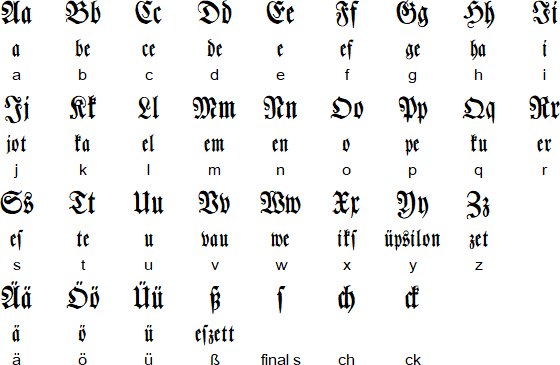

Capital letters in this font that can easily be confused or misread are B, P, V; C, E, G; D, O, Q; K, R; I, J. Lower-case letters to watch out for are f, l, (long) s; t, k; r, x.
Here is an example of the Kurrent alphabet, available online here.

Notice that these letters are written within four lines. Many of the letters are formed between the middle two lines only; the letters can be sorted into those with no ascenders or descenders, those with ascenders only or with descenders only, and those with both. Lower case letters with neither ascenders or descenders are: a, ä, c, e, i, m, n, o, ö, r, u, ü, v, and w. Those with ascenders only include: b, d, k, l, s, and t. Those with descenders only are: g, j, p, q, x, y, and z. Those with ascenders and descenders are: f, h, s, and ß. Most capital letters have ascenders; those with descenders include: E, F, G, H, J, P, Q, Y, and Z.
Letters that can commonly be confused in Kurrentschrift include the following:
- c and i – the only difference between the written form of these two letters is the dot over the i. In some areas, at some periods of time, scribes may have added a little “hook” at the top of the c to distinguish it from the i.
- e, m, n, r, u, v, w – the n and e can look almost identical, depending on the handwriting; in theory, the e is narrower than the n. The way the lower-case n is written is identical to the lower-case u. In order to distinguish the two, the scribe will add an U-Bogen, which is the little swoop above the u. (This is not the same as an umlaut, the two dots that may appear above an a, o, u, or in older records, possibly also the y.) When a word contains a double m or a double n, the scribe might write the letter only once, and put a straight line over the letter to indicate that it’s actually a double letter. Consider the word Zimmermann – carpenter. In the Kurrentschrift handwriting, it looks like an endless series of zigs and zags, as in the first line below. The second line shows the use of the straight line over the m and n to indicate the double letter. Next to it is an example of the word from an actual record, for comparison.
- Lower-case a and o may be confused.
- Lower-case b, d, and l might be hard to distinguish.
- Especially challenging are the lower-case f, h, and long s.
German handwriting tutorials are available as follows:
- Old German Script – 3 parts by Dr. Fritz Juengling
- German Paleography Seminar – 9 parts by Charlotte Noelle Champenois
- https://script.byu.edu – script tutorials for various languages
- A Guide to Writing the old German “Kurrent” Script
- Sütterlin tutorial
German dictionaries online can be helpful for deciphering words:
- http://dict.leo.org or http://dict.cc – German-English dictionaries (not necessarily great with archaic terminology)
- https://woerterbuchnetz.de/ – 44 German dictionaries, in German, but good for archaic terms and also some dialect words
- https://www.familysearch.org/wiki/en/German_Genealogical_Word_List
Other tools that can be useful for translating and even transcribing records include:
- Schrift generator – https://www.deutsche-handschrift.de/adsschreiben.php
- Transkribus – https://www.transkribus.org/ can transcribe both handwriting and Fraktur with mixed results
- https://www.wordmine.info/ to decipher words
- Deepl – to translate words and phrases, good for idiomatic phrases
- ChatGPT – good for translating records
- Download Kurrent font to your computer
German SIG Posts from previous meetings…
…can be found under the header “Previous German SIG posts, which is a drop-down from the German SIG tab.